

How much does it cost to repair a car’s AC?
Maintaining your car’s air conditioner and fixing it when something small breaks is generally more affordable than replacing major components. However, costs will vary based on the extent of the work and the parts needed.
We talked with five mechanics from around the country to get estimates for a standard AC service on our sample vehicles. This involves inspecting and recharging the vehicle’s air conditioning system. Quotes for each vehicle averaged between $430 and $521, with most of the cost coming from labor.
| Vehicle | Average parts cost | Average labor cost | Average total cost |
|---|---|---|---|
| 2017 Honda Civic | $106 (24.65% of total cost) | $324 (75.35% of total cost) | $430 |
| 2017 Ford F-150 | $198 (38%) | $323 (62%) | $521 |
| 2019 BMW 740i | $67 (15.23%) | $373 (84.77%) | $440 |
How much does it cost to replace a car’s AC?
The good news is that it’s rarely necessary to replace the entire AC system — but if your AC can’t be patched up or recharged, you might have to replace some components.
The most common individual component that needs replacing in modern car air conditioning systems is the compressor. Other parts can fail, but the compressor is the single most stressed piece of equipment in the system — and also the most expensive to replace.
“If a customer doesn't have cold AC, this is the first place we look,” said Tom Bonfe, owner of Bonfe's Auto Service & Body Repair in St. Paul, Minnesota.
Our survey showed average compressor replacement costs ranging from $1,319 to $2,515 for our sample vehicles.
| Vehicle | Parts cost | Labor cost | Total cost |
|---|---|---|---|
| 2017 Honda Civic | $908 (51.68% of total) | $849 (48.32% of total) | $1,757 |
| 2017 Ford F-150 | $610 (46.25%) | $709 (53.75%) | $1,319 |
| 2019 BMW 740i | $1,860 (73.96%) | $655 (26.04%) | $2,515 |
Cost of other individual AC components
If your compressor isn’t the culprit, you may be dealing with another part failure. Replacement part costs can vary widely depending on the vehicle and the extent of damage, but average prices for common AC components include:
| AC replacement component | Average parts cost | Average labor cost | Total average cost* |
|---|---|---|---|
| Evaporator | $407 to $551 | $847 to $1,242 | $1,254 to $1,793 |
| Refrigerant line | $780 | $159 to $234 | $940 to $1,014 |
| Condenser | $512 to $522 | $272 to $400 | $784 to $922 |
| Expansion valve | $176 to $227 | $227 to $333 | $403 to $561 |
What affects the cost of car AC repair?
Several factors influence how much you might pay to fix your car’s air conditioning.
- Vehicle make and model: Luxury vehicles or imported cars often have higher parts and labor costs. Complex AC systems or hard-to-reach components can add hours to labor, driving up the total.
- Type of repair: Minor fixes, like replacing a cabin air filter or sealing a leak, are typically inexpensive. Major component replacements, such as the condenser, evaporator or compressor, can cost hundreds to more than a thousand dollars.
- Parts and labor: Labor rates vary by region and shop, while parts can differ in price depending on OEM versus aftermarket options. Both factors directly affect total repair cost.
- Diagnostic complexity: Identifying the root cause of AC problems can require multiple tests, including pressure checks, leak detection and electrical inspections. More complex diagnostics increase labor costs before any repairs even begin.
How does air conditioning work in a car?
In a technical sense, air conditioning works by forcing a refrigerant to change from a liquid to a gaseous state in a pressurized closed loop.
To help you better understand this process, here’s a closer look at each major component in an AC system and how it functions:
- Compressor: Functions as a power unit for the system and is attached to the engine via the serpentine belt. Compresses low-pressure gas into high-pressure, high-temperature gas.
- Condenser: Uses moving air to rapidly cool the high-pressure, high-temperature gas, turning it into a low-pressure liquid. Generally mounted near the grille of your vehicle.
- Dryer: Contains a material (known as a desiccant) that removes water from the refrigerant.
- Expansion valve or orifice: Allows the system to bleed off pressure at a carefully measured rate and quickly lower the temperature. Turns refrigerant into a fine mist.
- Evaporator: Located behind the dash, the evaporator turns the liquid back into a gas in tubes. Air is blown over these supercooled tubes and into the cabin as cool air.
- Cabin air filter: Traps dust, pollen and debris before air enters the interior.
What are the signs of a bad car AC?
If you notice any of the following problems, your car’s AC could be to blame.
- Foul or mildewy air: If the air coming from your vents smells, you may have a faulty dryer or mold growing in the evaporator of your air conditioning system.
- Loud noises: When AC compressors or compressor clutches fail, they often make a loud noise (a clunk or a thud).
- Not blowing cold air: Your AC may turn on and blow air, but when the air from your vents isn’t as cold as you’d like, it’s not of much use.
What causes a car AC to stop working?
If your AC stops blowing cold air, it could be a number of issues:
- AC compressor failure: Compressor issues are some of the most common failures in air conditioning systems. If the refrigerant isn’t compressed into a high-pressure, high-temperature gas, all other parts of the system won’t work properly. Compressors usually fail because of a leak in the system or a lack of refrigerant. The refrigerant contains lubricant, and once it’s gone, the compressor may fail due to friction.
- Low/leaking refrigerant: Given enough time, leaks can form, and many AC systems will need to be refilled or “recharged” with refrigerant, even if they’re supposedly closed systems.
- Failing compressor clutch: Compressors are attached to the engine via a serpentine belt. The compressor clutch spins freely when the AC is not in use and activates when the compressor needs the power to operate. If the compressor clutch is failing, it will make an audible “clunk” when engaging the compressor, and eventually it will stop functioning completely.
- Clogged condenser: Since the compressor needs surface area to operate, road debris or damage can prevent it from doing its job. It’s not uncommon for mechanics to see condensers full of gunk, bugs and dirt when customers arrive at a shop complaining about warm air coming from their AC vents.
- Faulty electrical system: Broken fuses or frayed wires can cause issues within the AC system because components are not being activated at the right times.
DIY vs. professional car AC repair
Deciding whether to fix your car’s AC yourself or hire a professional depends on your skillset, what tools you have on hand and the complexity of the issue. Simple tasks, like replacing a cabin air filter or checking for leaks, are generally safe for experienced DIYers.
While DIY repairs can save money on labor, they don’t come without risks. Handling refrigerants requires special tools and certification in many regions due to environmental regulations. While “DIY recharge kits” exist, mistakes can damage the system, reduce cooling efficiency or even cause injury. It might also void your factory warranty.
Professional repairs are recommended for compressor, condenser or evaporator work. Certified technicians have the tools and knowledge to diagnose and repair issues accurately. Dealerships may charge more, but independent shops often offer lower labor rates without sacrificing quality.
Do extended car warranties cover AC?
Air conditioners generally fall under bumper-to-bumper warranty coverage. So, if your vehicle is still under the factory bumper-to-bumper term, fixing a faulty AC should be covered by the manufacturer as long as it failed due to a manufacturing error.
If you only have powertrain coverage, don’t expect your warranty to cover the cost of fixing your AC.
You may also be able to dodge an expensive car AC repair bill if you purchased an extended warranty for your vehicle. Michelle from Florida told us a $1,400 AC repair only cost her a $100 deductible thanks to her extended warranty: “Everything went pretty well when I submitted a claim. The most expensive one that I had was my air conditioner. That was $1,400 and I spent 100 bucks for it.”
A car AC compressor replacement may not be enough to totally offset the cost of an extended warranty, but it can help you avoid a large, unexpected repair bill. Plus, if you need another covered repair during your warranty period, you could come out ahead.
» CALCULATE: Is an extended car warranty worth it?
FAQ
Why is my car air conditioner not blowing cold air?
Air conditioners are pressurized systems that turn refrigerant from a liquid to a gas and back again. If any of the components in the system lose pressure or stop functioning, you may feel warm air blowing through the vents. Common causes include failing compressors and refrigerant leaks.
What does a car AC service include?
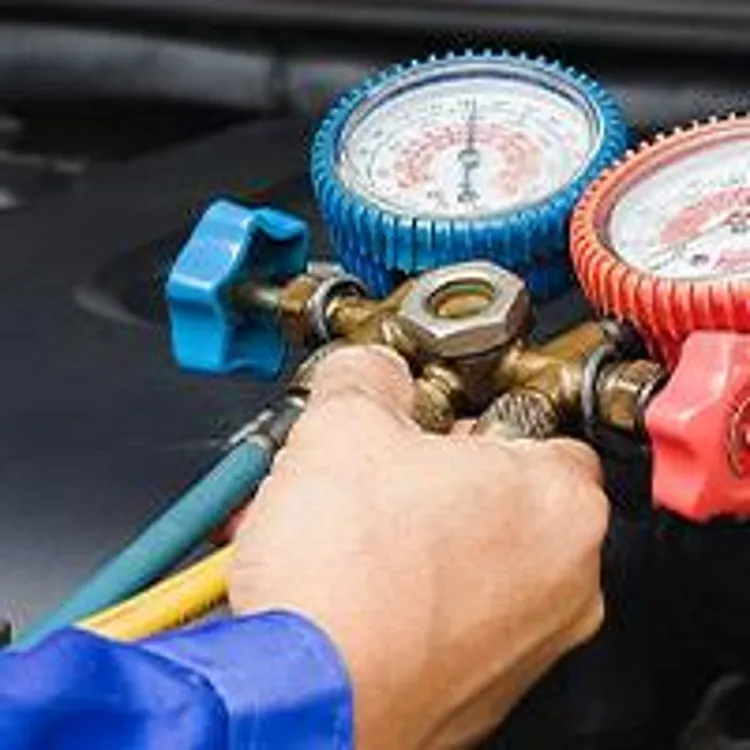
Car AC service usually includes inspecting the AC system’s components, checking its pressure and replacing the refrigerant.
Is it worth replacing the AC in a car?
For many, replacing a car’s AC is worth it. If replacement or repair costs more than the car's value, it might make sense to skip it or look for a different vehicle.
Is it expensive to get car AC fixed?
The cost to fix a car AC can be expensive, depending on the problem. Based on quotes we received, an inspection and AC recharge can cost about $400 to $500, depending on the car make and model. For an AC compressor repair, expect to spend at least $1,000 and potentially $2,000 or more. Other components, such as the condenser or evaporator, can cost from $700 to $2,000.
What is the most expensive part of a car AC?
The most expensive part of a car AC is the compressor. Expect to spend more than $1,000 to replace this part.
Does car insurance cover AC repair?
Most car insurance policies don’t cover routine AC repairs because they’re considered regular maintenance or mechanical wear-and-tear. However, if your AC is damaged in a covered accident or due to vandalism, repairs may be included under your collision or comprehensive coverage, minus your deductible.
Article sources
ConsumerAffairs writers primarily rely on government data, industry experts and original research from other reputable publications to inform their work. Specific sources for this article include:
- RepairPal, "AC Condenser Replacement Cost Estimate." Accessed Dec. 12, 2025.
- RepairPal, "Air Conditioning Refrigerant Line Replacement Cost Estimate." Accessed Dec. 12, 2025.
- RepairPal, "AC Evaporator Replacement Cost Estimate." Accessed Dec. 12, 2025.
- RepairPal, "Air Conditioning Expansion Valve Replacement Cost Estimate." Accessed Dec. 12, 2025.
- Federal Trade Commission, "Auto Repair Basics." Accessed Dec. 12, 2025.
- United States Environmental Protection Agency, "Section 609 Technician Training and Certification Programs." Accessed Dec. 12, 2025.