

Key Insights
Solar panels should generally be cleaned one to four times per year, though this may vary depending on where you live and what your panels are exposed to.
Jump to insightIf you clean your solar panels yourself, don’t use soap or abrasive materials. Use only water and a soft cloth or brush.
Jump to insightDo-it-yourself (DIY) solar panel cleaning can lead to an expensive mistake if you don’t do it correctly, so consider hiring a professional cleaning service.
Jump to insightHow often should you clean your solar panels?
Most solar panels require at least annual cleaning, though cleaning them more often is not uncommon.
Measuring solar panel efficiency is the best way to determine if cleaning is necessary.
“The general rule for solar panel maintenance is to have them cleaned every six months,” said Jesse Silkoff, founder of MyRoofingPal. “However, if you feel that weather conditions or other factors are dirtying them between cleanings, it might be beneficial to schedule cleaning as often as four times per year.”
Factors affecting cleaning frequency
Factors that impact the efficiency of solar panels include:
- Weather and climate: In wetter climates, solar panels may only need an annual cleaning — rain does a pretty good job of cleaning dust, pollen and pollution off panels. In dry regions, solar panels should be cleaned more often. Typically, you should clean them at least once every six months.
- Smog and pollution: If smog or pollution is high in your area, clean your solar panels monthly. Smog and pollution not only cause deposits on solar panels but also reduce the available sunlight reaching the panels.
- Pollen: Seasonal pollen is common from spring through fall. Clean panels at least once every six months in areas of high pollen count.
- Residue from biotic life, including tree sap, pitch and bird droppings: In areas where these are common, remove hard deposits as soon as you see them.
Measuring solar panel efficiency
The best way to determine if your solar panels require cleaning is to measure their efficiency. There are smart devices that pair with your solar array to make it easy to check the efficiency of each panel.
The data can also give you a clear picture of your solar array's overall performance. If you find a drop in efficiency, it’s time for a cleaning.
» LEARN: Solar panel efficiency
What’s the proper way to clean solar panels?
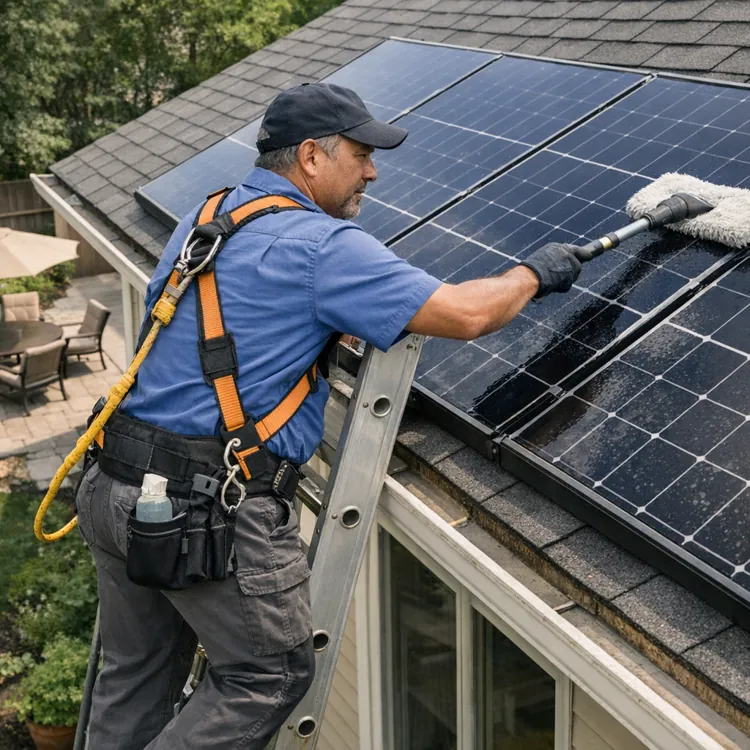
Cleaning your solar panels yourself can save you money, but it’s important to do it right. The product manual that came with your panels will outline the best way to clean your specific system.
Some manufacturers only recommend using your hose to spray off your solar panels, but your manual may also specify what products to use, what products to avoid and how to protect your system from damage during the cleaning process.
Use water and a very soft material to scrub with. No soaps or anything abrasive. Soaps tend to leave a film and that film is just as bad as the dirt you are trying to remove.”
Following directions is essential. Using improper cleaning techniques or abrasive cleaning supplies can lead to an expensive problem.
“Use water and a very soft material to scrub with,” advised Scott Briley, managing partner at KC Solar, a panel installer based in the Kansas City area. “No soaps or anything abrasive. Soaps tend to leave a film and that film is just as bad as the dirt you are trying to remove.”
In general, the most important thing is to be cautious with every step of the cleaning process, Briley said. Power washers, which most manufacturers don't recommend, can be acceptable if used correctly.
“As long as you keep the spray tip at a relatively light level you should be OK,” Briley said. “We do not want to penetrate the surface of the glass, so you do have to be careful with that.”
The best time to clean solar panels is at dawn or dusk, when sunlight is minimal. If you like to do chores during the day, wait for a cloudy day when incoming solar radiation is weakest. Whatever time of day you clean your solar panels, be sure to power down the solar array before you start.
Are there solar panel cleaning services?
If you don’t want to clean your panels yourself, you can pay professionals to do it. Before hiring a professional service to clean your solar panels, check your solar contract to see if cleaning is included in your maintenance agreement. Also, read over the warranty for your solar array to see if it specifies who's responsible for cleaning the solar panels and what the recommended process is.
Most solar panel installation companies also offer cleaning services, and if they don’t, they can refer you to one that does.
» MORE: Solar panel installation guide
If you hire the same company that installed your panels to clean them, they’ll probably inspect your system during the cleaning to make sure everything is in working order. This can give you a little peace of mind.
In many cases, a solar company will try to sell you on a regular maintenance and cleaning plan when you purchase your panels. Regular maintenance will keep your panels operating at optimal efficiency, so it’s often worth the cost if you don’t want the hassle of cleaning them yourself.
How much does solar panel cleaning cost?
On average, it costs between $100 and $350 to hire a professional to clean your solar panels, according to our research. There are a few factors that impact the cost of cleaning solar panels, including:
- Array location: On-ground systems are more affordable to clean than rooftop arrays. Systems that are complicated or even unsafe to access — for example, if your roof is steep or extremely slanted — may require more labor hours.
- Panel size: Smaller systems may be more affordable to clean, though many companies charge a base fee for all systems.
- Debris: The more buildup there is, the more expensive the cleaning is.
» READ MORE: Cost of solar panels
FAQ
Why isn’t rainwater enough to clean solar panels?
As a general rule, rainwater is often enough to clean solar panels. However, in places where there's not enough rainfall to wash away dust and pollen, the panels will need to be cleaned. Also, when the panels are dirty and rainfall isn't heavy, dirt or pollen can pool and form caked-on mud, which can reduce the panels' efficiency.
Should you avoid soap when cleaning solar panels?
You should always start the process with plain water to see if it cleans the panels. If water alone isn't enough, you can generally use a mild soap, but be sure to work in small sections and rinse the soap off quickly. Dried soap can cause hazing that blocks sunlight. Solar radiation will heat the panels and make the soap dry faster, so it’s best to clean with soap when the temperature is cool, usually early in the morning. Or, you can put it off until fall or winter.
Is it OK to clean solar panels with hard water?
You should avoid using hard water when cleaning solar panels. Any scaling or mineral residue deposited on the solar panel will reduce the panel's ability to absorb sunlight. Trying to remove mineral deposits from solar panels can damage them.
If you have hard water, it's best to use a cleaning service. A professional cleaning team will have a reservoir of clean, clear water to use under pressure rather than using hard water from your tap or hose. You can do it yourself if you have the right tools to use clean water without minerals, including salts.
Is it OK to power-wash solar panels?
It’s not usually a good idea to power-wash solar panels. High pressure can damage your panels, which is expensive to fix. Most manufacturers recommend hosing panels down with low pressure.
Can you walk on a solar panel?
Walking on a solar panel isn’t recommended. Pressure can cause cracks in the panels, and damage from walking on them may even void the warranty. Also, debris from your shoes can undermine the panels’ efficiency.
Bottom line
Solar panels are a great investment for homeowners interested in sustainability. Although they’re inherently low-maintenance, they still require some cleaning to maintain peak efficiency and output. Regularly checking your panels to see if they need cleaning is a good way to keep your panels working properly.
Cleaning solar panels can be a DIY job, but be sure to follow the manufacturer’s cleaning instructions. If you can’t (or don’t want to) clean them yourself, there are professional cleaning companies with the tools and skills to get the job done safely and correctly. Just make sure to choose a company that's licensed to operate in your area if necessary, and check its references and insurance.
» MORE: Where your solar savings go the furthest
Article sources
ConsumerAffairs writers primarily rely on government data, industry experts and original research from other reputable publications to inform their work. Specific sources for this article include:
- Solar Energy Industries Association, "U.S. Adds 58 GWh of New Energy Storage Capacity in 2025, Largest Single Year of New Battery Capacity on Record.” Accessed May 18, 2026.
- Solar Energy Industries Association, "Solar Market Insight Report 2025 Year in Review." Accessed May 18, 2026.
- Solar Energy Industries Association, "Solar Market Insight Report Q3 2025." Accessed May 18, 2026.