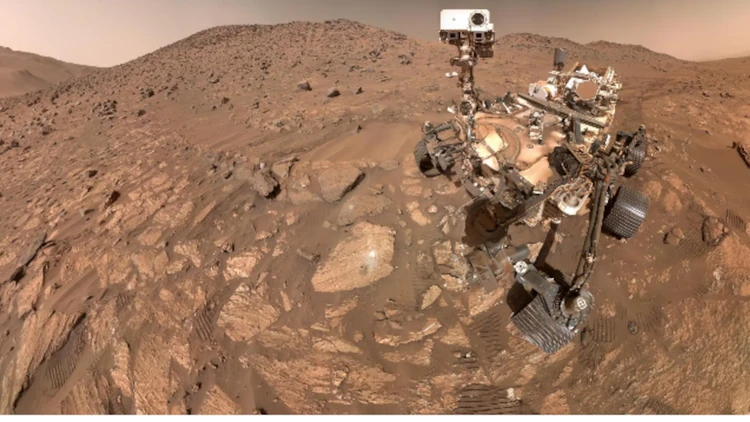

NASA’s Perseverance rover detects potential biosignatures in Jezero Crater sample
Discovery published in Nature marks closest evidence yet of past microbial life on Mars
Minerals linked to microbial processes on Earth found in riverbed rock
A rock sample collected by NASA’s Perseverance rover from an ancient riverbed in Jezero Crater may contain the strongest evidence yet of past microbial life on Mars. The sample, called “Sapphire Canyon,” was drilled from a site dubbed Cheyava Falls in 2024 and analyzed by the rover’s science instruments. But don't start planning townhouses and shopping malls just yet. "Life" covers a lot of territory and microbes are not likely to be renting apartments or applying for credit cards.
The findings, published Wednesday in Nature, describe chemical and mineral signatures that scientists say could be biosignatures — possible fingerprints of ancient life. While not definitive proof, the discovery has been hailed as a landmark moment in Mars exploration.
“This finding by Perseverance is the closest we have ever come to discovering life on Mars,” said acting NASA Administrator Sean Duffy. “The identification of a potential biosignature on the Red Planet is a groundbreaking discovery, and one that will advance our understanding of Mars.”
Signs written in the rocks
Cheyava Falls lies within the “Bright Angel” formation, a rocky stretch on the edges of Neretva Vallis, a dried-up river channel. Perseverance’s PIXL and SHERLOC instruments identified chemical spots on the rock rich in organic carbon, sulfur, phosphorus, and oxidized iron — elements that could have powered microbial metabolisms.
High-resolution imaging revealed “leopard spots,” patterns formed by two iron-rich minerals: vivianite, common around decaying organic matter on Earth, and greigite, which can be produced by certain microbes. Together, the minerals suggest possible biological activity — though non-biological processes could also have formed them.
“The combination of chemical compounds we found in the Bright Angel formation could have been a rich source of energy for microbial metabolisms,” said lead author Joel Hurowitz of Stony Brook University.
Extending the window of habitability
Scientists were surprised to find potential biosignatures in relatively young sedimentary rocks, overturning assumptions that evidence of life would only appear in older formations. The result suggests Mars may have remained habitable longer than previously thought.
Katie Stack Morgan, Perseverance’s project scientist, cautioned against overinterpreting the results. “Astrobiological claims, particularly those related to the potential discovery of past extraterrestrial life, require extraordinary evidence,” she said. “While abiotic explanations are less likely, we cannot rule them out.”
The next step in Mars science
NASA officials stressed that the finding demonstrates the mission’s ability to deliver on its core goal: to search for signs of ancient life. “This is exactly the type of science Perseverance was designed to do,” said Nicky Fox, NASA’s associate administrator for science.
Samples collected by the rover will eventually be returned to Earth for deeper analysis under NASA’s Mars Sample Return program. Until then, the discovery of “Sapphire Canyon” stands as the clearest hint yet that Mars may once have hosted life.