


Key Insights
Electric dryers are generally cheaper to repair than gas models because they’re more common and don't always require specialized gas line labor.
Jump to insightThe most common dryer problems are broken heating elements and drums that won’t spin.
Jump to insightPremium brands like Speed Queen often have higher replacement part costs compared to widely available brands like LG or Samsung.
Jump to insightIf your dryer is more than five years old and the repair estimate is more than half the price of a new dryer, consider an upgrade.
Jump to insightHow much does it cost to repair a dryer?
The average cost of a dryer repair is $50 to $800. That range reflects a variety of factors, including the specific problem, your dryer brand, local labor rates and whether the unit is a standard electric model, a gas dryer or a more specialized ventless or heat pump dryer.
Most home dryer repair bills break down into three main components:
- Diagnostic or service call fee
- Labor
- Parts
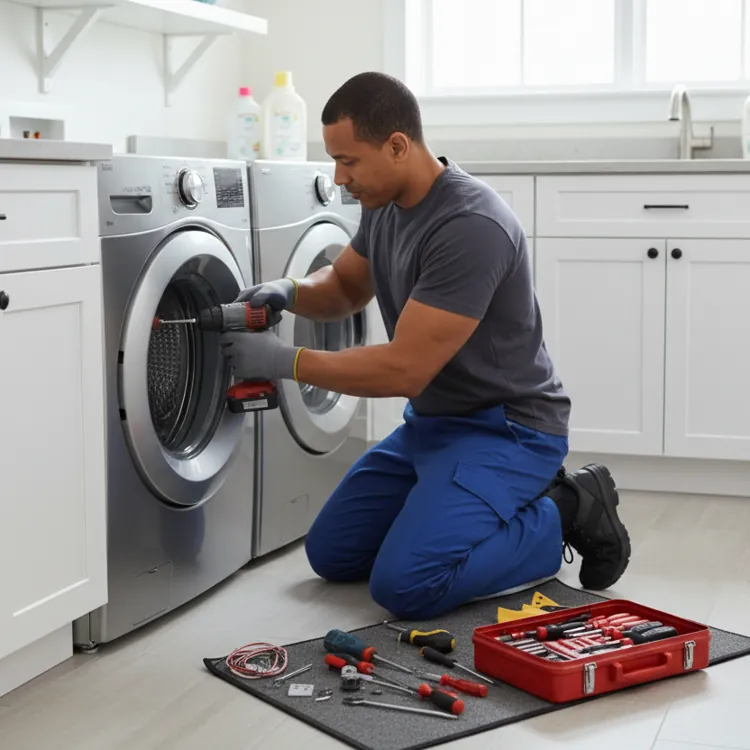
Most technicians charge from $50 to $100 per hour for labor, and many also charge a service call fee of about $100 to $150 before repair work begins. Some companies will waive that fee if you approve the repair.
Additional charges — such as after-hours or emergency service fees, sales tax on parts and labor, and travel charges for locations outside the standard service area — can raise the total. Always ask for an itemized quote so you can compare labor, parts and service-call costs side by side.
Factors that affect the cost of dryer repairs
Several variables influence how much you’ll pay to fix a broken dryer, including:
- Type of dryer: Electric dryers are typically the least expensive to repair. Gas models may need more specialized labor, especially if the issue involves the gas line.
- Model: Ventless condenser dryers and heat pump dryers can cost more to diagnose and repair than standard vented models.
- Brand: Premium or less common brands may often have more expensive or harder-to-find replacement parts. For example, parts for a Speed Queen or Amana may cost more and have longer lead times than those for an LG or Samsung.
- Nature of the problem: Simple fixes like replacing a door latch or fuse are much less expensive than major repairs, such as replacing the drum or motor.
- Labor rates in your area: Technician fees vary widely by location. Labor tends to cost more in large metro areas than in rural regions.
- Warranty status: Repairs covered under a manufacturer’s or third-party warranty could reduce or eliminate out-of-pocket expenses.
- Age of the dryer: Older units can be harder to repair if parts are discontinued or no longer stocked.
What are the most common dryer problems?
Dryers have only one real job to do, but multiple components can cause problems. We reached out to seven appliance repair companies across the country to ask about the issues their customers frequently have with their dryers and to get the estimates we used for our cost calculations in this article.
According to these industry professionals, the two most common problems by far are heating elements stopping and drums that won’t spin. Both of these will prevent your clothes from drying properly and can cost a few hundred dollars to fix.
Our sources mentioned that lint building up in the exhaust system or filter is also common. This can cause a dryer to run less efficiently or, worse, lead to safety concerns like overheating or even a fire. The good news is that this is a more affordable fix, with professional cleaning available for less than $100 in some areas.
Dryer repair cost by problem
Dryers are fairly simple home appliances, but it’s usually a good idea to have a trained technician come out to diagnose any problems your dryer is having.
“It’s not always just one part that’s broken or needed,” said Ron Shimek, former president of Mr. Appliance, an appliance repair franchise based in Waco, Texas. “That’s why a thorough diagnosis is needed to get to the root of the problem and all the different things that could have caused it.”
Not all dryers have the same components, so you may face different problems depending on whether you have an electric or gas dryer.
Electric dryer problems
In general, electric dryers are cheaper to repair than gas dryers, largely because electric dryers are simply more common.
| Problem | Likely cause | Average repair costs |
|---|---|---|
| Clothes won’t dry | Faulty heating element, broken thermostat | $100 to $350 |
| Drum won’t spin | Broken belt, worn-out bearing, broken motor | $100 to $500 |
| Door won’t stay closed | Broken door latch or strike | $50 to $150 |
| Too noisy | Faulty drum seal, old dryer belt, broken drum | $50 to $500 |
| Won’t turn on | Broken door switch, tripped circuit breaker | $50 to $450 |
| Turns off before it’s done | Broken thermostat, stuck timer | $150 to $250 |
Gas dryer problems
Gas dryers may cost more to repair because they use additional ignition and gas-delivery components. If the problem involves the fuel system, hire a qualified technician rather than attempting the repair yourself.
| Problem | Likely cause | Average repair costs |
|---|---|---|
| Funny smell when not running | Gas leak | $120 to $250 |
| Burner won’t ignite | Faulty thermal fuse or burner coils | $80 to $150 |
| Dryer won’t run on all cycles | Broken thermostat or gas valves | $100 to $250 |
| Dryer turns off mid-cycle | Blower rotation failure or lint buildup | $50 to $100 |
| Doesn’t get hot | Faulty igniter or thermal fuse | $100 to $250 |
» ADVICE: Gas vs. electric appliances
Dryer repair cost by brand
We repeatedly heard from appliance repair technicians that the cost and ease of repairs depend largely on your dryer brand. While it’s true that every technician has their own biases about which brands are more reliable, there are some common trends they mentioned seeing. Of course, even within a brand, there’s a range of potential issues that affect your overall costs.
| Brand | Usual repair cost range |
|---|---|
| Amana | $200 to $350 |
| Bosch | $100 to $400 |
| Crosley | $100 to $200 |
| Electrolux | $100 to $400 |
| Frigidaire | $100 to $200 |
| GE | $100 to $400 |
| Kenmore | $100 to $200 |
| LG | $50 to $400 |
| Maytag | $100 to $550 |
| Samsung | $150 to $350 |
| Speed Queen | $315 to $600 |
| Whirlpool | $200 to $350 |
Treat these ranges as broad averages, not fixed pricing. A premium Bosch heat pump dryer, for example, can be more complicated and more expensive to repair than a basic Bosch vented model, even though they sit under the same brand umbrella.
Dryer repair part costs
If you can safely handle a simple repair yourself, you can save a considerable amount in labor. Assuming you already have the right tools and know-how, you’ll only need to pay for the replacement parts. Costs vary based on the part you need, the brand you need it from and how widely available the part in question is.
| Part | Part cost |
|---|---|
| Heating element | $70 to $150 |
| Belt | $10 to $50 |
| Door switch | $6 to $20+ |
| Thermostat | $20 to $50+ |
| Drum | $300 to $450 |
| Bearings | $50 to $100 |
| Igniter | $100 to $250 |
| Timer | $50 to $75 |
| Roller | $10 to $30 |
| Motor | $50 to $200+ |
| Vent | $30 to $75 |
Keep in mind that a cheap part doesn’t always mean a cheap repair. A technician may still need significant time to disassemble the machine, test related components and reassemble the dryer safely.
Here’s a breakdown of the most common dryer parts that can affect repair bills:
- Heating element: This component dries your clothes, so if they remain wet, it’s likely failing. It can burn out over time from a power surge or a circuit failure. If you have an old dryer, it may be difficult to find a replacement. In that case, your best bet is to replace the dryer.
- Belt: The belt rotates the drum. If the drum isn’t spinning when turned on, the belt may have worn down. It normally lasts throughout the machine's lifespan, but heavy loads can wear it down prematurely.
- Door switch: If the door doesn’t latch correctly, the dryer won’t start. This is a quick fix for a technician.
- Thermostat: This piece controls the temperature. Without it, your clothes will either remain wet or be too hot. The price can vary widely depending on the dryer's brand and model.
- Drum: Replacing the drum — where you place your clothes — is an expensive, major repair. On an older machine, replacing the whole dryer may be the wisest move.
- Bearings: The bearings help the drum spin smoothly. If you hear a grinding or squealing sound, the bearings may be worn.
- Igniter: The igniter is found only in gas dryers and lights the gas to power the dryer. Expect higher labor costs because repairs can be time-consuming, but the part itself isn’t too expensive.
- Timer: This tells the dryer when to complete the cycle, and a failed timer can interrupt or shorten dry cycles. Since it’s an inexpensive part, it’s best to replace it if it’s broken.
- Roller: The roller is attached to the drum and helps keep it in place. You may notice an uneven thumping sound if it’s broken.
- Motor: This part powers the drum to spin. The motor is among the costliest repairs when parts and labor are both factored in. If you have an older machine, it could be worth replacing the unit instead.
- Vent: This tube connects to the outside of the house and is necessary to expel moist air. A clogged or broken vent can be a serious fire hazard, so don’t ignore this problem.
DIY vs. professional dryer repairs
Some dryer repairs are simple enough for handy homeowners to tackle, but others require professional expertise and specialized tools. Understanding which repairs you can safely handle versus when it’s time to call a pro can help you save money without creating any safety hazards.
Before attempting DIY repair, disconnect the dryer from power and consult your manual or reputable online tutorials specific to your dryer model.
Which repairs can you DIY?
If you're comfortable using basic tools and following instructions, these repairs are realistic DIY jobs:
- Dryer belt replacement: One of the most common DIY repairs. If your drum isn't turning, you can fix it in 30 to 60 minutes and some basic hand tools.
- Thermal fuse replacement: If your dryer won't heat, replacing a blown thermal fuse is straightforward once you locate it on the blower housing.
- Door switch replacement: If your dryer won't start or stops when the door opens, you can replace the door switch with a screwdriver.
- Lint trap and vent cleaning: Cleaning supplies cost under $20, and annual vent cleaning prevents fires and improves efficiency.
When to call a professional
Some repairs are too complex, dangerous or specialized to attempt by yourself. Hire a professional for these repairs that involve added safety risk, complicated diagnostics or specialized parts.
- Gas line work: Never attempt gas connection, valve or line repairs yourself. Gas leaks pose serious explosion and carbon monoxide risks. Always hire a licensed professional for repairs involving the fuel system.
- Motor replacement: While it’s technically possible for experienced DIYers, motor replacement requires significant disassembly and electrical knowledge. Given the high cost of parts and the complexity involved, it’s best left to the professionals.
- Electrical control board issues: Incorrect installation can damage the new board or create fire hazards, so this fix requires electrical expertise.
- Heating element replacement (electric dryers): Unless you have electrical experience, hire a professional to avoid the risk of electric shock when the repair involves high-voltage components.
- Drum support and bearing repairs: Requires extensive disassembly and specialized tools, and the time and effort rarely justify any DIY savings.
- Ventless or heat pump dryer repairs: These models often require professional service due to model-specific components and more complex diagnostics.
Safety warning
Gas dryers require extra caution. If you smell gas, immediately turn off the gas supply, evacuate your home and call your gas company or 911. Never use open flames to check for gas leaks.
Is it better to repair or replace a broken dryer?
If you have a dryer long enough, you’ll inevitably have to decide whether it’s best to repair or replace it (unless you have an extended warranty), and a few factors should guide your decision. The most important factors are your dryer's age and the cost of repairs. The average dryer lasts about 10 years, but many models can last longer with proper maintenance.
If your dryer is over five years old and the repairs would cost at least half of the price of a new dryer, replacement is often the better value.
To make an informed decision, balance the cost of your current repairs against the potential lifespan of your dryer. As a general rule (we’ll call it the 50% rule), if your dryer is over five years old and the repairs would cost at least half of the price of a new dryer, it’s probably time to cut your losses and buy a new one.
It’s also worth considering whether your washer and dryer are matching sets. If you’ve got a matching set and replacing a single unit would create compatibility or design issues, you may be more comfortable spending more on a repair.
» LEARN MORE: Cost to repair a washing machine
Tips for saving money on dryer repairs
Dryer repairs can add up quickly, but there are ways to cut costs without sacrificing quality or safety.
- Check your warranty: Before you call a technician, find out whether your dryer is still under the manufacturer’s warranty (or covered by a home warranty) to potentially save hundreds of dollars.
- Get multiple quotes: If your dryer is out of warranty, compare quotes from at least two or three local repair services to make sure you’re getting a fair price.
- Consider DIY repairs: If you’re handy and the repair job is simple — like replacing a door latch, belt or fuse — you might be able to fix the issue yourself with inexpensive parts and online tutorials.
- Weigh repair costs vs. replacement: Remember the 50% rule. If the repair costs more than half the price of a new dryer and your unit is more than five years old, replacement is probably the smarter choice.
- Bundle repairs: If you have multiple appliances needing service, some companies offer discounts for bundling visits. This can help you save on service call fees and labor.
Dryer maintenance tips to prevent costly repairs
Regular maintenance can extend the life of your dryer. Prevent costly breakdowns by following these tips:
- Clean the lint screen after every use. Otherwise, the dyer can overheat and could be a fire risk.
- Schedule professional dryer vent cleaning about once a year, or more if you use the dryer frequently.
- Don’t overload your dryer, as it can wear out some parts. Instead, separate your clothes into smaller loads.
- Wipe out the inside of your dryer clean about once a month and vacuum around the area to prevent dust and lint buildup.
» LEARN: Annual home maintenance checklist
Warning signs to watch for
Catching these dryer problems early can prevent minor issues from turning into expensive repairs.
- Longer drying times often signal a clogged vent or a failing heating element.
- Unusual noises like squealing, thumping or grinding can indicate worn drum rollers or bearings.
- Burning smells could indicate lint buildup or electrical issues that require immediate attention.
- The drum not turning suggests a broken belt or motor problem.
- No heat points to a faulty heating element, thermostat or thermal fuse.
If you notice one or more of these symptoms, address them quickly. Ignoring warning signs typically leads to more extensive damage and higher repair costs down the line.
FAQ
How long should a dryer last?
A dryer should last around 10 years. Ron Shimek, former president of Mr. Appliance, pointed out, however, that a well-maintained dryer can last well beyond its average lifespan. “The biggest factor is how long the manufacturer will be making replacement parts,” Shimek told us. “Personally, my dryer was manufactured in June of 1979 and it’s still running strong.”
Do home warranties cover dryers?
Yes, home warranty companies almost always offer plans that include dryers, though you still may owe a service fee and coverage terms vary by plan. While dryer repairs alone probably aren’t enough to justify the cost of a home warranty, plans usually cover your other appliances, too.
What is the most expensive dryer part to replace?
The dryer motor is typically the most expensive part to replace, costing between $100 and $500 for parts and labor. The control board is also costly on newer models, ranging from $150 to $400. If your dryer is older or experiencing multiple issues, replacement may be more cost-effective than repairing these expensive components.
How often should I clean my dryer vent?
At least once a year. If you do multiple loads daily, have a large household or notice clothes taking longer to dry, clean it every six months. Regular vent cleaning prevents lint buildup, reduces fire risk, improves dryer efficiency and can extend your dryer’s lifespan.
Bottom line
Dryer repair costs typically range from $50 to $800, depending on the issue, with many common repairs falling in the $100 to $300 range. Simple fixes like thermal fuse or door switch replacements are often DIY-friendly and cost under $50 in parts, while complex repairs like motor or drum replacements can exceed $400 with professional labor.
Before approving any repair, get multiple quotes from licensed technicians and weigh the repair cost against your dryer's age and condition. As a general rule, if repair costs exceed 50% of a new dryer's price or your unit is over 10 to 13 years old, replacement may be the smarter financial choice.
Regular maintenance, especially annual lint and vent cleaning, can help you avoid some of the most common service calls.
Article sources
ConsumerAffairs writers primarily rely on government data, industry experts and original research from other reputable publications to inform their work. Specific sources for this article include:
- GE Appliances, “Troubleshoot Your Common Dryer Problems.” Accessed May 6, 2026.
- Whirlpool, “Dryer Not Heating: Troubleshooting Guide.” Accessed May 6, 2026.
- Lowe’s, “How to Fix a Dryer.” Accessed May 6, 2026.