This website utilizes technologies such as cookies to enable essential site functionality, as well as for analytics, personalization, and targeted advertising. To learn more, view the following link:
This living topic explores the dynamics of the housing market, addressing key issues such as legislative actions during the COVID-19 pandemic, predatory real estate practices, home improvement trends, and challenges faced by potential buyers. It covers topics like foreclosure moratoriums, market recovery acts, and the impact of economic policies on homeowners. Additionally, it looks into the latest remodeling trends, the aspirations of younger generations to own homes, pest control in different climates, and new real estate industry regulations. The content aims to provide a comprehensive overview of the current state and trends in the real estate market, offering insights and practical advice for homeowners, buyers, and industry professionals.
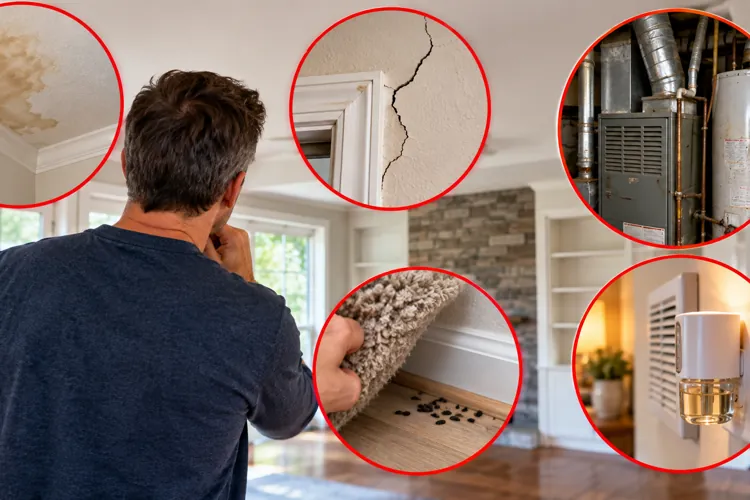
Look beyond the staging: Fresh paint, candles, and air fresheners can make a house look and smell great — but they can also make problems harder to notice.
Some warning signs are surprisingly easy to spot: Water stains, certain cracks, aging equipment. and pest evidence deserve a closer look.
Spotting a red flag doesn't mean you should walk away: Take a photo, ask questions, and make sure your home inspector investigates it before you buy.
New AARP Livability Index Platform picks top spots to live
AARP has released its latest "Livability Index," scoring every community in the country for the services and amenities that improve quality of life.
While the top-performing communities have various policies in place to promote livability, the data shows that many of the highest scoring communities lack affordable housing and accessibility options, highlighting the need for local leaders to address rising housing costs, insufficient supply of housing options, and growing income inequality.
“People overwhelmingly want to stay in their homes and communities as they age, which requires walkable neighborhoods, affordable and adaptable housing, public transportation options, and opportunities for community engagement,” said Rodney Harrell, PhD, AARP Vice President of Family, Home, and Community.
The 10 top-scoring communities by population size, in ranking order, are:
Very large communities (population 500,000+): San Francisco, CA; Montgomery County, MD; Seattle, WA; Ramsey County, MN; Fairfax, VA; New York City, NY; Boston, MA; Nassau County, NY; Portland, OR; and Bergen County, NJ
Large communities (population 100,000-499,999): Arlington, VA; Alexandria, VA; Cambridge, MA; Salt Lake City, UT; St. Paul, MN; Boulder, CO; Minneapolis, MN; North Hempstead, NY; Madison, WI and Chittenden, VT
Mid-size communities (population 25,000-99,999): Cliffside Park, NJ; Fort Lee, NJ; Portland, ME; Burlington, VT; Rockville, MD; Chapel Hill, NC; Somerville, MA; Brookline, MA Harrisburg, PA; and Belmont, MA
Small towns (population 5,000 to 24,999): Great Neck Plaza, NY; Falls Church, VA; Pella, IA; Aspen, CO; Knoxville, TN; Los Alamos County, NM; Takoma Park, MD; Orange City, IA; Salida, CO; Williston Park, NY
Users can search the interactive online tool by address, ZIP code, or community to find an overall or category score, identify challenges in their community and compare their neighborhood to others across performance benchmarks.
The updated platform now includes neighborhood-level employment data ─ hiring rates by age, typical earnings, and unemployment levels. It also includes natural hazard risk by displaying each community's FEMA natural hazard risk rating, which shows its relative exposure to 18 types of hazards from floods to earthquakes. While this new data doesn’t contribute to a community’s livability score, it provides a fuller picture to help people understand how their community is doing today.
Launched in 2015, the AARP Livability Index platform scores livability by using more than 50 national data sources, such as the U.S. Census Bureau American Communities Survey, across seven categories: housing, neighborhood, transportation, environment, health, engagement, and opportunity. The tool measures every city, county, and town against 61 indicators of livability, ranging from monthly housing costs to environmental pollution, opportunities for social connections to the presence of age-friendly community plans.
To view the AARP Livability Index or see your community’s score, visit aarp.org/livabilityindex.
Rocket Homes gave kickbacks to realtors for homeowner loans, CFPB alleges
Lender Rocket Homes gave kickbacks to real estate brokers and agents to get homebuyers to sign up for its loans, the Consumer Financial Protection Bureau alleged in a lawsuit on Monday.
The lawsuit aims to stop the alleged kickback scheme, which gave refferals and other incentives to pressure "real estate brokers and agents not to share valuable information with their clients concerning products not offered by Rocket Mortgage, such as the availability of down payment assistance programs, which often save homebuyers thousands of dollars," the CFPB said.
“Rocket engaged in a kickback scheme that discouraged homebuyers from comparison shopping and getting the best deal,” CFPB Director Rohit Chopra said. “At a time when homeownership feels out of reach for so many, companies should not illegally block competition in ways that drive up the cost of housing.”
Additionally, the CFPB sued The Jason Mitchell Group, a real estate firm doing business in 41 states and the District of Columbia, for participating in the kickback scheme and referring thousands of homebuyers to Rocket Homes and an affiliate.
For example, the CFPB said The Jason Mitchell Group gave $250 gift cards to agents that made the most referrals to its favored partners: Rocket Mortgage and Amrock, a Rocket Homes-affiliate that handles title, closing and escrow services.
A spokesperson for Rocket Homes told ConsumerAffairs that the "allegations are false and a distortion of reality."
"The facts are clear – data shows one third of consumers with a loan application already in progress with Rocket Mortgage, before contacting Rocket Homes, chose to close with a different lender," the spokesperson said. "This proves Rocket Homes is committed to empowering homebuyers to make the best decisions for their unique needs. Rocket Homes has always focused on connecting buyers with top-performing agents based on measurable success metrics."
The Jason Mitchell Group didn't immediately respond to ConsumerAffairs's request for comment.
These were the worst cities for power outages in 2023
Power outages are a big problem in some of America's largest cities.
One in four households had a power outage within the 12 months before they were interviewed between May and September in 2023 by the federal government's American Housing Survey, which surveys the nation every two years.
And 70% of those households said the outage lasted 6 or more hours.
Homeowners experienced power outages more than renters: Around 28% of homeowners had an outage compared to 20% of renters.
Outages were also more common in rural areas, with around 35% of households reporting an outage in rual areas versus 23% in urban areas.
Still, among the 20 of the nation's biggest metros surveyed, an average of more than one in four of households reported a power outage.
The worst city for power outages was Cincinnati (46%), followed by Detroit (45%) and Cleveland (44%).
On the other hand, the best city for power outages was Miami (6%), followed by New York (11%) and Chicago (15%).
The ranking suggests that cities with more outages have poorer or aging grid infrastructure.
For instance, the second-worst city Detroit is in the state of Michigan which has one of the least reliable power grids.
But severe weather and electrical overloads during high heat are also big reasons some cities have it worse.
And Americans say the outages can cause mild to serious problems.
The most common difficulty households reported from outages was food spoiling (5%), having to stay somewhere overnight (3%) and missing work (2%).
But less than 1% of households reported that pipes froze, medicine spoiled or water collected in their basement or crawl space.
The outages also present unique difficulties for people with disabilities and their caregivers: Around 28% of households with at least one disabled person living there reported a power outage.
'Going bare': Where Americans lack homeowners insurance
Millions of American don't have homeowners insurance, exposing them to natural disasters and challenging their ability to build wealth.
One in thirteen, or 7.4%, of U.S. houses lacked homeowners insurance in 2021, according to an analysis by nonprofit Consumer Federation of America of the U.S. Census's most recent American Housing Survey.
That is the equivalent of around 6.1 million homes and at least $1.6 trillion of uninsured property under conservative estimates, CFA said.
“Not only are uninsured families unprotected, but the economic fabric of entire communities is also at risk if significant portions of residents cannot rebuild after a disaster," said Douglas Heller, CFA’s director of insurance.
Foregoing homeowners insurance is often called "going bare," which comes at a time when Americans are struggling to pay steep premiums and get insurance in some states, such as California and Florida, that some insurers are pulling out of.
It is possible even more homeowners are uninsured today after insurance costs have gone up in recent years and living comfortably has grown more expensive due to inflation, but CFA said research into homeowners insurance remains in its infancy because of poor data.
Where Americans don't have homeowners insurance
The disparity in homeowners insurance is on display among 15 of America's biggest cities.
In 2021, the five cities with the highest percentage of uninsured homes were Miami (14.5%), Houston (9.8%), Detroit (9.3%), Riverside (6.3%) and Phoenix (5.8%).
The five cities with the lowest percentage of uninsured homes were Chicago (2.4%), Boston (2.5%), Washington D.C. (3.3%), New York City (3.4%) and Seattle (3.5%).
The percentage of homes with insurance varies considerably by city and state, in large part because of household income, frequency of natural disasters and availability of competitively-priced insurance.
The five states with the highest percentage of uninsured homes were Mississippi (13.5%), New Mexico (13.1%), Louisiana (11.9%), West Virginia (11.3%) and Alaska (11.2%).
The five states with the lowest percentage of uninsured homes were Utah (4.4%), Oregon (4.9%), Maryland (5.1%), New Hampshire (5.1%) and Massachusetts (5.2%).
How can homeowners insurance coverage be improved?
CFA has recommendations for what should be done to address the issue of homeowners insurance:
More investment: Governments need to grow investments in protecting communities and homes from natural disasters, which could lower what insurers charge.
More data: Regulators need to collect more specific and timely information on homeowners insurance to understand where the problems are.
Racial gaps: Homeowners of color are reportedly being denied insurance because of their ethnicity and more research needs to be done under existing Fair Housing Laws to hold insurers accountable.
Tips for lowering homeowner insurance premiums
The Insurance Information Institute has suggestions to lower your homeower insurance bill:
Shop around: Compare multiple insurers, contact your state insurance department, check consumer guides, speak with insurance agents and use online comparison services to get a good price.
Raise deductible: Increasing your homeowner insurance deductible, or what you pay towards a loss, from typically $500 to $1,000 can lower the amount you pay in monthly premiums.
Bundle insurance: Buying both your car and home insurance from the same provider can get you a discount.
Stay with insurer: Keeping the same insurer for several years can get you a discount as a long-term policyholder.
Improve disaster resilience: You may be able to save on premiums by adding home upgrades such as storm shutters, reinforcing your roof and buying stronger materials.
Improve security: Installing burglar alarms, dead-bolt locks, smoke detectors and fire sprinklers can lower your monthly homeowners insurance premiums.
Buying a home? Thinking about a home warranty? Do you know all the ins and outs?
We’re only weeks away from the spring housing market when the bulk of sales occur. One thing that homebuyers will no doubt face is the question of whether or not they should buy a home warranty plan.
On average, a home warranty plan costs between $36 and $68 per month ($432 to $816 per year), according to ConsumerAffairs' most recent cost analysis, and can come in handy if a seller wasn’t exactly forthcoming on things like the condition of the appliances they left behind or write off that musty basement as one of those “Oh, we get a big rain ever so often, but it’s nothing to worry about” type things.
Especially with an older home, the service agreement can save a homeowner thousands of dollars while they are living there. But the Federal Trade Commission (FTC) says a homeowner needs to understand how these plans work.
In addition to the upfront cost, some warranty companies charge a service call fee each time a homeowner files a claim which results in sending a contracted technician to the home. The fees quickly add up if there are a lot of claims.
“When big things in your home break — like your dishwasher or air conditioning system — they can cost lots of money to fix,” said Kira Krown, a consumer education specialist with the FTC. That said, Krown believes homeowners should be very familiar with how their plans work before signing on the dotted line.
What questions to ask
“There are different types and options depending on the company and amount you pay, but home warranties typically cover replacements and repairs for things like appliances or air conditioning systems. They last for a set amount of time and — unlike builder warranties for new homes, or warranties included with some products — they cost extra,” Krown said.
“And after looking at the details, you may find that a home warranty duplicates coverage you already have. Or covers only part of a product. Or makes it nearly impossible to get repairs done when you need them.”
She offered four key things everyone should consider:
Is it likely to save you money? Two things to weigh here – both the upfront cost and extra costs like deductibles or fees you have to pay every time a product is serviced.
What are the limitations? The questions to ask here are: Are there limits on the amounts you can be reimbursed? Is accidental damage covered? Are certain appliances or systems not included? Are there restrictions or fees for cancellation?
Does the claims process seem difficult or slow? Waiting a long time to get paid back can reduce the value of having coverage.
Does the company have a good reputation? A home warranty is only as good as the company responsible for coverage. Search for the name of the company and words like “review” or “complaint” to see if people have had issues in the past.
Reputation
That last part – reputation – is crucial. Separate from the FTC, ConsumerAffairs has done its homework on that angle.
After analyzing more than 200,000 reviews and more than 20 home warranty companies, our research team recently released the results of research on available plans, what customers raved and complained about, and coverage limits and prices. A breakout of that research is available here.
Our experts at ConsumerAffairs advise homeowners to get quotes from multiple home warranty companies, noting that some companies offer price-matching guarantees. Consider both the monthly and yearly costs, as well as what is covered. If you have an ancient air conditioning system you want to make sure that's covered.
Warranty plans come with a cost, but paying a monthly premium could be much less expensive than paying hundreds or thousands of dollars out of pocket for a system or appliance repair or replacement.