
Fixer-upper homes are booming in popularity, drawing 52% more page views than comparable listings.
Big savings: Median fixer-uppers are listed at $200,000 — a 54% discount from the national single-family median of $436,250.
Hot markets: St. Louis, Detroit, Jackson (Miss.), Toledo, and Dayton are leading the way in fixer-upper deals.
For the last few years, listing agents have told home sellers to make their homes “move-in ready” to ensure a quick sale. But as home prices have reached record highs, that advice may not hold up the way it once did.
New data suggest more Americans who want to buy a home are eyeing fixer-uppers as a practical way to enter the housing market. A new Realtor.com analysis shows that interest in these older, project-ready homes is surging — and for good reason.
Homes marketed as “fixer-uppers” now receive 52% more online page views than other older, affordable listings. Searches for the keyword “fixer-upper” more than tripled in July 2025 compared to four years earlier, highlighting the growing appetite among budget-conscious buyers who are willing to invest sweat equity to secure a home.
Nationally, fixer-uppers are listed at a median price of $200,000 — a steep 54% discount compared with the $436,250 median for all single-family homes. These properties tend to be smaller and older, with an average of three bedrooms, two bathrooms, and a construction date around 1958. At 1,628 square feet, the typical fixer-upper is more compact than the 2,000-square-foot national single-family average, but for buyers priced out of the market, the trade-off is clear: affordability.
“Fixer-uppers give buyers a way to break into the housing market at a time when affordability is still stretched thin,” said Danielle Hale, chief economist at Realtor.com. “For those with the vision and a toolbox, fixer-uppers provide both a starting point in the market and the chance to create a home that’s truly their own.”
Where the deals are
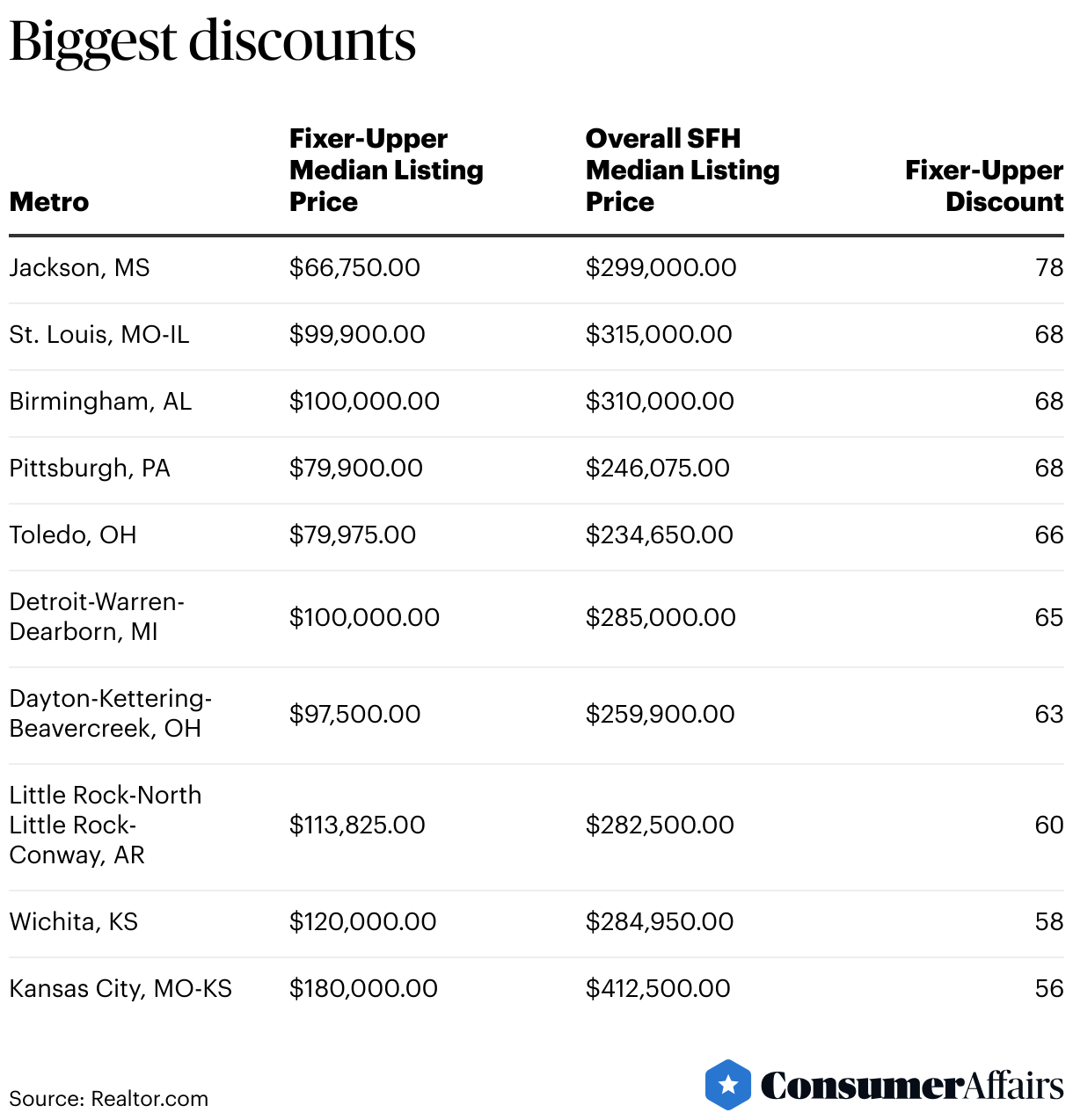
Realtor.com identified five metro areas that combine both abundant fixer-upper listings and deep discounts compared to move-in-ready homes:
St. Louis, MO-IL
Detroit, MI
Jackson, MS
Toledo, OH
Dayton, OH
For example, buyers in Jackson, Miss., can expect a 77.7% discount, with fixer-uppers listed at just $66,750 compared to $299,000 for all homes. St. Louis offers a similar opportunity, with homes discounted by 68.3%.
Other standout markets include Syracuse, N.Y., New Orleans, and Albany, N.Y., which rank high for fixer-upper availability. Meanwhile, Birmingham, Pittsburgh, and Detroit join the list of metros with some of the nation’s largest discounts.
Scarcer, but still attractive
While the number of fixer-uppers on the market has grown nearly 19% since 2021, they now represent a slightly smaller share of total listings. That scarcity may actually fuel more competition among buyers looking for value.
Homes labeled as fixer-uppers also used to linger much longer on the market. But the gap has narrowed: they now sell in about 53 days on average, compared to 50.5 days for similar homes.
Rising mortgage rates and higher home prices appear to be pushing more buyers toward these budget-friendly properties. For buyers facing affordability hurdles, fixer-uppers may represent one of the last viable entry points into homeownership.
The trade-off — rolling up your sleeves for repairs and renovations — may be worth it in exchange for significant upfront savings.