
How to pack paintings for a move
Nick Friedman, co-founder of College HUNKS Hauling Junk & Moving in Tampa, Florida, broke down the process into the following steps.
1. Gather your packing supplies
You need these materials to pack for a move:
- Glassine or acid-free paper
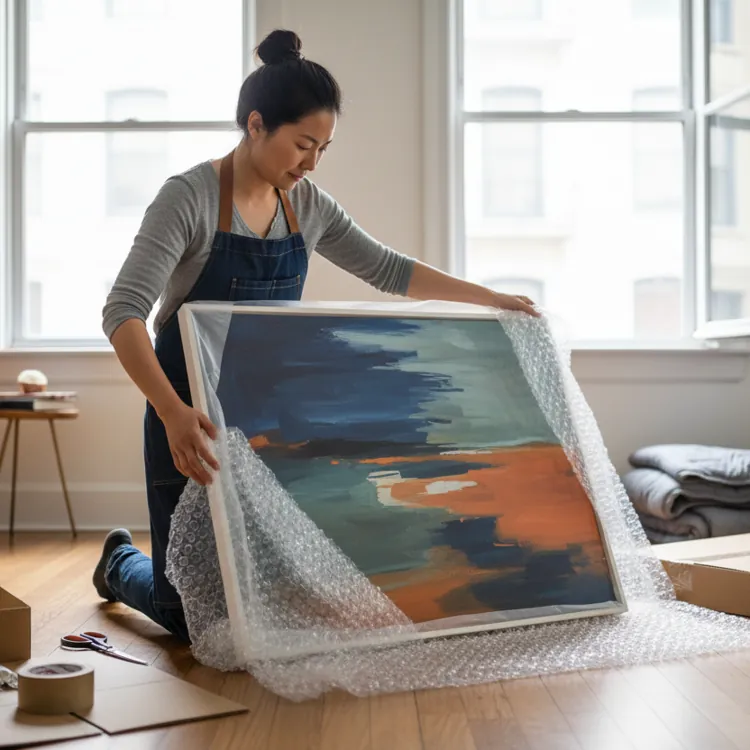
- Bubble wrap (bubbles facing outward)
- Plastic wrap
- Packing paper or foam
- Cardboard corner protectors
- Painter’s tape or low-tack artist’s tape
- Specialty picture or mirror boxes
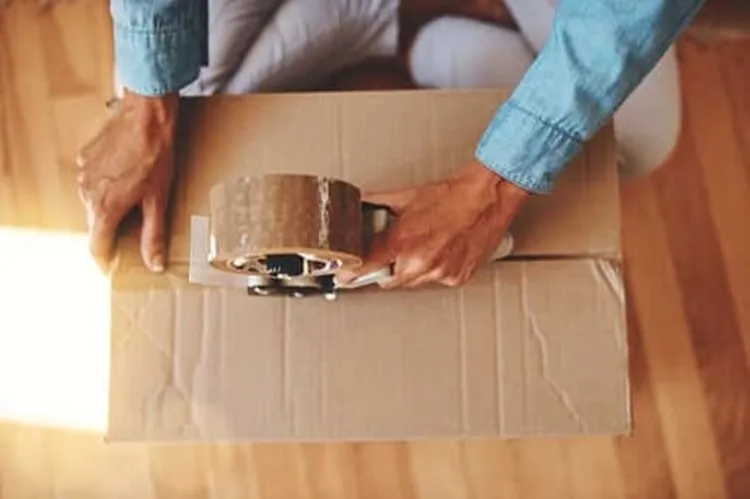
- Packing tape and scissors
2. Document and prep each painting
Before wrapping anything, “Take clear photos of the front, back, frame and corners, so you have a record of the condition before the move,” Friedman said.
If a painting has been sitting in an attic, garage or basement, give it one to two days in a climate-controlled room first. “Sudden temperature shifts can cause cracking or warping, so stabilizing the environment early is important,” he added.
3. Sort paintings by size
“You can often group small and medium pieces, but always pack large pieces individually in a specialty box slightly larger than the frame,” said Friedman. If specialty boxes aren’t available, you can flatten and reshape a larger box to fit the frame.
4. Wrap the painted surface
Always start with glassine. It’s acid-free and won’t bond to or stain the paint. If the piece has glass, press painter’s tape or low-tack artist’s tape in an X across it before anything else goes on. It won’t save the glass if something hits it, but it’ll keep the shards from going everywhere.
5. Add protection against moisture and impact
Plastic wrap goes on next, straight over the glassine, then bubble wrap over that. “Keep the bubbles facing outward so they don’t imprint the surface,” Friedman advised.
6. Secure corner protectors
Corners are first to take a hit during a move. Press a cardboard corner protector firmly onto each corner and secure with tape — they’ll slide off mid-move if you don’t.
7. Box and cushion each painting
The box should have enough room for padding, but not so much that the painting shifts inside. Line the bottom with packing paper, slide the wrapped painting in (upright) and fill every gap with paper or foam.
Then give the box a shake. If anything moves, add more padding before sealing.
“Avoid packing multiple large framed pieces in one box, as they can damage each other,” Friedman warned.
8. Load paintings into the truck
Paintings go into the truck last and come out first to minimize handling. “Artwork should be loaded upright, secured with straps and placed between stable items such as mattresses to minimize movement,” Friedman emphasized. Never stack heavy boxes on top of artwork or lay pieces flat once they’re in the truck.
Should I hire a professional?
Not every move requires a professional art handler. But for high-value pieces, Friedman suggested taking a hybrid approach. “Combining careful do-it-yourself preparation with professional loading is often the smartest balance,” he said. “It saves money while ensuring the artwork is secured properly inside the truck.”
Painting packing materials and boxes
For fragile items like paintings, “skimping on materials is one of the most common causes of preventable damage,” Friedman said. Here’s what to use and why.
| Purpose | Best for | |
|---|---|---|
| Glassine paper | First-contact surface protection; acid-free and non-stick | All paintings |
| Acid-free paper | Surface protection without chemical damage | Canvas and unframed artwork |
| Plastic wrap | Moisture barrier | All paintings, especially in humid conditions |
| Bubble wrap | Impact cushioning; bubbles facing outward | All paintings |
| Foam sheets | Lightweight cushioning and scratch prevention | Delicate frames and surfaces |
| Cardboard corner protectors | Absorbs impact at the frame’s most vulnerable points | All framed artwork |
| Tubes with end caps | Secure transport for rolled artwork (no frames) | Flexible, low-texture canvas and posters |
Why materials matter
“Choosing the right box is just as important as choosing the right wrapping materials,” said Friedman. Picture boxes work for standard framed artwork. Mirror boxes are heavier-duty for larger or glass-covered pieces. Oversized artwork boxes handle anything outside standard dimensions.
The box should be slightly larger than the frame — enough room for padding, but not so much that the painting shifts. If specialty boxes aren’t available, flattened cardboard shaped into a custom fit works in a pinch (as long as every seam is taped and the painting is fully enclosed).
Pro tip
Cost-conscious movers can reuse sturdy standard moving boxes and swap specialty materials for clean cardboard sheets. They won’t hold up as well to the stacking and shifting inside a moving truck, but they beat nothing.
Packing framed vs. unframed paintings
Framed and unframed paintings face different risks during a move, so they need different packing approaches. Here’s how to handle each one.
Framed paintings with glass
Framed artwork requires protecting both the surface and the structure. Start by pressing an X of painter’s tape or low-tack artist’s tape across the glass. This won’t prevent breakage, but it will contain shattered pieces if the glass cracks.
Plexiglass doesn’t need the tape treatment, but it scratches easily and builds up static that attracts dust and debris. Wrap it in glassine first and keep it covered until the last possible moment. From there, layer plastic wrap and bubble wrap as usual, with corner protectors on last.
Unframed canvas paintings
Without a frame for support, a canvas painting is especially vulnerable to pressure. Even moderate contact can dent or crack the paint surface.
Friedman recommended handling bare canvas with clean cotton, latex or nitrile gloves, since oils from your hands can stain it. Wrap in glassine first and keep bubble wrap away from the painted face.
Rolling paintings for tubes
Not every painting can or should be rolled. “Rolling is appropriate only for flexible, low-texture canvas or posters,” Friedman pointed out. Place glassine over the surface, roll loosely with the painted side facing outward and slide it into a sturdy tube with secure end caps.
Double boxing for extra protection
High-value, heavily textured or older paintings are too rigid or fragile for rolling, so double-box or box them flat instead. Double boxing adds a critical second layer of defense. Pack the painting in a fitted inner box, then place that box inside a slightly larger outer box with foam or packing paper filling the gap between them. This absorbs the impact that would otherwise transfer to the artwork.
Avoid damage during moving and storage
Douglas Van Soest, owner of Storology Storage, a climate-controlled self-storage facility in Tyler, Texas, has seen what happens when customers pack and store paintings carelessly. “Temperature and humidity kill paintings. Canvas warps, paint cracks, mold grows,” he said. “Bad wrapping is huge too.”
To keep your paintings safe, here’s what Van Soest and Friedman recommend:
Do
- Transport and store paintings vertically with padding between each piece
- Secure paintings with straps inside the moving truck
- Keep humidity below 55% and temperatures stable during storage
- Label every box “Fragile,” “Artwork,” “This Side Up,” and “Glass” on all sides
- Make sure the paint is dry before wrapping
- Tape all box seams securely on every side
- Place paintings between flat, stable items like mattresses in the truck
Don't
- Stack paintings flat or allow heavy boxes on top of them
- Pack multiple large framed pieces in one box (frames will rub against each other)
- Store paintings in garages, attics or non-climate-controlled units
- Expose artwork to direct sunlight, which fades colors quickly
- Wrap oil paintings while the paint is still tacky (bubble wrap patterns can imprint in the surface)
- Leave any unsealed gaps (shifting during transit often happens because boxes aren’t fully closed)
- Lean them against rounded or unstable surfaces that can shift
Storing your paintings long-term?
“Pay for climate control and don’t cheap out on packing,” advised Van Soest. “The money you save is nothing compared to what you’d pay to replace damaged artwork.”
FAQ
Can I use newspaper to wrap artwork?
No, you shouldn’t use newspaper to wrap artwork. The ink is acidic and can transfer onto canvas, frames or glass, leaving permanent stains that are difficult to remove. Use acid-free glassine paper as your first layer, then add bubble wrap on top for cushioning.
Should artwork be packed flat or standing up?
Always stand paintings upright on their edges during a move, the same way you’d carry them off a wall. Flat packing turns every box stacked on top into a potential pressure point, which is bad news for glass and frames. Vertical positioning keeps the structural load off the artwork.
How do I pack a large canvas painting?
Start with glassine against the painted surface, then build outward — corner protectors, bubble wrap and finally two stiff cardboard or foam board panels sandwiching the whole thing. That rigid outer shell protects a large canvas from the flexing and shifting in a moving truck. Finish by boxing it snugly with padding and filling any gaps.
Is packing paper or bubble wrap better for moving?
Neither is “better” — they serve different purposes when moving paintings. Acid-free paper sits closest to the artwork and prevents surface contact damage, while bubble wrap handles the bumps and drops that happen in transit. Using both in the right order gives you complete protection.