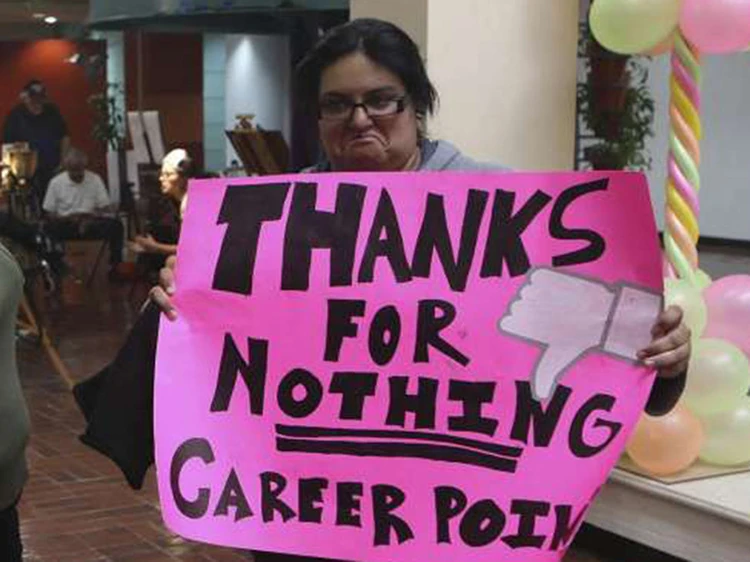
We’re closing in on year three since the U.S. Department of Education (DOE) was tasked with canceling federal student loans for thousands of consumers. These students were victimized by predatory for-profit colleges like Corinthian Colleges, which, at its peak, operated more than 100 campuses in the U.S. and Canada.
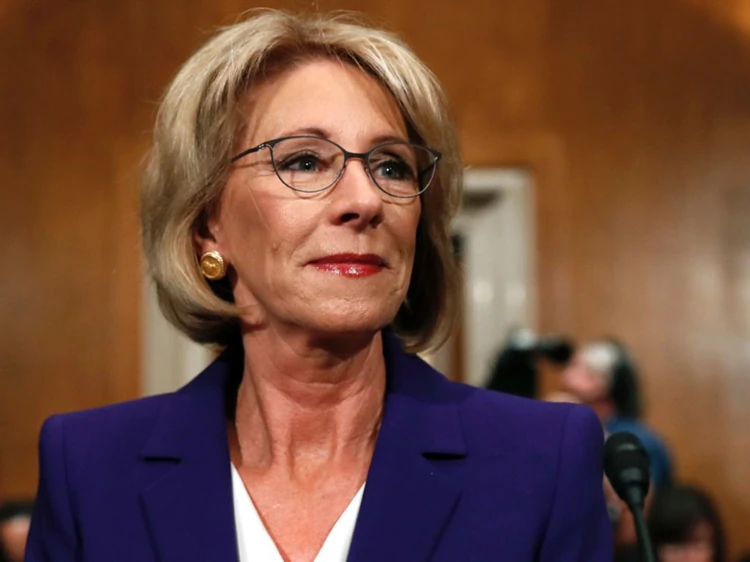
When someone asks why the debt cancellation is getting nowhere, the answer usually includes a mention of Education Secretary Betsy DeVos.
Whether DeVos doesn’t like taking orders from Congress or is made of Teflon, no one knows. But what we do know is nothing seems to stick when she’s asked to make something happen for the benefit of those exploited students.
You want me to do what?
A coalition of states tried to get DeVos to take action on 27,000 applications for loan forgiveness filed by students whose for-profit schools collapsed and left them stranded without a degree or guaranteed admission to another school. That went nowhere, and neither did another alliance of 18 states. Then, 23 senators asked the Consumer Financial Protection Bureau (CFPB) to look into the mismanagement of the forgiveness program because they also couldn’t get DeVos to move forward.
Fast forward to Thursday, when the House Education and Labor Committee called DeVos on the carpet to try to find out two things:
Why her department has been dragging its feet on bringing some resolution to the affected students.
What the logic was behind the math in her loan relief plan -- specifically how it deals with debt relief claims made under the “borrower defense to repayment” statute, a law which gives students a defense against loan repayment if they were subject to adversarial debt collection. The Washington Post’s education economics writer Danielle Douglas-Gabriel reported that higher education experts went as far as saying DeVos’s new sliding scale will result in substantially less loan cancellation than before.
Why the stonewalling?
Committee Chairperson Bobby Scott (D-VA) didn’t waste any time in laying out his case in Thursday’s hearing.
“The department's initial partial relief formula would have provided about 93 percent of defrauded students full relief,” Scott said. “In 2018 the federal court blocked the initial partial relief formula because it misused students personal data. But even after the court's ruling which specifically asserted the department could provide timely and full relief to eligible borrowers under the Obama era framework, the department refused to do so.”
Scott then moved to some facts which showed how defrauded students were completely left out in the cold:
In the 18 months between the court's 2018 ruling and the department’s announcement of a new revised formula, the department failed to process a single borrower defense claim.
In that same timeframe, the number of borrowers awaiting relief soared from 54,000 to approximately 240,000.
The department illegally collected on 45,000 borrowers during that period of inaction, putting some borrowers in a situation where wages and tax returns were garnished by the government when those borrowers should have been receiving some type of monetary relief.
The gloves came off as Scott made it clear that the department has done nothing on behalf of the students who were hoodwinked.
“So, Madame Secretary, your refusal to process those claims is inflicting serious harm on students that you have the duty to serve while the department has been searching for a legal method to shortchange these defrauded borrowers,” he argued.
“These defrauded borrowers have been left with mountains of debt, worthless degrees and none of the job opportunities they were promised. In many cases, they were unable to go back to school, start a family, or move on with their lives.”
DeVos defends herself
To her credit, DeVos appeared prepared for Scott’s barrage and defended both her department and the administration vigorously. She put some of the blame back on the Obama administration, saying it not only left behind 64,000 borrower defense claims to be processed, but it also “weaponized the regulation against schools it simply didn't like.”
“They applied the law in a discriminatory fashion...since 2015, there has been a 5,000 percent increase in borrower defense claims. This administration is committed to pulling back the previous administration's overreach and will enforce a borrower defense rule that is consistent with Congress' intent, that protects all borrowers and that treats taxpayers and schools fairly.”
In defense of the DOE’s new formula, DeVos wanted it known that the DOE’s rule first and foremost “puts into place a process that is clear, understandable and easily accessible for borrowers. It also ensures that claims are processed efficiently, carefully, transparently and fairly.”
However, DeVos’ definition of “clear, understandable, and easily accessible” might be interpreted as an exhausting number of hoops a student would have to jump through to get a loan absolved. Students have to file claims “which will be judged using a preponderance of the evidence standard”; the new process allows for “both borrowers and institutions to present evidence, obtain relevant evidence we are considering in the case and respond to any evidence in the record.”
One caveat that might make matters worse for students using the borrower defense rule is that DeVos’ version does not apply retroactively. When it goes into effect on July 1, 2020, it will apply to loans only dispersed after that date.
“This means that the Department will continue to enforce, in good faith, the previous administration's 2016 rule for all loans dispersed between July 1st, 2017 and July 1, 2020,” DeVos said, leaving her interpretation of “in good faith” up for conjecture.
“Frankly, it’s criminal”
When Rep. Lori Trahan (MA-03) had her turn at the grill, she went straight at Secretary DeVos’ revised formula, which, in Trahan’s estimation, provided only partial loan relief to the defrauded students.
Rep. Trahan demonstrated why DeVos’ plan won’t work by weaving a tale about an imaginary student (named “Betsy,” interestingly enough) who was defrauded by their school. Because “Betsy” makes less than the federal minimum wage, she would not receive full debt relief, Trahan argued.
As the video shows, Trahan took no prisoners, playing pin-the-tale-on-DeVos with the Education Secretary and her new formula.
“Look, the new partial relief formula that you came out with two days ago, it doesn't benefit students who have been fleeced,” argued Trahan. “It doesn't take into account individualized earnings, debt load, whether Betsy is back in a full-time or part-time accredited college program, which is why my friend from Pennsylvania, Representative Wild, and economists alike call it nonsensical.”
“These are students who wanted nothing more than to get ahead, who took out loans in good faith, and they were taken advantage of instead. And your response to them is to cheat them again.”
Speaking to Scott’s tirade about the DOE’s snail’s pace, Trahan pointed out to DeVos that she has the ability to make things better, but she said the Education Secretary simply isn’t doing enough.
“So, I know right now, you have the authority to provide full, fair, and immediate debt relief to student borrowers who were defrauded by these predatory colleges. And every day that goes by is a violation of students' rights. And frankly, it's criminal,” Trahan said.
“I know fraud when I see it”
When Suzanne Bonamici (D-OR) had her turn at DeVos, she didn’t spare her concerns either.
In lawmaker’s scrutiny of the Education Department’s revised formula for processing Borrower Defense claims, she argued that only a fraction of borrowers will get that relief and that DeVos’ continuing efforts to demand loan repayment from defrauded students was an insult.
“I’m a former consumer protection lawyer for the Federal Trade Commission, and I know fraud when I see it,” Bonamici said during the hearing. “These students were misled and cheated. And the fact that some of them may be making money doesn’t mean they weren’t defrauded. If someone went into one of these programs hoping to become a nurse, for example, and now they’re selling clothes at a department store, it doesn’t mean that they weren’t defrauded.”
“That’s not the way it works”
Not unlike anything else we’ve seen from congressional hearings lately, the Republicans on the committee went to bat for DeVos. Rep. Virginia Foxx (R-NC), the ranking member on the committee, offered this analogy in defense of DeVos’ right to provide partial relief for successful borrower defense claims:
“I bet you there is not a member of this committee who has not had a car accident or a problem in homeowner's insurance, and I'll guarantee you that the insurance companies don't write you a check for what you think is your damage. They assess that damage. They look at your car. They come to your home. What these members are saying is, you just write a check from the taxpayers and say, ‘It's okay if you tell us you've been defrauded or you've been damaged.’ That's not the way it works.”
Dealing with the DOE?
The Department of Education barely gets one star from ConsumerAffairs reviewers, and now you may be able to understand why.
But one thing that raises an eyebrow is something that Trisha of Thousand Oaks CA brought up in her review of the DOE. She says that when someone calls the DOE, they’re actually getting a call center run by Maximus Federal Services Inc. which, Trisha claims, “runs every aspect of FSA (Federal Student Aid).”
“They can't answer questions. Being on the outside, we can't possibly know this...They work off of a script. If you ask a question not on the script, they will dance around an answer and actually make something up. They don't offer anything because they don't know how.”