CONSUMER NEWS    RECALLS    COMPLAINT FORM    SCAM ALERTS  


Complain about a product or service

Small Claims Guide | Class Actions | Lemon Law | FAQ | Resources | Newsletters | Spanish
Automotive    Education    Electronics    Family    Finance    Health    Homeowners    Shopping    Travel   
NEWS   Latest |  Archives |  Auto |  Cells, etc. |  Computers |  Financial |  Health |  Homeowners |  Parents |  Privacy |  Scams |  Seniors |  Travel

The Healthy Geezer

What Women -- and Men -- Should Know about Breast Cancer


By Fred Cicetti

May 24, 2008

Breast Cancer

Companies Agree To Cut Cancer-Causing Chemicals In Potato Chips
What Women -- and Men -- Should Know about Breast Cancer
Daily Aspirin May Reduce Risk of Breast Cancer
FDA Approves New Genetic Test for Breast Cancer
Gene Mutation Spreads Breast Cancer
Research Finds Green Tea Helpful Against Breast Cancer
Marijuana Compound May Fight Breast Cancer
Mayo Clinic Sees New Hope In Breast Cancer Drug
FDA Approves Evista For Reducing Breast Cancer Risk
Side Effects Drive Women from Breast Cancer Drug
Hypnosis Reduces Pain and Costs in Breast Cancer Surgery
Grapefruit Linked to Breast Cancer
Study Finds No Link Between Abortion, Miscarriage and Breast Cancer
Falling Breast Cancer Rates Linked to Declining Use of Hormone Replacement Therapy
Hispanic Women Three Times More Likely to Develop Advanced Breast Cancer
MRI Screening of Opposite Breast Necessary for Women with Breast Cancer
FDA Approves Tykerb for Advanced Breast Cancer Patients
FDA Clears New Breast Cancer Test
Needle Biopsy May Not Be Enough to Rule Out Breast Cancer in Some Cases
Red Meat May Increase Breast Cancer Risk
Breast Cancer Survivors Skipping Mammograms, Study Finds
Breast Implant Complications Frequent, Study Finds
Tests Show Drug Fights Aggressive Breast Cancer
California Sues to Require Cancer Warnings on Potato Chips and French Fries
Study Ties Fries To Breast Cancer Risk
Low-Fat Diet May Reduce Risk of Recurrent Breast Cancer
Study Suggests Pain Reliever, Breast Cancer Link
Trials Show Herceptin Aids Breast Cancer Recovery
That Pink Ribbon Can Be Misleading, Consumer Group Warns
Survival Better When Breast Cancer Detected Through Mammography

Breast cancer is second — behind lung cancer — as the leading cause of cancer death in women. The chance of developing invasive breast cancer at some time in a woman's life is about 1 in 8.

The female breast is composed primarily of milk-producing glands (lobules), ducts that connect the glands to the nipple, and soft tissue.

Breast cancer is a malignant tumor that has grown from breast cells. Nearly all breast cancers start in the ducts or lobules of the breast. The cancer can spread (metastasize) to other parts of the body, but it will continue to be defined as breast cancer.

Types of breast cancer

There are many forms of breast cancer.

Infiltrating ductal carcinoma (IDC) is the most common form. It starts in a duct, then breaks through the duct wall and invades the tissue of the breast. At this point, it can metastasize through the lymphatic vessels and the bloodstream. About 80% of invasive breast cancers are infiltrating ductal carcinomas.

Lymph plays a major role in breast cancer. It is a fluid that carries immune-system cells through lymphatic vessels. Lymph nodes are small collections of these cells in the vessels. Almost all lymphatic vessels in the breast connect to lymph nodes under the arm. Cancer cells that enter lymphatic vessels can spread and begin to grow in lymph nodes. This is why doctors check the lymph nodes to see if breast cancer has spread.

Ductal carcinoma in situ (DCIS) is the most common type of noninvasive breast cancer.

The term “in situ” means the cancer is confined to its original site. DCIS denotes that the cancer cells are inside the ducts but have not spread through the walls of the ducts into the surrounding breast tissue. About 20% of new breast cancer cases will be DCIS. Nearly all women diagnosed at this early stage of breast cancer can be cured.

Risk factors

There are many risk factors for breast cancer.

• The risk rises with age. About 77% of women with breast cancer are older than 50 when they are diagnosed.

• Breast cancer risk is higher among women whose close relatives have the disease.

• A woman with cancer in one breast is at high risk of developing a new cancer in either of her breasts.

• Women who started menstruating before age 12 or who went through menopause after age 55 have a slightly higher risk of breast cancer.

• Having multiple pregnancies and becoming pregnant at an early age reduces breast cancer risk.

• Long-term use of hormone replacement therapy (HRT) after menopause increases your risk of breast cancer.

• Drinking alcohol is linked to an increased risk of developing breast cancer.

• Obesity is a breast cancer risk, especially for women after menopause.

Evidence is growing that exercise reduces breast cancer risk.

Diagnosis

The most common breast cancer symptom is a lump. Other symptoms include swelling, skin irritation, nipple pain or retraction, and an unusual discharge.

Early diagnosis saves lives. The combination of a mammogram, a clinical breast exam and self-exams is recommended by healthcare experts to reduce breast-cancer deaths.

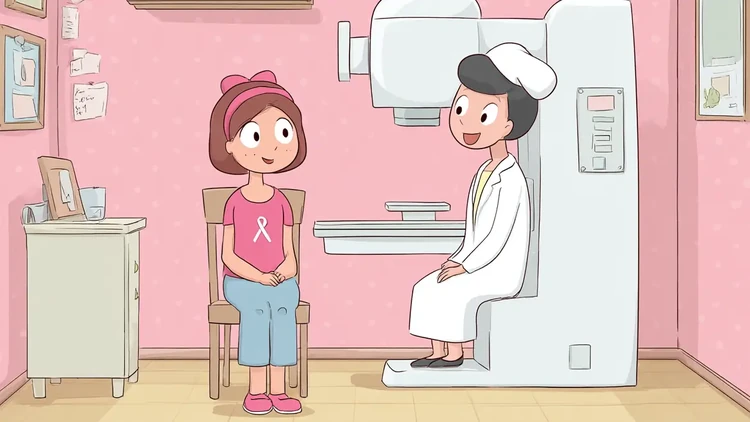
A mammogram is a breast x-ray. If mammography finds an abnormality, confirmation by biopsy is required. In a biopsy, a tissue sample is taken for analysis.

About 2/10 percent of mammograms lead to a cancer diagnosis. About 10 percent of women examined will need another mammogram. Only about 10 percent of those women will need a biopsy. Out of those biopsies, 80 percent will come back negative for cancer.

Women 40 and older should have an annual mammogram and breast exam by a healthcare professional. As long as a woman is in good health and would be a candidate for treatment, she should continue to get mammograms and exams.

Research has shown that self exams help find breast cancer. Self examination teaches women how their breasts feel normally and to notice changes.

Ultrasound and MRI are other diagnostic tools.

Ultrasound uses high-frequency sound waves to outline a part of the body. Breast ultrasound can focus upon something picked up by a mammogram.

Magnetic resonance imaging (MRI) use radio waves and strong magnets instead of x-rays. They can be used to examine cancers found by mammogram.

Treatment

Most women with breast cancer have some type of surgery. Surgeries include lumpectomy to remove only the breast lump and surrounding tissue, a mastectomy that removes part or all of the breast or can be more extensive to include lymph nodes and muscle tissue.

Radiation therapy is another form of treatment. It uses high-energy rays or particles that destroy cancer cells. This treatment may be used to destroy cancer cells that remain in the breast, chest wall, or underarm area after surgery.

Medicines are also used to treat breast cancer. Chemotherapy employs intravenous and oral drugs that can kill cancer cells in most parts of the body. The anti-estrogen drug tamoxifen has been used for more than 20 years to treat breast cancer.

Hormone replacement therapy (HRT) to treat menopause symptoms and its relationship to breast cancer has become a controversial issue. Unfortunately, many women experience menopausal symptoms after treatment for breast cancer.

In the past, doctors had offered HRT after breast-cancer treatment to women suffering from severe symptoms. However, recently, a study found that breast cancer survivors taking HRT were much more likely to develop a new or recurrent breast cancer than women who were not taking the drugs. This study discouraged doctors from recommending HRT to breast-cancer patients.

Phytoestrogens, estrogen-like substances, may be safer than the estrogens used in HRT. However, there is insufficient data on phytoestrogens to evaluate their safety for breast cancer survivors.

Male breast cancer

Breast cancer strikes most often when men are in their sixties.

Male breast cancer? Men do have breast cells that can become cancerous. The disease is uncommon in men. It represents only 1% of all breast cancers. Because of its rarity, many men aren’t aware it exists. And that’s a problem.

For unknown reasons, the incidence of male breast cancer has been increasing. About 2,000 men in the U.S. are diagnosed with breast cancer annually.

Young boys and girls have a small amount of breast tissue made up of a few ducts. At puberty, female hormones in girls make breast ducts grow, milk glands form and fat increase. The male hormones in boys prevent further growth of breast tissue. Men's breast tissue contains ducts, but only a few if any lobules.

The most common symptom of male breast cancer is the same as it is for women — a lump. Other signs include: skin dimpling, a new indentation of the nipple, redness or scaling of breast skin, a clear or bloody discharge from the nipple.

Risk factors

Some risk factors for male breast cancer are:

• Age. The average age for a man diagnosed with breast cancer is 67.

• Family. About 20 percent of men with breast cancer are related to someone with the disease.

• Genes. About 7 percent of breast cancers in men are inherited.

• Radiation. There’s a higher risk to men who underwent chest radiation treatments when they were younger.

• Klinefelter Syndrome. Men with this syndrome make lower levels of male hormones — androgens — and more female hormones. This can cause gynecomastia, benign breast enlargement. Men with this condition may be at greater risk of breast cancer. Many medicines used to treat ulcers, high blood pressure, and heart failure can cause gynecomastia, too.

• Estrogen. The risk is small for men who take estrogen — the main female hormone. Estrogen drugs may be used to treat prostate cancer.

• Liver disease. This can increase your risk of gynecomastia and breast cancer.

• Obesity. Fat cells convert androgens into estrogen.

• Alcohol. Drinking alcohol raises the odds that a man will develop breast cancer. The risk increases with the amount of alcohol consumed.

If a man has a family history of the disease, he should consult a doctor about regular testing. Diagnostic tests for men include a clinical breast exam, mammograms, ultrasound, biopsy and, if indicated, a nipple discharge exam.

Breast cancer treatment for men is similar to that given to women. Some men may need only surgery. Others will need surgery and radiation, chemotherapy or hormone therapy.

There isn’t much tissue to a man's breast, so removing the cancer usually means excising most of the tissue. The procedures that are used on women to save breast tissue aren’t practicable for men.

Most men with breast cancer require a modified radical mastectomy. In this procedure, a surgeon removes the entire breast and some underarm lymph nodes, but leaves chest muscles intact.

Ask Fred

If you would like to ask Fred a question, please use this form. Fred is not able to respond to all questions. Your name will not be used in Fred's column.

Your Name

City, St, Zip

E-mail

Your Question

All Rights Reserved © 2008 by Fred Cicetti


Report Your Experience
If you've had a bad experience -- or a good one -- with a consumer product or service, we'd like to hear about it. All complaints are reviewed by class action attorneys and are considered for publication on our site. Knowledge is power! Help spread the word. File your consumer report now.


Consumer News

August 20 2008

Recent Recalls & Safety Alerts


FREE CONSUMER NEWSLETTERS

The Daily Consumer
Afternoons M-F

Sign up now!


Consumer News & Alerts
Every Sunday

Sign up now!


Knowledge is free.
Knowledge is power.


Back to the top |

Advertisement


Home | Rogues Gallery | Good Guys | Complaint Form | News | Recalls | Search | Video | FAQ |
Consumer Resources | Small Claims Guide | Lemon Law | Newsletter | Contact Us
Advertise With Us | Testimonials | Newsroom | RSS Feeds | Radio | Job Postings


Terms of Use Your use of this site constitutes acceptance of the Terms of Use

Advertisements on this site are placed and controlled by outside advertising networks. ConsumerAffairs.com does not evaluate or endorse the products and services advertised. See the FAQ for more information.

Company Response Welcome If complaints about your company appear on our site, we welcome your response. Please see the Response Form for more information.

For more information, see the FAQ and privacy policy. The information on this Web site is general in nature and is not intended as a substitute for competent legal advice.  ConsumerAffairs.com Inc. makes no representation as to the accuracy of the information herein provided and assumes no liability for any damages or loss arising from the use thereof. 

Copyright © 2003-2008 ConsumerAffairs.com Inc.  All Rights Reserved.