

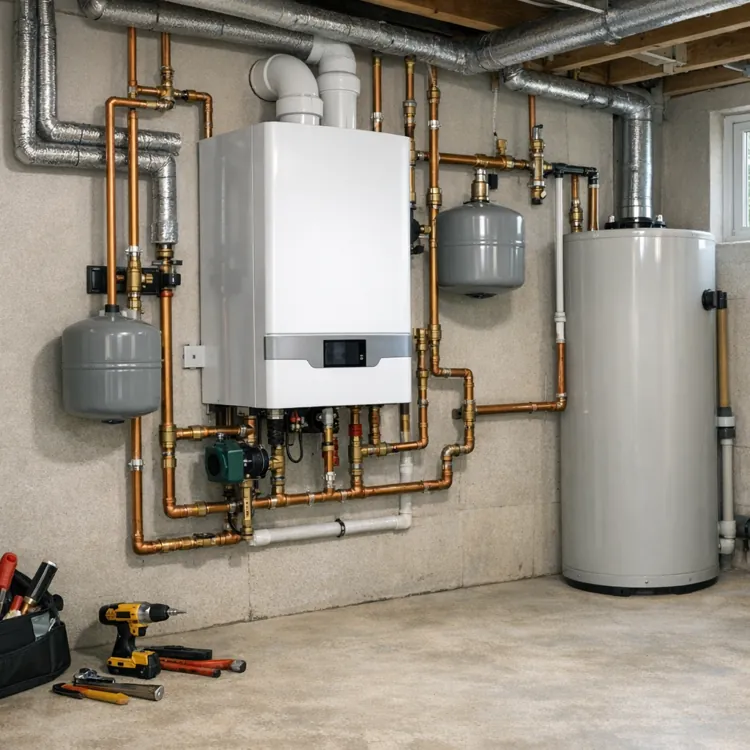
Average cost range for boiler installation
The average cost to replace a boiler in 2026 is $5,750, and most homeowners pay between $4,000 and $7,500. These costs are based on national averages we got from Jordan Benjamin, President at Done Rite Services, an HVAC, plumbing and electrical company in Tucson, Arizona, and David Watkins, CEO of Watkins Heating & Cooling in Springboro, Ohio.
Just like with other types of HVAC systems, the size and efficiency of the boiler are the two biggest factors affecting your pricing, with larger, high-efficiency boilers pushing prices closer to the upper end of that range and smaller, low-efficiency boilers sitting closer to the lower end.
According to the Department of Energy, moderate efficiency means a unit with an Annual Fuel Utilization Efficiency (AFUE) rating of 80% to 83%, while high-efficiency units have an AFUE rating of 90% or higher. Higher efficiency ratings come with a higher upfront HVAC installation cost but can end up saving you money on utility bills in the long run.
Boiler installation cost by home size
Larger homes have more space to heat and require a boiler with a higher level of heat output, measured in British Thermal Units (BTUs). Bigger boilers cost more, which means your boiler installation costs will vary based on home size.
Your heating and cooling technician should perform a Manual J calculation on your home, which considers things like home square footage, ceiling height, window quality and size, insulation quality and age, home age, climate and more.
The calculation helps determine what size boiler is appropriate, which helps avoid situations where an undersized boiler works overtime to keep up with demand and those where an oversized boiler short-cycles because it’s too powerful for your space. A boiler that’s too small or large will experience a shortened lifespan and, potentially, inadequate heating for your home.
You can use the table below to get an idea of what heat output you need based on home square footage, but note that these are just estimates. Much like with other types of HVAC systems, you should have a professional determine what size you need based on your particular home.
| Home size (sq. ft.) | Estimated BTUs | Average cost |
|---|---|---|
| 1,000 | 30,000 to 60,000 | $4,000 |
| 1,500 | 45,000 to 90,000 | $4,900 |
| 2,000 | 60,000 to 120,000 | $5,800 |
| 2,500 | 75,000 to 150,000 | $6,700 |
| 3,000 | 90,000 to 180,000 | $7,600 |
Boiler replacement cost by fuel type
Most boilers in the U.S. use natural gas, propane or oil as a fuel source to generate heat, and some use electricity. The type of fuel source your boiler uses will affect the pricing. Here’s a quick breakdown of average boiler installation costs based on fuel source.
| Fuel source | Average cost | Additional considerations | Best for |
|---|---|---|---|
| Electricity | $4,000 to $6,500 | Lower heat output, which may demand larger unit | Eco-friendliness and safety |
| Natural gas | $4,000 to $7,500 | Gas line installation and maintenance | High heat output and high efficiency |
| Oil | $5,000 to $7,500 | Oil tank installation and maintenance, as well as delivery fees | High heat output where gas isn’t available |
| Propane | $4,000 to $7,000 | Propane tank installation, as well as delivery fees | High heat output and high efficiency in remote areas |
In most cases, homeowners replacing their boiler will stick with the same fuel type for the sake of familiarity and simplicity. However, there are some things to consider if you’re looking to move to a new fuel source. You can ask your heating and cooling specialist for help deciding if changing fuel sources is a good option.
- Switching from oil: Most homeowners will want to remove their oil tank, which will come with additional costs. If your tank is buried, you can usually abandon it rather than remove it.
- Switching to oil: You’ll need to install an oil tank, which can go in your basement, in your utility room or outside. For outside installations, you can go above-ground or below-ground, but buried oil tanks can lead to major issues if you ever run into a leak. In addition to tank installation costs, you’ll need to pay specific permit fees.
- Switching from natural gas: If you’re switching from natural gas, you’ll need to cap your gas line.
- Switching to natural gas: You’ll need to pay to install a gas line that leads from the supply lines in the street into your boiler room. You’ll need an additional permit and help from a plumber.
- Switching from propane: Switching from propane to another fuel source means you’ll need to remove your propane tanks or repurpose them for other equipment in your home, like your stove.
- Switching to propane: You’ll need to have a professional install permanent propane tanks outside your home, which usually requires an additional permit and fees for pouring a concrete pad. Your pro will also need to run propane lines from your tanks to your boiler.
- Switching from electricity: Switching from electricity usually doesn’t require any additional work, although you’ll need to add in the new fuel source.
- Switching to electricity: Most homeowners will need to pay to install a subpanel dedicated to the boiler, and some may need to pay to upgrade to 200-amp service. Many homeowners couple electric boilers with solar panels, which aren’t necessary but can reduce operating costs.
Boiler installation labor, permits and add-ons
Installation labor will always be a major part of your boiler installation, but it’s a good idea to consider permit fees and additional charges you may run into to avoid surprises.
Labor cost to install a boiler
On average, between 40% and 50% of your total will go toward labor, which means average labor costs between $2,300 and $2,900. Hourly and per-project labor charges can be higher in areas where the cost of living is above average.
Anything that makes the installation more challenging or urgent can drive these prices higher. This includes the following:
- Switching from one fuel source to another
- Requiring installation in a hard-to-reach crawl space or cramped utility room
- Requiring an emergency replacement in the winter
Permit fees
In most municipalities, replacing mechanical equipment like a boiler will require a permit, so you’ll need to pay permit fees to keep your project legal. Fees vary widely based on your local building department’s fee schedule, but in most cases, fees won’t add more than a few hundred dollars to your total.
Add-on fees
Some homeowners couple their boiler installation with add-ons, which can help reduce ongoing operating costs, extend the lifespan of the equipment and improve utility and comfort in the home. Here are some add-ons you may want to consider.
- Insulation upgrades: Replacing insulation throughout your home or adding insulation to attics or unfinished basements can improve energy efficiency, lower heating and cooling bills and extend the life of your boiler. Depending on the specific work you want done, this could add hundreds or thousands to your total.
- Energy audit: An energy audit usually costs a few hundred dollars but can pinpoint areas to improve efficiency and save on long-term heating costs.
- Warranty: Some boiler manufacturers sell extended HVAC warranties, which can give you peace of mind and insulation from out-of-pocket repair and replacement costs. You can also consider a home warranty that covers your heating system.
- Adding heating zones: Adding zones to your existing heating system may involve new piping and usually involves adding circulator pumps to your boiler system. These drive costs higher, but you get increased comfort and control, and you could save money on heating costs if the extra zone leads to improved efficiency.
- Old boiler removal: Most HVAC companies will include the cost of removing and hauling away your old boiler in their initial estimates, but if yours doesn’t, you should budget a few hundred dollars for the add-on service and dumping fees.
- Chimney liner replacement: Boilers need to vent through a chimney or flue pipe, and over time, build-up and deterioration can lead to unsafe conditions and carbon monoxide leaks. Replacing the liner can add thousands to your total, but it’s well worth the investment if it means improved safety for you and your family.
- Asbestos removal: Some older boiler systems include asbestos wrapping for pipes. Asbestos is a known carcinogen, so you may want to budget extra for removal. Costs can range from hundreds to thousands of dollars, depending on how much you have and whether your pro recommends removing or encapsulating the material.
FAQ
Why is boiler installation so expensive?
Boiler installation is expensive because the equipment is costly, usually averaging between $2,900 and $3,450, and because the installation process takes hours for a licensed professional to complete. Boilers also use closed-loop water lines and oil lines, so your HVAC tech will need to cut and reseal copper lines and check that your oil line is functioning safely.
Is it worth replacing a 20-year-old boiler?
Yes, it’s worth replacing a 20-year-old boiler because this is close to the average unit lifespan. At 20 years old, your boiler is likely close to reaching the end of its life, which means decreased efficiency and a much higher risk of an outage that could leave you and your family in unsafe living conditions.
How much is a boiler for a 2,000-sq-ft house?
The average cost to install a boiler for a 2,000-square-foot house is $5,800, but it’s important to note that home size is just one of many factors that can influence your installation costs. Your professional will also need to consider your home age and insulation quality, the climate in your area, ceiling height and more.
How long does boiler installation take?
Most HVAC professionals can replace a boiler in 1 to 2 days. If you’re switching fuel types, adding zones to your heating system or coupling your boiler installation with add-on services, your project could take longer.
Article sources
ConsumerAffairs writers primarily rely on government data, industry experts and original research from other reputable publications to inform their work. Specific sources for this article include:
- U.S. Department of Energy, "Furnaces and Boilers." Accessed April 29, 2026.
- Building America, Building Technologies Program, Office of Energy Efficiency and Renewable Energy, U.S. Department of Energy, "Strategy Guideline: Accurate Heating and Cooling Load Calculations." Accessed April 29, 2026.
- Learn Metrics HVAC Systems, "Heating BTU Calculator: How Many BTUs Per Square Foot?" Accessed April 29, 2026.