Financial Strain for Car Owners (2026)

+1 more

As of September 2023, new car prices were still up about 21% above their pre-pandemic levels, and used car prices were up more than 36%. As a result, lots of people are wanting to keep their current vehicles running as long as possible. But maintenance and repair costs have also risen by almost 30% in the same period, putting many car owners in a financial bind.
ConsumerAffairs conducted an online survey on Aug. 22, 2023, of 1,000 drivers through Pollfish, asking about vehicle maintenance habits and confidence in paying for automotive repairs. Survey respondents included residents 18 and older from all states except North Dakota and Wyoming. The margin of error is about 4 percentage points.
Nearly 13% of respondents said they couldn't afford a $1,000 car repair bill, even by taking on debt.
Jump to insightEven households making well into six figures annually are more financially vulnerable than you’d expect — almost 23% would need to borrow money to pay for that $1,000 fix.
Jump to insightSurvey respondents largely maintained their cars as often as they should, but most admitted to leaving their check engine lights on longer than experts recommend.
Jump to insightCar warranties can help people avoid paying for repairs, but most don’t fully understand how. About half of the people surveyed weren't sure what a warranty covered, and about half of the people who thought they knew were wrong.
Jump to insightHow financially vulnerable are drivers?
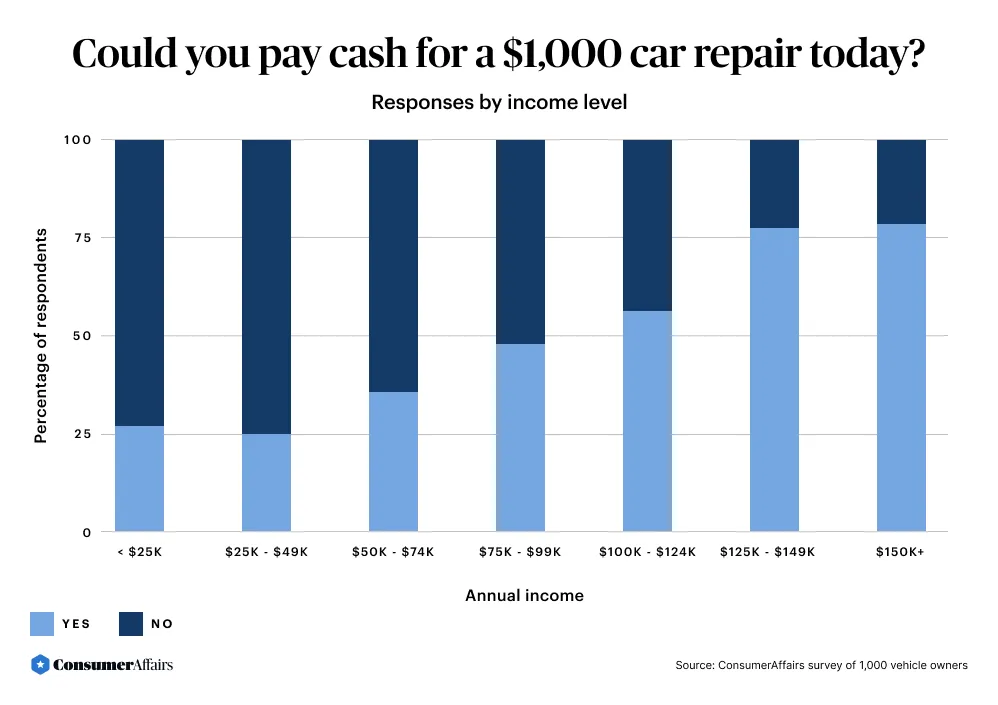
According to our survey, only 41% of Americans have enough money saved to pay for a $1,000 car repair out of pocket. That means the majority of people would need to take on debt to deal with a major car repair. (Cox Automotive data indicates the average car repair now costs $548.32, but we’ve found that larger fixes, like transmission and catalytic converter replacements, can cost thousands.)
Nearly 70% of females said they couldn't pay cash for a $1,000 repair, while a majority of men (55%) said they could afford it out of pocket.
So, how are people keeping their cars on the road?
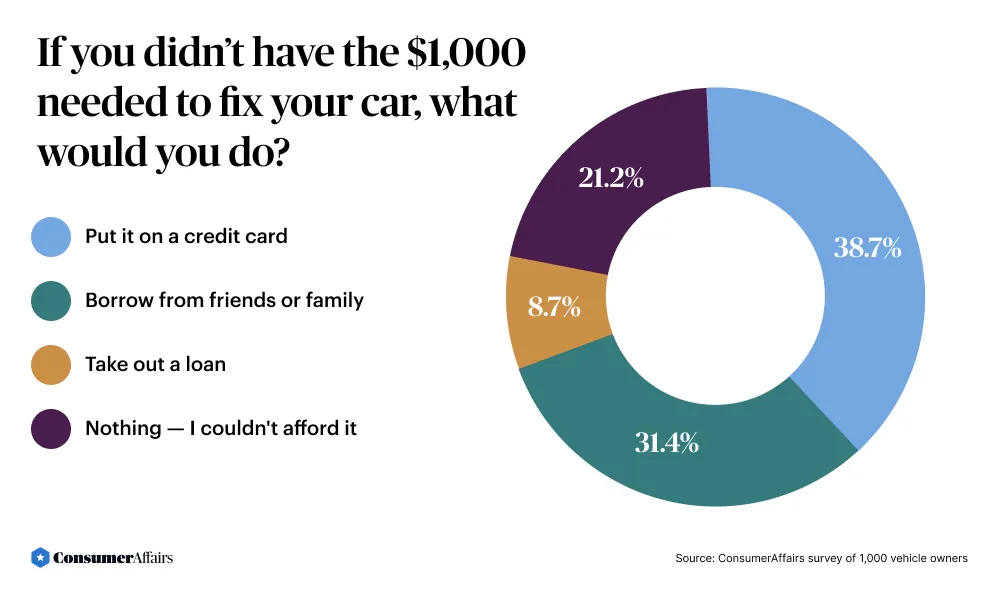
Of survey respondents who didn’t have enough savings to pay for a $1,000 repair, 39% would put it on a credit card, and 31% would have to borrow the money from a friend or family member. About 9% would take out a loan. Finally, 21% couldn’t pay for it at all — they’d just be stranded.
That means 13% of all respondents would have no way to afford a major car repair. (And, unfortunately, if you can’t afford a $1,000 repair, you probably can’t afford a new car, either.)
While putting repairs on plastic is rarely advisable — high-interest debt can make solving money problems even harder — it may be the lesser evil if that’s your only option.
» MORE: Car shopping shortage and struggles
Even high-income households struggle
While respondents’ ability to pay out of pocket for a major car repair rose correspondingly with income, high earners weren’t as financially secure as you might think.
Nearly 23% of households earning over $150,000 annually still claimed they couldn't afford to pay cash for an urgent $1,000 car repair. And 2% of those respondents said they would have absolutely no way to cover the cost.
» LEARN: Are you still in the middle class?
Are you making things worse for yourself?
Putting off maintenance and ignoring your check engine light can lead to more severe problems, which means even bigger bills down the road.
Think of the check engine light as your car's cry for help. The sooner you respond, the better it is for your vehicle's health and your wallet.”
We asked our survey respondents how long they had left their check engine lights on, and most of the results were longer than experts generally recommend.
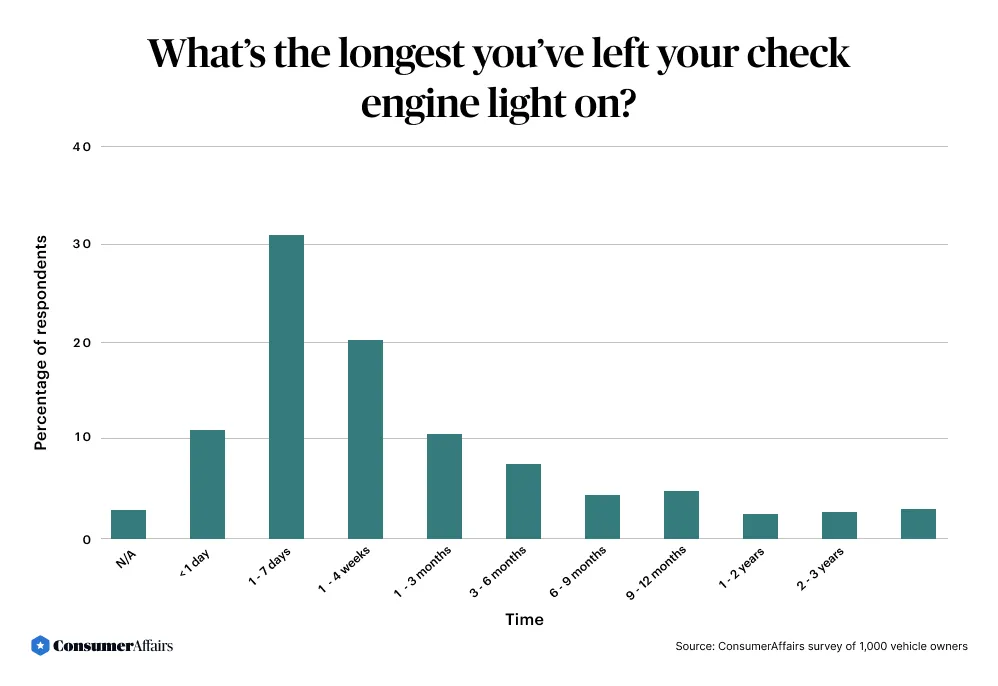
How soon should you take your car in after the check engine light goes on? Ideally, as soon as possible, but you may have a little bit of leeway.
- If your check engine light stays on (not flashing), it means there's an issue but not an emergency, according to Robert Walden, CEO of VehicleFreak, a website providing auto maintenance advice. He said you should get it checked out within a week or so — at the most.
- A flashing check engine light is much more urgent. Walden said you could cause major damage if you keep driving the car, and you should pull over right away.
“No matter what kind of light you see, it's not smart to put off dealing with it for long,” Walden said. “Think of the check engine light as your car's cry for help. The sooner you respond, the better it is for your vehicle's health and your wallet.”
How you can protect yourself from car repair bills
The good news is that there are things you can do to shield yourself from expensive car repairs.
Keep up with maintenance
Regular maintenance (like oil changes, fluid flushes, inspections and filter replacements) can help you avoid serious problems and lower your overall upkeep costs. Sure, it’ll cost you a little now, but it should save you money long-term.
What does that look like for most people? Over 95% of our survey respondents reported that they perform maintenance on their cars at least once a year, and most of them spent less than $500 on it in the last 12 months.
Take advantage of warranty coverage
Warranty coverage can be a lifesaver when something goes wrong with your vehicle, especially if you don’t have the cash to pay out of pocket or the credit to finance the costs.
New cars come with warranties from the factory, but they don’t last forever. (The industry standard is three years/36,000 miles of bumper-to-bumper coverage and five years/60,000 miles of powertrain coverage. A few manufacturers offer more.) You can also get warranty coverage with a certified pre-owned vehicle or an extended warranty.
Unfortunately, there’s also a lot of consumer confusion around car warranties.
Almost 27% of our survey respondents weren’t sure whether their vehicle was under warranty, and just under half of those people didn’t know how to check, either. (If you aren’t sure about your vehicle, you can look up your factory warranty status with your vehicle identification number.)
To make things worse, about 55% of people surveyed were confident that they knew what a car warranty covers, but almost 47% of these respondents incorrectly believed a warranty pays for routine maintenance.
The confusion and misinformation around warranty coverage mean that many people probably aren’t taking advantage of it like they should. Or worse — they’re relying on warranty coverage to help them in ways it’s not capable of.
Make sure you have adequate insurance
While car insurance is mandatory in almost every state, the required coverage is generally meant to limit your danger to others. In other words, liability insurance won’t cover damage to your own vehicle.
Spending more for collision or comprehensive insurance with good protection and an affordable deductible may be worth it if you want coverage for your own car after an accident, theft or extreme weather event.
» COMPARE: Car warranty vs. car insurance
Bottom line
Many more Americans may soon find themselves stuck between a rock and a hard place — unable to afford a new vehicle but without the money to keep their current cars on the road.
If you find yourself in a financial pinch, remember that putting off routine maintenance to save money in the short term often leads to bigger bills over time. Likewise, ignoring issues may turn small problems into major repairs.
To avoid getting stuck with a large repair bill in the future, do what you can to keep your vehicle in good shape, carry enough insurance to protect yourself from the unexpected and remember to take advantage of whatever warranty coverage you have.
Article sources
ConsumerAffairs writers primarily rely on government data, industry experts, and original research from other reputable publications to inform their work. Specific sources for this article include:
- Federal Reserve Bank of St. Louis, “Consumer Price Index for All Urban Consumers: New Vehicles in U.S. City Average.” Accessed Oct. 18, 2023.
- Federal Reserve Bank of St. Louis, “Consumer Price Index for All Urban Consumers: Used Cars and Trucks in U.S. City Average.” Accessed Oct. 18, 2023.
- Federal Reserve Bank of St. Louis, “Consumer Price Index for All Urban Consumers: Motor Vehicle Maintenance and Repair in U.S. City Average.” Accessed Oct. 18, 2023.
- Kelley Blue Book, “Here’s How Much the Average Car Repair Now Costs.” Accessed Oct. 18, 2023.