Best Places to Move to Start Over (2026)

+2 more



Millions of Americans are entering 2026 considering a fresh start. After saying goodbye to 2025 and making resolutions for the year ahead, do you find yourself itching for a true reset? A change of address might be just what you need to revitalize your career, relationships or lifestyle.
Moving to a new city is both an emotional and financial decision. Yet, not all cities offer the same opportunities for starting over. It’s important to identify what you most value — or what you’re most looking to change — when narrowing down the list of cities that could meet your needs.
To find the best cities for a fresh start in 2026, ConsumerAffairs analyzed the 100 most populous U.S. cities for quality of life, economic stability and opportunity, ease of relocating, affordability, and safety. See where your city lands — and which could give you the fresh start you’re looking for.
Key insights
Wilmington, North Carolina, is the best city for a fresh start. Its top-ranked economy offers a range of opportunities for someone looking for a reset.
Jump to insightCharlotte, North Carolina, and two Texas cities — Dallas and Houston — lead the pack in job market diversity, which is worth considering for those who don’t want to get stuck in a one-industry town.
Jump to insightLooking for love? You won't be the only one starting a new chapter in New Orleans, Louisiana. The city has the highest concentration of singles aged 35 to 64.
Jump to insightPort St. Lucie, Florida, makes finding a place to live a challenge. While rental options are plentiful, one-bedroom apartments run around $2,300 a month, pushing overall affordability toward the bottom of the list.
Jump to insightVallejo, California, ranks as the most difficult city for a fresh start, with sky-high housing costs and limited community resources.
Jump to insightTop five cities for a fresh start
A city doesn’t need to excel in every category to provide fertile soil for putting down new roots. The cities that ranked best overall for a fresh start had standout scores in a variety of categories and ranked moderately (or occasionally lower) in others.
Still, the top five cities share some traits. In a couple of categories — affordability and safety — three of the five cities scored highly, giving them a well-rounded edge.
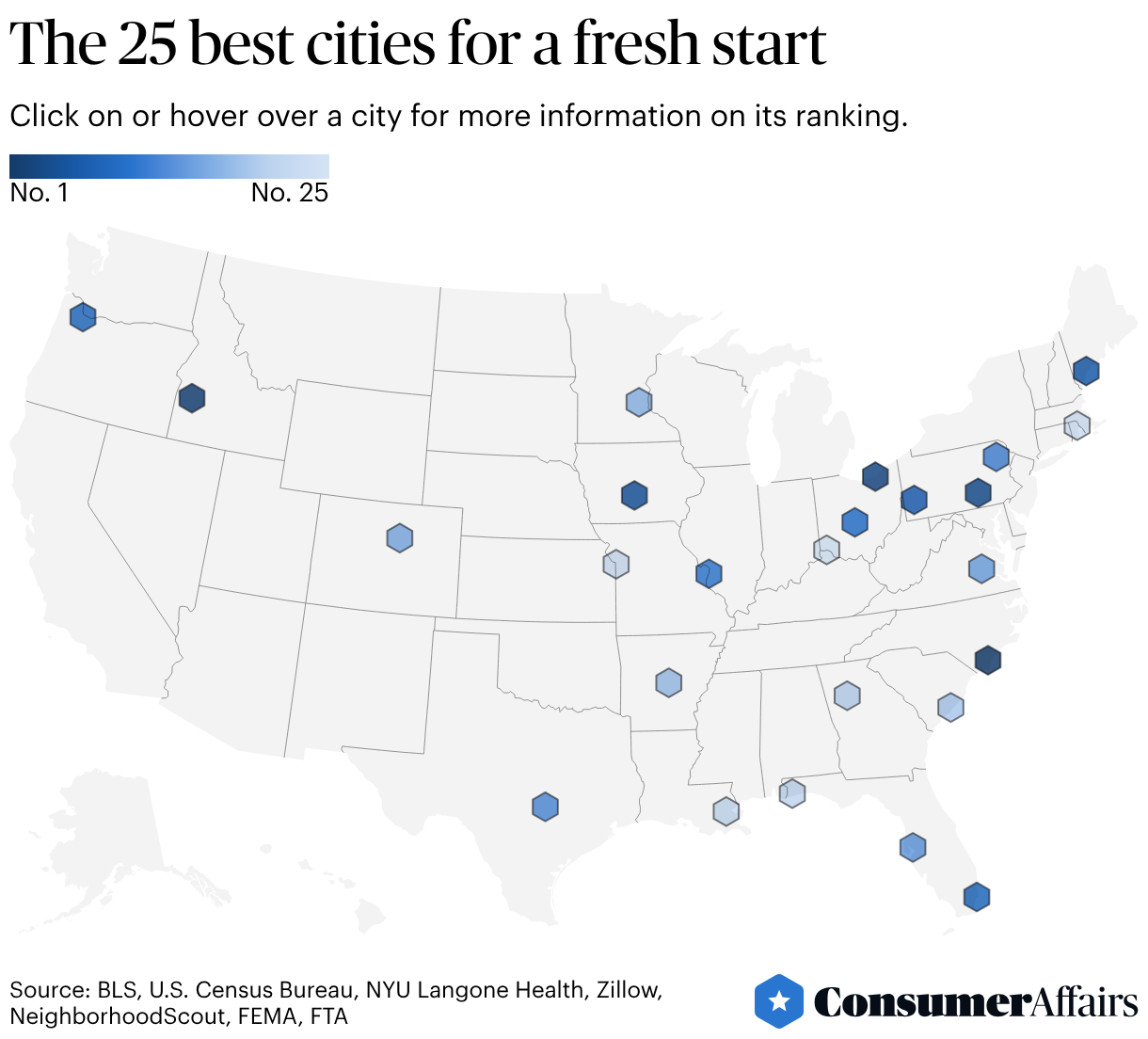
As the map below shows, the best cities for starting over are spread across the United States — though there are noticeably fewer in the West, with just three cities appearing in the top 25. Read on for a closer look at the top-ranked cities.
1. Wilmington, North Carolina
Wilmington, North Carolina, claims the top spot for a fresh start in 2026. Between robust economic opportunity, ample rentals and a rich recreational scene, it's got the whole package for someone ready to hit the reset button. In addition to ranking No. 1 overall, Wilmington has the highest score for economic stability and opportunity. It is also the top city for income growth and has seen an explosion of new jobs, with a 47% increase over the last five years.
Wilmington also stands out for its ease of relocating, ranking in the top 10. With a high percentage of rental homes available — second highest on our list — it’s easier than ever to find a place to call home, making the city even more appealing for those ready to start fresh.
Another perk of Wilmington: There’s no shortage of things to do. The Port City has the highest concentration of sports and social clubs of the cities on our list.
2. Boise, Idaho
Idaho may be known for its potatoes, but you don’t need to be a spud to put down new roots in Boise. The city offers a thriving economy (ranked No. 2), including rising incomes and a diversified, growing job market. While the rental market is fairly tight (the seventh worst for vacant units), rents aren’t astronomically high.
Boise ranks around the middle of the pack for overall quality of life (No. 48), but that doesn’t mean there isn’t much to do on the weekends. The city is just behind top-ranked Wilmington in terms of the highest concentration of sports and social clubs.
3. Cleveland, Ohio
If you’re looking for a fresh start after heartbreak, Cleveland could hold the key to a romantic 2026. The Land is one of the best cities for singles to make a fresh start, with nearly one in six people unmarried and aged 35 to 64.
Ohio has plenty to offer newcomers, whether or not you’re a single looking to mingle. The city has high scores for affordability (No. 9) and quality of life (No. 11). And with a median home price of about $210,500 and a median income of $72,500, Cleveland ranks in the top five for home affordability — making it easier to enjoy all the city has to offer without breaking the bank.
4. Harrisburg, Pennsylvania
If safety is high on your list for a fresh start, Harrisburg, Pennsylvania, has plenty to offer. The city ranks among the safest on our list, with the lowest property crime rate and a top 10 overall safety score (No. 9). But starting fresh isn’t just about security — Harrisburg is also easy to get around. It’s the 10th-most walkable city on our list, and 97% of residents live within a 10-minute walk of a green space, making it easy to stay active and connected.
And the best part? You don’t have to pay a premium to enjoy it all — Harrisburg is also one of the most affordable cities on our list (No. 16).
5. Des Moines, Iowa
If a fresh start means finding a city that balances work and life, Des Moines, Iowa, might be your next move. The city has a diverse job market and one of the shortest commute times among the cities we analyzed — so you can spend less time in traffic and more time enjoying your day.
Des Moines is also easy on the wallet. The median rent for a one-bedroom apartment is about $1,250, and the ratio of median income to median home price is about 31%, which is 10th highest among the cities we examined.
It’s important to note, however, that paychecks haven’t grown much in recent years, rising only about 19.8% since 2018 — one of the slowest rates in the country.
The toughest cities to start over in
In some cities, a combination of factors creates a difficult environment for newcomers to have that fresh start they’re seeking. The following cities scored poorly across most categories we analyzed.
96. Bridgeport, Connecticut
With contracting job growth and a high cost of living, Bridgeport, Connecticut, ranks among the toughest cities for a fresh start, coming in fifth worst on our list.
The city is expensive to live in: Median rent for a one-bedroom apartment is the second highest, behind only Boston, Massachusetts, and the median home price is over five times the median income of about $116,000, giving Bridgeport one of the lowest affordable ratios among the cities we analyzed.
Finding a place to settle in isn’t easy. Bridgeport ranks last for ease of relocating, with a low rental vacancy rate and a low percentage of newcomers over the past year.
97. Port St. Lucie, Florida
Port St. Lucie is not the easiest city to get around. Walkability and access to green space are among the lowest on our list. Fewer than 30% of residents live within a 10-minute walk of a park, and commutes are long.
Renting isn’t much easier. The city ranks fifth in rental availability, but affordability is a challenge, with one-bedroom apartments going for roughly $2,300 a month.
The economy is one of the few bright spots. Median income has jumped nearly 45% since 2018 (fifth in the country), and jobs have grown almost 15% (sixth nationally).
98. McAllen, Texas
If you’re looking to turn over a new leaf with your finances, McAllen, Texas, may actually be a viable option — it’s one of the most affordable cities on the list (No. 11). McAllen offers the cheapest median rents in the country for one-bedroom apartments — about $1,100 — and home affordability that ranks in the top half.
But a real fresh start needs more than a low price tag, and McAllen ranks at the very bottom for quality of life. Relative to its population, it has few restaurants, community centers and social clubs — not to mention one of the lowest percentages of singles.
99. Worcester, Massachusetts
Worcester ranks as one of the worst cities for ease of relocating (No. 98). The city’s tight rental market makes it hard to find a place to live quickly, and limited transit and long commutes can contribute to a difficult transition.
The Woo may not be the best option for those seeking a revitalized career, either. The city ranks sixth worst in economic stability and opportunity. Unfortunately for prospective newcomers, the job market isn’t growing — it’s actually shrunk by almost 10% over the last five years.
100. Vallejo, California
Vallejo, California, ranks as the most difficult city for a fresh start, with low ranks in safety, economic opportunity, affordability and ease of relocating.
Housing costs are among the highest in the country, with a typical one-bedroom apartment renting for around $2,400 a month and median incomes representing only 17% of the median home sale price. Newcomers might feel like they’re spending their whole paycheck on housing, without other advantages making up for it — not exactly the new beginning most people have in mind.
Vallejo ranks in the bottom 15 cities in economic stability and opportunity, with the highest unemployment rate of all the cities we analyzed and the lowest income growth. Together, these factors paint a picture of a local economy that’s less than booming.
How do the largest cities rank for a fresh start?
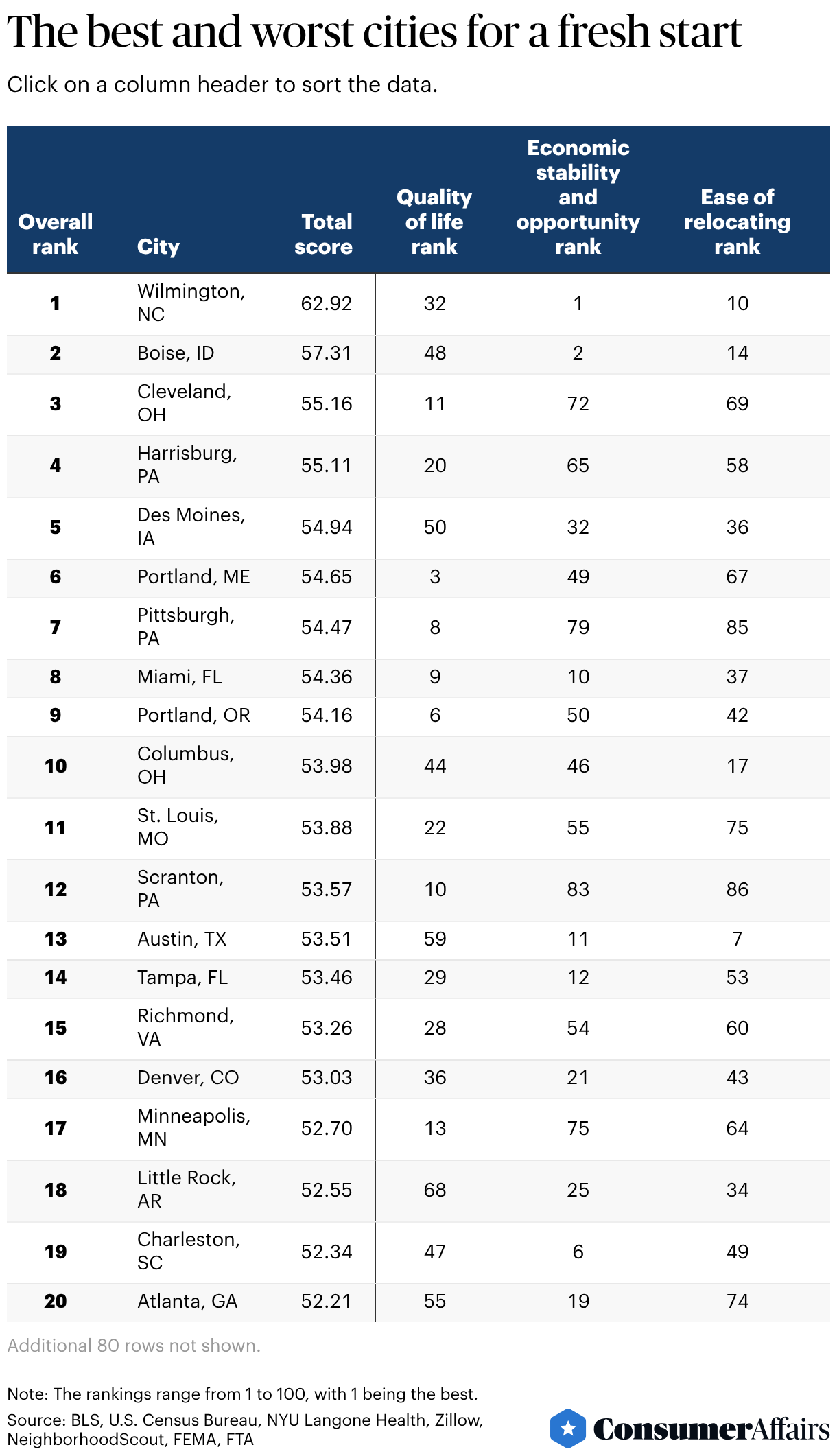
To find which cities might be your best match, it’s not just about the top overall rankings. Consider what you most value, or what you most want your new city to offer, and comb through the full data below to see which metros deliver in those categories.
For example, if you’re looking for a fresh start in your work life, consider Charlotte, Dallas or Houston. These cities lead the pack for job market diversity and rank high for job growth.
Or, if you want your fresh start to involve a fresh dating pool, try New Orleans — the top city for singles, where nearly one of every five people is single and between 35 and 64. And there’ll be no shortage of date ideas — the Big Easy has the highest concentration of restaurants in the country, and plenty of recreational and cultural sites to explore.
For the full data and rankings, check out the table below.
How to start over in a new city
As exciting as it can be to start over in a new city, the process can be overwhelming, too. From researching the job market to evaluating the cost of living, thoughtful planning and preparation are key for a smooth move.
Try these tips to help your transition to a new city:
- Explore neighborhoods and housing options. Many metros are “cities of neighborhoods,” with unique historic and cultural character in different areas. Try visiting your chosen city for a few days before committing to a move, and take time to wander or dine in various parts of town. It’ll help you get a feel for what neighborhood you might see yourself in and narrow down your housing search.
- Budget carefully. Moving costs go well beyond boxes and packing tape — professional movers can run anywhere from a few hundred to several thousand dollars, depending on distance and services. Understanding how moving quotes work, including binding versus nonbinding estimates, can help you avoid surprise charges and budget more accurately.
- Connect with the community. Relationships are vital to a meaningful, balanced life. Especially if you’re moving somewhere “brand-new” (i.e., where you don’t already have a friend or relative to help get you plugged in), you’ll need to take proactive steps to form new connections. Finding friends around shared hobbies and passions is a great place to begin, but don’t forget local civic or service organizations — you can meet your neighbors while investing in your new community, too.
- Give yourself time to settle in. Depending on the circumstances of your move, it may take a few months to over a year to feel like you can call your new city “home.” Know that the transition will take time, and trust that your efforts to get to know the city and its residents are worthwhile, even if they don’t yield new connections immediately.
Methodology
To identify the best U.S. cities for a fresh start in 2026, the ConsumerAffairs Research Team analyzed the 100 most populous cities across five key categories: quality of life, economic stability and opportunity, ease of relocating, affordability, and safety. Each city was scored using publicly available data from federal sources and specialized databases to provide an accurate and comprehensive ranking.
- Quality of life (35 points): The quality of life metric is based on seven metrics: number of restaurants per 100,000 residents (4 points), number of gyms per 100,000 residents (4 points), number of community centers per 100,000 residents (4 points), number of sport or social clubs per 100,000 residents (4 points), percentage of total residents aged 35 to 64 who are not currently married (11 points), walkability (Walk Score) (4 points) and the percentage of residents living within a 10-minute walk of a green space (4 points). Data was sourced from the Bureau of Labor Statistics (2025), the U.S. Census Bureau (2024), and NYU Langone Health (2024).
- Economic stability/opportunity (30 points): The economic stability score is based on four metrics: unemployment rate (5 points), median income growth from 2018 to 2024 (5 points), job growth from 2018 to 2024 (10 points) and job market diversity (10 points), which measures how evenly employment is distributed across industry sectors. Data comes from the U.S. Census Bureau (2018 to 2024) and the Bureau of Labor Statistics (2018 to 2024).
- Ease of relocating (15 points): The ease of relocating score is based on four metrics: rental vacancy rate (3 points), percentage of residents who moved into the city in the past year (6 points), the number of public transit systems (3 points) and average commute time (3 points). Data comes from the U.S. Census Bureau (2024) and the Federal Transit Administration (2024).
- Affordability (10 points): The affordability score is based on two metrics: median rent for a one-bedroom apartment (7 points) and the ratio of median income to median home sale price (3 points). Data was sourced from the U.S. Census Bureau (2024) and Zillow (2025).
- Safety (10 points): The safety score is based on three metrics: violent crime rate per 1,000 residents (3.5 points), property crime rate per 1,000 residents (3.5 points) and FEMA National Risk Index score at the county level (3 points). Data was sourced from NeighborhoodScout (2025) and the Federal Emergency Management Agency (2024).
The city that performed best in each metric was awarded the maximum number of points, and others received relative scores. We then added individual scores together to get a total score, which is out of a maximum of 100 points. Because of a lack of data, some metro areas were removed from consideration.
Reference policy
We love it when people share our findings! If you do, please link back to our original article to credit our research.
Questions?
For questions about the data or if you'd like to set up an interview, please contact dedens@consumeraffairs.com.
Article sources
ConsumerAffairs writers primarily rely on government data, industry experts and original research from other reputable publications to inform their work. Specific sources for this article include:
- U.S. Bureau of Labor Statistics, "Data Tools." Accessed Dec. 30, 2025.
- U.S. Census Bureau, "Explore Census Data." Accessed Dec. 30, 2025.
- NYU Langone Health, "City Health Dashboard." Accessed Dec. 30, 2025.
- Zillow, “Housing Data.” Accessed Dec. 30, 2025.
- Federal Transit Administration, "The National Transit Database (NTD)." Accessed Dec. 30, 2025.
- NeighborhoodScout, "NeighborhoodScout." Accessed Dec. 30, 2025.
- FEMA, FEMA Resilience Analysis and Planning Tool. Accessed Dec. 30, 2025.
Figures