Best Coastal Cities to Live in (2026)

+1 more


From rustic retreats in Maine to beachside rentals in Florida, many Americans flock to seaside towns for rest and relaxation. Some of these destinations, however, deserve more than just a brief vacation visit — they can be the perfect location for year-round living. If you’re seriously considering planning a long-distance move to a coastal location, there are a few top cities you should keep on your radar.
The ConsumerAffairs Research Team determined the best places to live near the coast by analyzing 143 metropolitan areas based on four key factors: affordability, livability, safety and economy. Read on to discover the best coastal location for your next move.
Key insights
Pensacola, Florida, is the best coastal city to move to in the U.S., thanks to its strong scores in safety and affordability.
Jump to insightFive of the 10 best coastal cities are located in Florida.
Jump to insightBremerton, Washington, ranks No. 2 overall and is the only West Coast city in the top five, due to its above-average livability and affordability.
Jump to insightOf the 50 best cities, 21 are located on the East Coast, 16 on the Gulf Coast and 13 on the West Coast.
Jump to insightThe top five coastal cities to call home
Though the cities in our top five each have unique aspects they excel in, two metrics they share in common are affordability and job growth. Financial strengths of these cities are an important aspect to consider when relocating, especially given that moving can be expensive.
1. Pensacola, Florida
Located in Escambia County, Pensacola, Florida, tops our list as the best coastal city to live in. One of its biggest strengths is affordability: It has the second-best affordability ratio (median home sale price to median income) on our list and the ninth-lowest median rent, at $1,848 — about $800 less than the average among cities we analyzed. That’s a good deal, especially considering the area offers 18 access points along the Pensacola Beach and Perdido Key areas.
Additionally, 85% of Pensacola residents live within a 10-minute walk of a green space. Relatively low violent and property crime rates also mean residents have the peace of mind to relax.
County: Escambia County
Number of beaches within the county: 18
2. Bremerton, Washington
Nearly 3,000 miles from the No. 1 city, Bremerton, Washington, ranks second on our list. Its county, Kitsap, has the lowest coastal risk score, which measures the area’s vulnerability to common coastal hazards like flooding, hurricanes and tsunamis. Its Pacific Northwest location also brings a unique climate benefit: zero muggy days per year.
There are 168 beaches in the county, including the rocky and sandy beaches at Illahee State Park. The park includes hiking trails, year-round campsites and a veterans war memorial with two large naval guns donated from the USS West Virginia.
County: Kitsap County
Number of beaches within the county: 168
3. Jacksonville, North Carolina
Jacksonville, North Carolina, located in Onslow County, ranks third on our list. With a median rent of just $1,562, it's the sixth-most affordable metro we analyzed. It also may be a great place to launch a career: Jacksonville saw more than 9% job growth from 2019 to 2023, the second-highest rate in our rankings.
Residents enjoy access to more than 30 miles of coastline, including North Topsail Beach and Bear Island. The New River, closer to town, is a great spot for fishing, kayaking and canoeing. Those with military backgrounds will also appreciate that Jacksonville is home to Marine Corps Base Camp Lejeune, which has close to 40,000 active-duty service members.
County: Onslow County
Number of beaches within the county: 14
4. Port Charlotte, Florida
Like our top-ranked city, Port Charlotte is located on Florida’s Gulf Coast. It leads all metros on our list in job growth, with a 10.5% increase from 2019 to 2023. Port Charlotte also has the smallest population among the top five cities, giving residents a better chance to enjoy more room at the beach. And with high average sunlight exposure, there are plenty of sunny days to do just that.
Port Charlotte residents have access to a variety of beaches, including at Stump Pass Beach State Park, Don Pedro Island State Park and Gasparilla Island State Park. Wildlife enthusiasts will appreciate the area's diverse fauna, from tarpon to loggerhead sea turtles.
County: Charlotte County
Number of beaches within the county: 11
5. La Porte, Texas
Rounding out our top five is La Porte, Texas, located just 26 miles east of Houston. Texas has the lowest state-local tax burden of the 12 states with cities on our list, at just 8.6%. La Porte also had only three days of beach closures in 2024 due to poor water quality.
The area offers six beaches to explore, including those at Sylvan Beach Park, a 31-acre public space with two beaches, a fishing pier and a skate park. History buffs can also visit the nearby San Jacinto Battleground State Historic Site and take in views from the top of its 567-foot monument.
County: Harris County
Number of beaches within the county: 6
Comparing America’s coastal cities
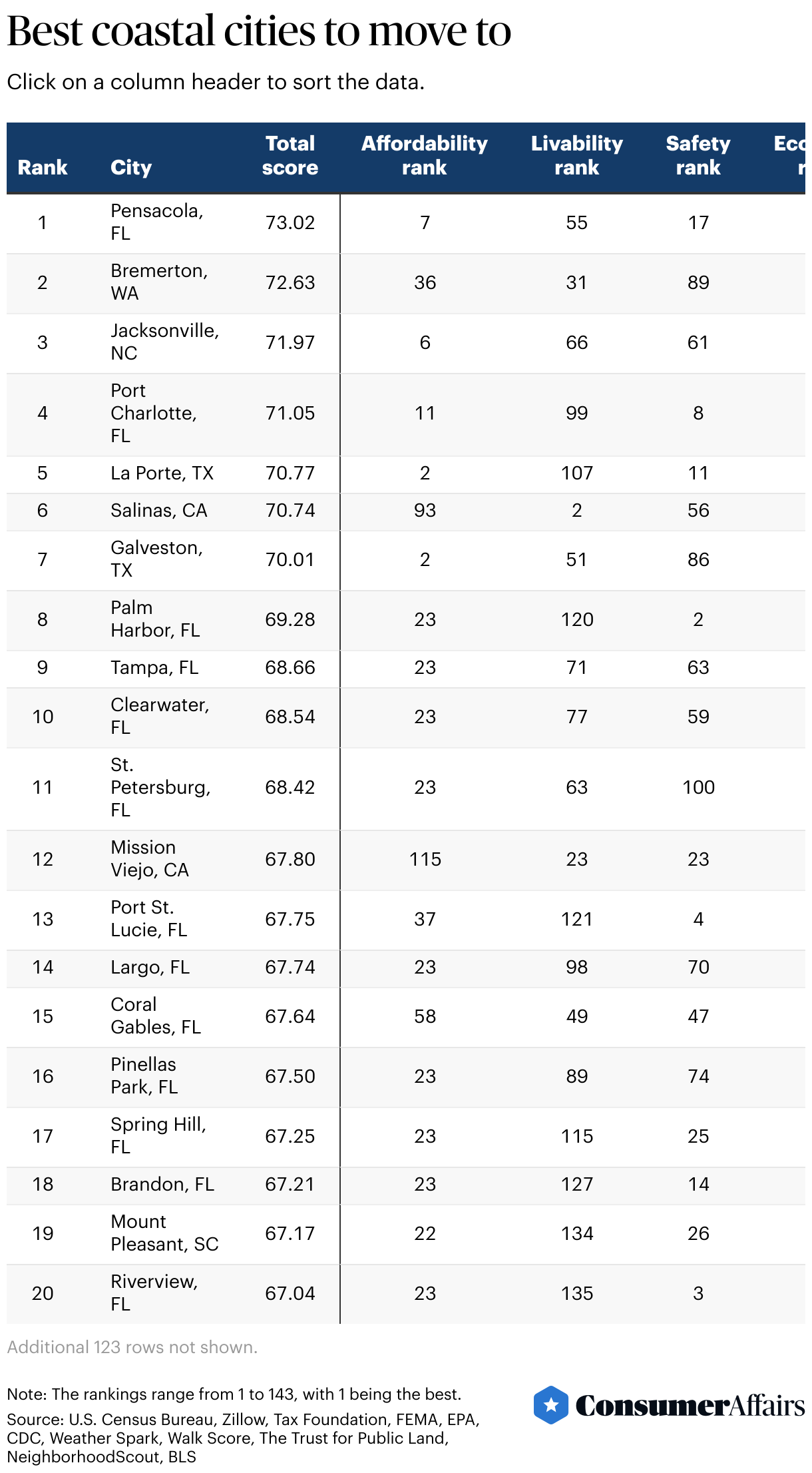
Choosing the best coastal city to live in is a personal journey, and thankfully, there’s no shortage of options. Half of the top 10 are in Florida, but if you’re drawn to a different state, you still have plenty to choose from. The top 50 cities are spread across the country, with 21 on the East Coast, 16 along the Gulf and 13 on the West Coast.
Take a look at the full rankings to see which city may be best for you:
Should you relocate to a coastal city?
From scenic shorelines to year-round outdoor recreation, there are many reasons to seriously think about a relocation to a coastal city. These regions offer the potential to reap the relaxing benefits of a beachside vacation year-round — in fact, some researchers have found that living by a coast may even be good for one’s health and well-being.
But ocean views come with trade-offs, and it’s important to weigh the pros and cons of coastal living before making your decision to move. Coastal areas are increasingly vulnerable to natural disasters like hurricanes and flooding — risks that are intensifying due to climate change. Sea level is expected to rise 10 to 12 inches over the next 30 years, increasing the frequency and severity of coastal flooding and storm surges. This risk can make homeowners insurance significantly more expensive than in inland states, and many coastal properties require separate flood insurance, which is typically not included in standard homeowners policies.
Our methodology: How we determined the best coastal cities of 2025
The ConsumerAffairs Research Team evaluated 143 cities located in coastal counties across the contiguous U.S. to determine which are the best places to live in, based on our unique methodology. We recognize there are many ways to define the “best” coastal city. Our rankings reflect just one perspective: a data-driven analysis of livability, affordability, safety and economic strength.
Defining a coastal city
We identified coastal cities using geospatial data from multiple federal sources. Any county — defined by U.S. Census Bureau shapefiles — with a population of at least 130,000 and located within 15 miles of a saltwater beach was eligible for inclusion.
Beach locations were mapped using coordinates from the Environmental Protection Agency, and official coastline boundaries were based on National Oceanic and Atmospheric Administration shapefiles. We only included counties with at least one beach monitored under the BEACH Act, which requires monitoring coastal waters.
We excluded cities whose beaches were reported as closed for all 365 days of the year, based on EPA data, as well as New York City and Great Lakes beaches. Although some cities and counties met the population and coastal mileage thresholds, they were ultimately excluded due to insufficient data.
How we scored each city
Each metro was evaluated across four core categories, with a total possible score of 100 points. The categories were:
- Livability (45 points): This category captures how livable and environmentally resilient each coastal metro is. It includes a coastal risk score based on hurricane, tsunami and flood risk at the county level (10 points), as well as the average number of beach closure days due to poor water quality (10 points). We also considered average annual sunlight exposure measured by solar irradiance at the county level (10 points) and the percentage of days per year with muggy conditions at the city level (5 points). To round out this category, we included each city’s Walk Score (5 points) and the percentage of residents living within a 10-minute walk of a green space (5 points). Data sources include FEMA, EPA (2024), CDC, Weather Spark and Walk Score.
- Affordability (20 points): To evaluate how financially accessible each coastal metro is, we considered three factors: median rent (10 points), the affordability ratio comparing median home sale price with median income (5 points) and the state-local tax burden (5 points). Data sources include Zillow, the U.S. Census Bureau and the Tax Foundation (2024).
- Safety (20 points): This category measures safety in each metro, based on the rate of violent crimes (10 points) and the rate of property crimes (10 points) per 1,000 residents. Data is from NeighborhoodScout.
- Economy (15 points): This category reflects overall economic health and opportunity in each metro. It includes percentage job growth from 2019 to 2023 (5 points), the percentage of residents living below the poverty line (5 points) and the unemployment rate (5 points). Data sources include the Bureau of Labor Statistics and the U.S. Census Bureau.
In each category, the metro that performed the best was given the highest possible score, with other metros getting relative scores. We added the category scores together to get an overall score, which is out of 100 points.
Reference policy
We love it when people share our findings! If you do, please link back to our original article to credit our research.
Questions?
For questions about the data or if you'd like to set up an interview, please contact rsowell@consumeraffairs.com.
Article Sources
ConsumerAffairs writers primarily rely on government data, industry experts and original research from other reputable publications to inform their work. Specific sources for this article include:
- Zillow, “Housing Data.” Accessed Aug. 3, 2025.
- Tax Foundation, “Facts & Figures 2024: How Does Your State Compare?” Accessed Aug. 3, 2025.
- Federal Emergency Management Agency, “Map | National Risk Index.” Accessed Aug. 3, 2025.
- Environmental Protection Agency, “BEACON.” Accessed Aug. 3, 2025.
- Centers for Disease Control and Prevention, “Indicator: Sunlight Exposure.” Accessed Aug. 3, 2025.
- Weather Spark, “The Weather Year Round Anywhere on Earth.” Accessed Aug. 3, 2025.
- Walk Score, “Cities & Neighborhoods.” Accessed Aug. 3, 2025.
- The Trust for Public Land, “Park Data Downloads.” Accessed Aug. 3, 2025.
- NeighborhoodScout, “Custom Analytics to Invest, Appraise, or Finance Real Estate.” Accessed Aug. 3, 2025.
- Bureau of Labor Statistics, “Occupational Employment and Wage Statistics.” Accessed Aug. 3, 2025.
- U.S. Census Bureau, “Explore Census Data.” Accessed Aug. 3, 2025.
- Visit Pensacola Florida, “Public Beach Access.” Accessed Aug. 3, 2025.
- Washington State Parks and Recreation Commission, “Illahee State Park.” Accessed Aug. 3, 2025.
- Onslow County Tourism, “Beach Days in Onslow.” Accessed Aug. 3, 2025.
- Jacksonville Tourism Development Authority, “Explore the Outdoors.” Accessed Aug. 14, 2025.
- MilitaryINSTALLATIONS, “Camp Lejeune.” Accessed Aug. 14, 2025.
- VISIT FLORIDA, “Port Charlotte's Best Beaches.” Accessed Aug. 3, 2025.
- TourTexas.com, “Things to Do in La Porte.” Accessed Aug. 3, 2025.
- Texas Historical Commission, “San Jacinto Battleground State Historic Site.” Accessed Aug. 14, 2025.
- ScienceDirect, “Does living by the coast improve health and wellbeing?” Accessed Aug. 3, 2025.
- Environmental Protection Agency, “Climate Change Impacts on Coasts.” Accessed Aug. 3, 2025.
- Earth Information Center, “2022 Technical Report | Resources.” Accessed Aug. 3, 2025.
- Insurify, “How climate change is raising home insurance rates.” Accessed Aug. 3, 2025.
- Environmental Law Institute, “The Coastal Property Insurance Crisis: Policy Options in a Time of More Severe Storms and Rising Seas.” Accessed Aug. 3, 2025.
Figures