The Most (and Least) Tax-Friendly States in America (2026)

+1 more


From paychecks and grocery bills to gas fill-ups and homeownership, taxes touch nearly every part of daily life.
But not all Americans are taxed equally. Residents of some states are unencumbered by state income taxes, while others face an outsize burden from sales and property taxes. The overall tax environment can significantly impact cost of living, especially for families on tight budgets or seniors with fixed incomes. Whether you’re struggling and looking for tax relief, or just trying to hang on to more of your hard-earned wages, tax policy may even factor into a decision to relocate.
To determine which states impose the highest and lowest overall tax burdens, the ConsumerAffairs Research Team evaluated each state across five major tax categories — including income, sales and property taxes. Read on to see where your state ranks.
Key insights
Alaska is the most tax-friendly state, with no state income tax, no statewide sales tax and relatively low burdens across other categories.
Jump to insightHawaii ranks last overall, with residents facing steep income taxes and the country’s largest sales tax burden.
Jump to insightCalifornia’s income taxes consume 3.6% of total state personal income — the highest share in the country; it has the nation’s top marginal rate, at 13.3%.
Jump to insightNew Jersey homeowners face the highest property tax burden in the country, with property taxes equal to 9% of personal income.
Jump to insightIn Alabama, property taxes total just 1.3% of personal income, the lowest share nationwide.
Jump to insightThe 5 most tax-friendly states
The “top five” leaderboard includes four states with no statewide income tax as of 2024 — but that’s not the only factor landing these states in a top position. Some states offset the lack of income tax with other revenue sources, like sales or excise taxes, but still maintain lower overall tax burdens. None of the top-ranked states have inheritance or estate taxes; they also don’t have payroll taxes for disability insurance or paid family leave.
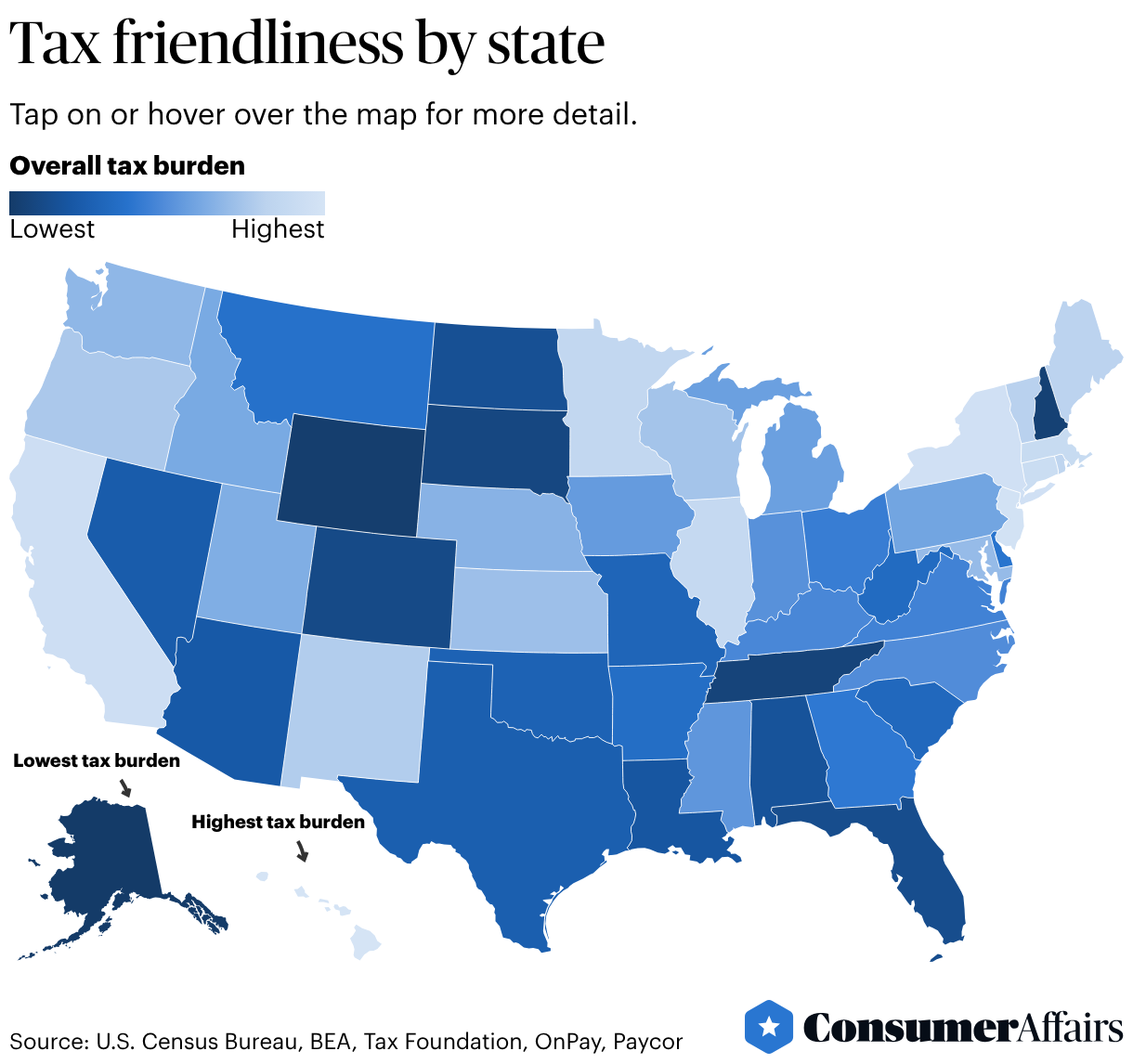
Notably, the two states that rank at the extremes of tax-friendliness are also at geographical extremes: Alaska (ranked No. 1 for tax friendliness) and Hawaii (ranked No. 1 for least tax-friendly).
Below the map, read on for a closer look at the five states that present the lowest tax burden to a typical resident.
1. Alaska
The Last Frontier leads the list of most tax-friendly states. Residents benefit from no state income tax, no sales tax and a relatively low burden for property taxes and the other categories we measured.
This doesn’t mean it’s the cheapest state to call home — Alaska’s cost of living is higher than average, especially when it comes to groceries and utilities. But the tax burden overall is much lower than in other states, which means a lot more money stays in Alaskans’ pockets to spend as they choose.
Alaska is unique in another regard: It’s the only state with no statewide sales tax that allows local municipalities to levy their own. But this could soon change. In January 2026, Gov. Mike Dunleavy proposed a 4% statewide sales tax in the summer, falling to 2% in the winter, in order to help address a projected statewide budget deficit.
2. Wyoming
All hat and no cattle? Not so when it comes to taxes in the Cowboy State. Wyoming ranks second best for tax friendliness, with no income tax and low to moderate taxes in other categories. There is a general statewide sales tax, but at only 4%, it’s one of the lower non-zero tax rates among all of the states.
Wyomingites catch a break on goods like alcohol, tobacco and gasoline. Wyoming has the lowest beer tax in the country (2 cents per gallon). If you’re drinking the harder stuff, even better luck: Distilled spirits are subject to zero excise tax.
Wyoming also boasts low property taxes. Property taxes represent just 2.6% of a median household income, a manageable burden for many homeowning households.
3. New Hampshire
The third most tax-friendly state is New Hampshire. With 0% state sales tax and minimal excise taxes, residents save significantly on taxes whenever they spend in the Granite State.
Unlike the other top-ranked states, New Hampshire had a limited income tax in 2024. The 3% rate applied only to interest and dividend income — not wages — making it one of the lowest and narrowest income taxes in the country. That tax generated just $183.4 million in revenue in 2024, accounting for only 0.2% of the state’s total personal income.
As of Jan. 1, 2025, New Hampshire fully repealed this tax, bringing its income tax rate to 0%.
4. Tennessee
Tennessee is the fourth most tax-friendly state, offering residents a place to live with no state income taxes and low to moderate taxes in other categories.
Tennessee actually has one of the highest sales tax rates in the country (7%) — only beaten by California (7.25%), one of the states ranked worst overall for tax burden. However, the Volunteer State balances the scales with significant tax breaks in other areas. The state’s property tax burden is tied for seventh lowest in our analysis.
One place that Tennesseans don’t catch a break? Their local watering hole. The state beer tax is $1.29 a gallon — the steepest in the country, and almost four times the national average. How’s that for a cold one?
5. South Dakota
Closing out the top five is South Dakota, which — like most states at this end of the ranking — has no state income tax. That helps keep the overall tax burden competitive.
Property taxes typically make up 3.8% of household income, slightly below the national average. In the excise tax categories we examined, South Dakota’s rates are all below U.S. averages, with beer (27 cents per gallon) and liquor ($4.93 per gallon) standing out as particularly low.
Sales taxes tell a slightly different story. While the statewide rate is a moderate 4.2%, the state’s sales tax burden (2.4%) is higher than the national average, accounting for about $1.7 billion of South Dakota’s roughly $70 billion in total personal income.
Lawmakers are now considering a proposal that would allow counties to adopt a sales tax of up to 0.5% to reduce property taxes for homeowners — a shift that could work in some homeowners’ financial favor.
The 5 least tax-friendly states
At the other end of the spectrum, residents in some states have to shoulder significant tax burdens. The states explored below often combine high income taxes with elevated property or sales taxes. Even states with a low tax rate in one category can rank poorly due to a cumulative burden across multiple tax types.
Four out of the five states below also have at least two of the “other taxes” we evaluated: inheritance or state taxes, state disability insurance taxes, and paid family leave payroll taxes.
Read on for a closer look at the five states with the largest tax burdens.
1. Hawaii
Residents of the Aloha State are no strangers to significant tax burdens. Hawaii ranks as the least tax-friendly state in America. It has the highest sales tax burden relative to personal income, at 4.7%, which is more than double the national average. Workers also face steep income tax rates (up to 11%, the second-highest rate in the country).
For residents who own a home, there is one bright spot. While Hawaii home prices are among the highest in the nation — and saving for a home may take decades — Hawaii boasts a relatively low property tax burden, as measured in comparison with the median household income.
Unfortunately, this isn’t enough to improve Hawaii's overall ranking. A high cost of living may further amplify the strain for residents with tight budgets.
2. New Jersey
Scoring just behind Hawaii is New Jersey, ranking second worst for tax friendliness. New Jersey stands out in the property tax category — in a bad way. It presents the steepest tax burden relative to income of all the states: the typical household has to spend 9% of its annual household income — over $9,300 on property taxes.
The Garden State also has an inheritance tax, a state disability insurance tax and a paid family leave tax — making it the only state other than Hawaii to have taxes in all three categories. It also ranks in the top half of states for income tax burden. On the flip side, it ranks in the bottom half of states for sales tax burden.
3. New York
Ranking third worst overall for tax friendliness is New York. Individual income taxes there present a steep burden to residents, with 3.2% of total personal income going to the government; that’s fifth highest in the U.S.
Statewide sales taxes measured against total household income are low, working in New York’s favor. But the Empire State still ranks near the top of the list in property tax burden, which represents 7.6% of income. It’s also the only state other than New Jersey that levies taxes in all three of the “other” categories we measured; residents are subject to an estate tax, as well as payroll taxes for state disability insurance and paid family leave.
4. California
The Golden State ranks fourth worst overall, but it takes the worst rank for several individual tax-friendliness metrics. California ranks first in heaviest income tax burden, with 3.6% of all household income going toward income taxes. Though tax brackets didn’t factor directly into our analysis, it’s worth noting that the state has the highest top marginal income tax rate in the nation (13.3%).
Residents are also subject to some of the steepest excise taxes, including the highest gas taxes in America — 71 cents a gallon, more than double the national average of 33 cents.
5. Connecticut
Connecticut joins New Jersey and New York as another Northeastern state where residents face heavy tax burdens.
While Connecticut’s income taxes are below average when measuring taxes collected against total household income, the property tax burden is third highest in the U.S. Nearly 7% of the typical household’s income goes toward real estate taxes; the only states that have higher rates are New York and New Jersey.
Smokers should also beware — the Constitution State levies one of the steepest taxes on cigarettes ($4.35 a pack).
How tax burdens compare by state
Outside of the highest and lowest ranks, where does the rest of the country fall?
The data tells a nuanced story. Some of the regional trends may not be surprising: In line with their tax-friendly reputation, Southern states rank mostly in the bottom half for overall tax burden, while Northeastern and coastal Western states are generally at the top of the list.
But across the country, some states with lower income tax burdens rank only in the middle of the pack overall due to higher sales taxes.
- Washington presents an interesting case: The Evergreen State ranks 17th for highest tax burden, even though it has no state income tax. The reason: Sales taxes are relatively high, and its excise taxes are the highest of all states in our analysis.
- Neighboring Oregon (13th-highest tax burden) presents a nearly opposite situation; residents benefit from no sales tax, but income taxes there add up to 3.2% of total household income, which is sixth highest in the U.S.
- Texas is a state where a $100,000 salary goes the furthest, no doubt in part because the Lone Star State ranks as 13th most tax-friendly. There are no state income taxes or inheritance or estate taxes, and excise taxes are low.
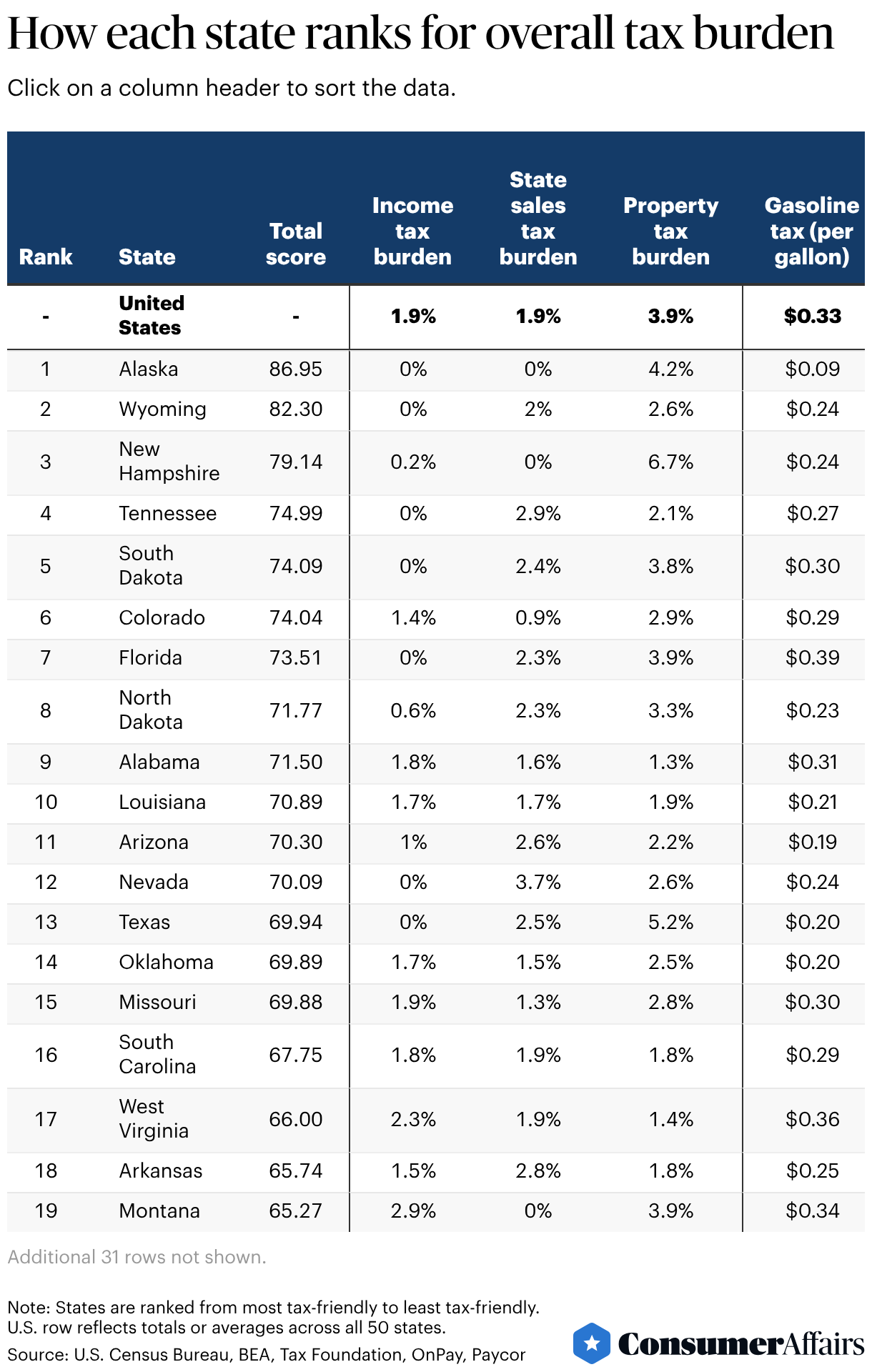
- Alabama (ninth friendliest) has the lowest property tax burden in the U.S. and lower-than-average income and sales tax burdens.
For complete data and rankings, check out the table below.
How to manage your taxes no matter where you live
You may not be able to control your state’s tax policies, but that doesn’t mean you can’t take an active role in managing your tax burden. Check out these tips to reduce your personal exposure and potentially lower your taxes.
- Take advantage of deductions and credits. The 2025 passage of the One Big Beautiful Bill Act meant significant changes to the federal tax code. Make sure you’re in the loop about the latest deductions or credits that you can apply to your 2025 taxes, and that you can use to your advantage as you plan for the year ahead.
- Contribute to retirement savings. Different retirement accounts offer different benefits, but saving for retirement with a tax-advantaged account is key. Every dollar of your paycheck that you put into a 401(k) reduces your taxable income, and Roth IRAs offer the benefit of tax-free growth.
- Enroll in an FSA or HSA. Like a 401(k), the money from your paycheck that goes into a flexible spending account (FSA) or health savings account (HSA) reduces the amount of money you’re being taxed on. Make sure you know the benefits and drawbacks of each — for example, FSA funds generally must be used by the end of the calendar year.
- Donate to charities. Sharing your wealth can lower your tax burden. Consider “bunching” major charitable contributions in a single year to make the biggest impact on your taxable income.
Methodology
To determine which states have the highest and lowest overall tax burden, ConsumerAffairs evaluated all 50 U.S. states across five weighted tax categories. For each metric, the state with the lowest tax burden received the maximum number of points, with other states earning relative scores. Category scores were combined to produce an overall tax burden score out of a maximum of 100 points. Higher scores indicate greater tax friendliness.
- Income tax burden (30 points): This score is based on state individual income tax collections as a share of total personal income (the sum of all income earned by residents in the state. Data is from the U.S. Census Bureau (2024) and the Bureau of Economic Analysis (2024).
- Sales tax burden (30 points): This category reflects combined state sales tax collections as a share of total personal income. This approach captures both tax rates and consumer spending patterns, which together determine the real-world sales tax burden. Data is from the U.S. Census Bureau (2024) and the Bureau of Economic Analysis (2024).
- Property tax burden (25 points): This score is calculated using median real estate taxes paid as a share of median household income. Data is from the U.S. Census Bureau (2024).
- Excise taxes (10 points): States were scored up to 2.5 points each based on taxes for gasoline, cigarettes, distilled spirits and beer. Data is from the Tax Foundation (2025).
- Other mandatory state and local taxes (5 points): This category reflects the presence of estate or inheritance taxes (2.5 points) and required employee payroll assessments, including state disability insurance and paid family leave taxes (1.25 points each). Data is from the Tax Foundation (2025), OnPay (2026) and Paycor (2026).
Reference policy
We love it when people share our findings! If you do, please link back to our original article to credit our research.
Questions?
For questions about the data or if you'd like to set up an interview, please contact dedens@consumeraffairs.com.
Article sources
ConsumerAffairs writers primarily rely on government data, industry experts and original research from other reputable publications to inform their work. Specific sources for this article include:
- U.S. Census Bureau, “Annual Survey of State Government Tax Collections Tables.” Accessed Feb. 22, 2026.
- Bureau of Economic Analysis, “Regional Data: GDP and Personal Income.” Accessed Feb. 22, 2026.
- U.S. Census Bureau, “B25103 | Mortgage Status by Median Real Estate Taxes Paid (Dollars).” Accessed Feb. 22, 2026.
- U.S. Census Bureau, “B19013 | Median Household Income in the Past 12 Months (in 2024 Inflation-Adjusted Dollars).” Accessed Feb. 22, 2026.
- Tax Foundation, “Gas Taxes by State, 2025.” Accessed Feb. 22, 2026.
- Tax Foundation, “Compare Tobacco Tax Data in Your State.” Accessed Feb. 22, 2026.
- Tax Foundation, “Distilled Spirits Taxes by State, 2025.” Accessed Feb. 22, 2026.
- Tax Foundation, “Beer Taxes by State, 2025.” Accessed Feb. 22, 2026.
- Tax Foundation, “Estate and Inheritance Taxes by State, 2025.” Accessed Feb. 22, 2026.
- OnPay, “SDI tax rates for 2026: State-by-state breakdown for employers.” Accessed Feb. 22, 2026.
- Paycor, “State’s Laws for Paid Family Leave.” Accessed Feb. 22, 2026.
- State of Alaska, “Governor Dunleavy Introduces Fiscal Plan Legislation.” Accessed Feb. 22, 2026.
- Tax Foundation, “Economic Implications of an Alaska Income Tax or Its Alternatives.” Accessed Feb. 23, 2026.
- State of New Hampshire, “Repeal of NH Interest and Dividends Tax Now in Effect.” Accessed Feb. 22, 2026.
- South Dakota Searchlight, “Governor-backed plan advances as Legislature continues to cull property tax reduction ideas.” Accessed Feb. 25, 2026.
Figures