FCC Rulings and Consumer Protections

This living topic covers the Federal Communications Commission (FCC) and its efforts to regulate and protect consumers in the telecommunications space. Key points include the FCC's proposed regulations on AI-generated robocalls and texts, the efficacy of the Do-Not-Call registry, and the challenges the FCC faces in enforcing consumer protection laws. Additionally, it highlights recent initiatives like Broadband Consumer Labels for clearer internet service information and the ongoing scrutiny of FCC's enforcement and regulatory procedures by governmental bodies. The overall theme is the FCC's role in balancing technological advancements with consumer protection and regulatory transparency.

Latest

States move to curb ‘surveillance pricing’ as consumer concerns grow

Policymakers call for more pricing transparency

Featured Political News photo

States including California, Colorado, and New York are advancing legislation aimed at limiting “surveillance pricing,” a practice in which companies use personal data to tailor prices to individual consumers.

Consumer advocates say the pricing models can quietly charge higher prices based on factors such as location, browsing history, income estimates, or shopping habits.

Businesses argue dynamic pricing improves efficiency and reflects market demand, but lawmakers are in...

Read Article
Featured Political News photo
2025
2024
2022
Article Image

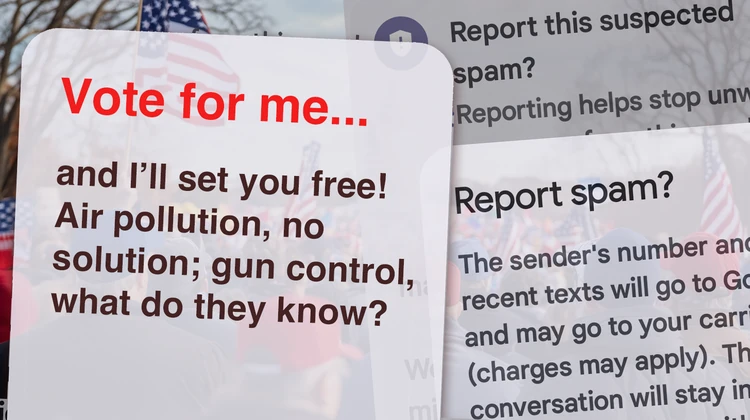
Phone companies that allow roboscam texts to be sent have been put on red alert

Like cockroaches, it appears that robobandits are hard to kill. A year ago, the Federal Communication Commission (FCC) had a firm grip on robocallers after it put a chokehold on carriers to put a stop to it or else.

Now, a year later “or else” has returned – this time, though, the FCC is giving carriers the stinkeye about allowing scam-oriented robotexts through to Americans’ phones. The agency has a pretty solid reason going for it, too. In the last year, robotexts have jumped from 1 billion to 15.6 billion a month.

The FCC has laid down the law to seven phone companies, telling them that they will be shut down for allowing scam robocalls on their networks if they don’t put a stop to the robotext scourge. This is a big shift for the FCC’s bedside manner – in fact, it’s the first time the FCC has made such a move.

In response to these developments, Teresa Murray, Consumer Watchdog for U.S. PIRG Education Fund praised the FCC's move. “The problem is not going to be solved in a day. But these are real developments.

“Bad guys will continue to go after our information and money. Scams are a chameleon-like problem with no end in sight. Robocalls are slowing while robotexts are skyrocketing. We still see phishing emails, which started more than 20 years ago, while targeted messages through social media are becoming a bigger menace.” 

What companies are included in the FCC’s demand? 

The FCC has put Akabis, Cloud4, Global UC, Horizon Technology Group, Morse Communications, Sharon Telephone Company, and SW Arkansas Telecommunications and Technology on notice.

Those companies have to show cause soon, too. The agency has given them 14 days to explain why it should not remove them from the database.

But what does “removal from the database” actually mean?

When ConsumerAffairs examined the FCC’s letter to Cloud4, it said if the company didn’t straighten up its act by the end of those two weeks, “all calls from Cloud4’s customers would be blocked and therefore no traffic originated by Cloud4 would reach the called party.”

“This is a new era. If a provider doesn’t meet its obligations under the law, it now faces expulsion from America’s phone networks,” FCC Chairwoman Jessica Rosenworcel said in announcing the move.

“Fines alone aren't enough. Providers that don't follow our rules and make it easy to scam consumers will now face swift consequences.”
2021
Article Image

Facebook doubles down on promise to get out of politics

Facebook has pledged to depoliticize Facebook… again. 

In a quarterly earnings call, Facebook reaffirmed that it’s not going to talk politics anymore. Company CEO Mark Zuckerberg said that Facebook is taking a hard look at how it can reduce the amount of political content that users see in their News Feed. 

“One of the top pieces of feedback that we’re hearing from our community right now is that people don’t want politics and fighting to take over their experience on our services,” Zuckerberg vowed, doubling down on the social media giant’s promise to ratchet down political content on the platform following the uprising at the U.S. Capitol on January 6. 

Zuckerberg also announced that Facebook is getting out of the civic and political group recommendation business altogether -- a move made permanent after the company temporarily paused recommending those groups to U.S. users in October as it got ready for the 2020 U.S. elections. 

True or false?

Zuckerberg has made similar promises before, but he couched the new line the company is taking as a “continuation of work we’ve been doing for a while to turn down the temperature and discourage divisive conversations.”

Contrary to Zuckerberg’s claims, nonprofit news site The Markup said it found that Facebook continued to recommend political groups to its users throughout December and on into the new year.

“We found 12 political groups among the top 100 groups recommended to the more than 1,900 Facebook users in our Citizen Browser project, which tracks links and group recommendations served to a nationwide panel of Facebook users,” found The Markup’s Leon Yin and Alfred Ng. “Our data shows Facebook also continued to recommend political groups throughout January, including after it renewed its promise not to on Jan. 11.”

Caught in the headlights, Facebook had no real answer other than saying it would look into the matter.

“We have a clear policy against recommending civic or political groups on our platforms and are investigating why these were recommended in the first place,” Facebook spokesperson Kevin McAlister wrote in response to The Markup’s findings.