Moving to Puerto Rico Statistics (2026)

+2 more


In 2023, Puerto Rico saw its first positive net migration since the COVID-19 pandemic. This migration signals renewed interest for both mainland Americans and returning Puerto Ricans — especially after the devastating effects of Hurricane Maria in 2017. While San Juan remains popular, new migration patterns to inland mountain towns like Barranquitas, Naranjito and Aibonito are reshaping the island. In fact, more and more U.S. citizens are starting to consider Puerto Rico for its tax incentives and comfortable weather.
Moving from the U.S. is generally straightforward, but it still requires planning for housing, work and utilities. Using a moving company familiar with long-distance relocations can make the process smoother.
Key insights
Approximately 23,588 people moved to Puerto Rico in 2023, marking a 12.6% decrease in the number of movers from the year prior (26,989).
Jump to insightPuerto Rico has 3,203,295 residents as of 2024, ranking 33rd in the U.S. in terms of population size.
Jump to insightThe median rent in Puerto Rico is $580, and the median home sale price is $290,000.
Jump to insightPuerto Rico’s cost-of-living index is 102.5, ranking 35th in the U.S. and making the state more expensive than the national average.
Jump to insightHow many people move to Puerto Rico?
In 2023, an estimated 23,588 people moved to Puerto Rico — the first positive net migration (1,872 people) since the pandemic. That means more people moved to the island than moved away. The U.S. Census estimates positive net migration for 2024 as well — approximating an impressive 15,204 people.
However, the territory still lost population, due to having more deaths than births. In fact, Puerto Rico has consistently had more deaths than births since 2016. Between 2022 and 2023, the population declined by 14,422, or 12.6%.
Top 5 cities that people move to in Puerto Rico
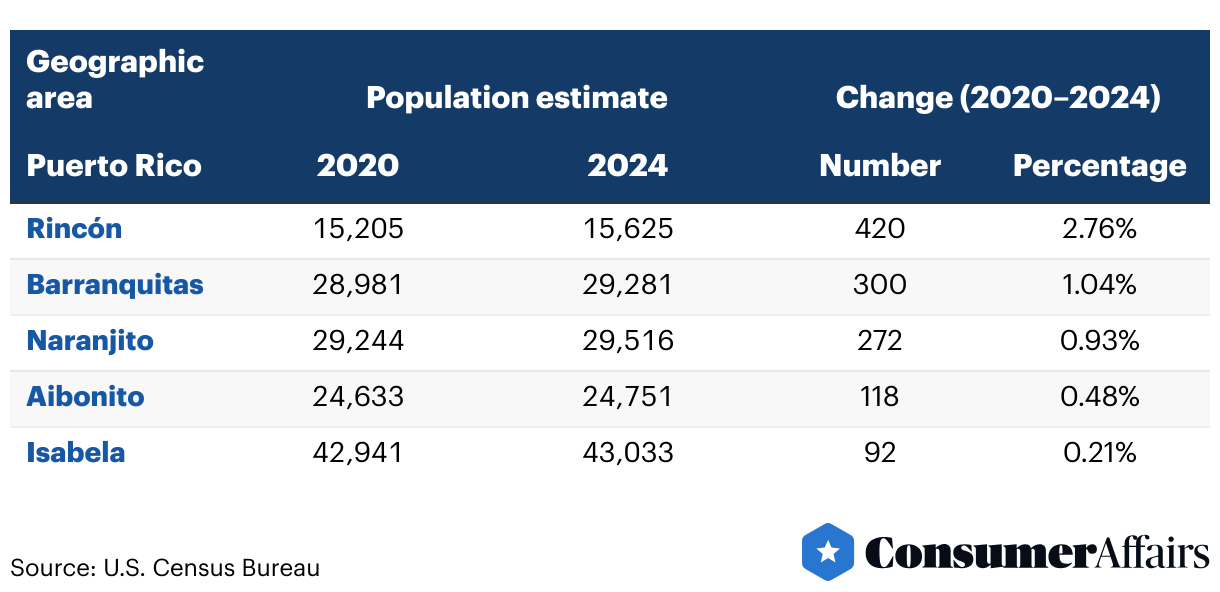
While many movers will choose one of Puerto Rico’s larger cities, including San Juan, Bayamón and Carolina, those aren’t the cities with the fastest-growing populations. Instead, a small town on the island’s west coast known as Rincón — a surfing and tourism hotspot — saw the highest population increase between 2020 and 2024 (420 people or a 2.76% increase).
Most of the other cities and towns that gained population are located in the mountainous regions south of San Juan, including Barranquitas, Naranjito and Aibonito. In part, net migration here is the result of people leaving major metropolitan areas like San Juan in search of economic stability and safety from tropical storms.
The top five cities people moved to in Puerto Rico between 2020 and 2024 were as follows:
Why do people move to Puerto Rico?
Stateside movers relocate to Puerto Rico for a variety of reasons, including:
Tax incentives
Puerto Rico is a great relocation option for businesses and individual investors, as the island’s Act 60 tax incentives provide numerous benefits. Qualified movers can take advantage of a 4% fixed income tax rate, 100% exemption on capital gains, 75% exemption on property taxes and a 50% reduction on municipal license taxes. Eligible activities include export services, manufacturing, finance, technology and tourism. Plus, incentive decrees can last up to 15 years, providing long-term financial stability for investors.
Easy moving process
Regardless of where you currently live, moving to Puerto Rico is easy if you’re a U.S. citizen. U.S. citizens can work, buy property and even start their own business without a passport or special visa. The process is as simple as relocating to another U.S. state — no customs checks, immigration paperwork, or currency exchange required. However, do keep in mind you may need federal and local licenses or permits for some activities.
Tropical marine climate
While it may not be easy to measure statistically, many people simply choose Puerto Rico because they love the climate. The island offers warm, tropical weather with temperatures ranging from 70 to 90 degrees Fahrenheit, without the same humidity you’d find in Florida. You’ll also have access to stunning beaches, beautiful mountains and even bioluminescent bays.
Rich cultural heritage
With a vibrant mix of Spanish, African and native Taino culture, Puerto Rico has a thriving musical, artistic and culinary heritage. Old San Juan and other cities’ historic and colorful streets showcase the island’s gorgeous architecture, while festivals like La Fiesta de San Sebastián, Noche de San Juan and Carnaval Ponceño celebrate rich musical and dancing traditions. Not a fan of dancing? Try beloved and flavorful dishes like mofongo, lechón asado and arroz con gandules.
Remote work opportunities
In 2024, Puerto Rico passed Act 27-2024, which is meant to facilitate more remote work in the private sector. Under this new law, eligible remote workers — including executives, administrators and professionals domiciled in Puerto Rico — can have their employment governed by the contract they have with their employer outside the island, rather than local employment laws. This simplifies the relocation process for remote workers.
Puerto Rico housing statistics
Puerto Rico has more affordable housing than the contiguous U.S., especially when it comes to rental options. The average rent on the island is only $580 per month, though you can expect to pay more in popular cities like San Juan.
Housing is also more affordable than in many U.S. states. Despite sharply rising prices within the past few years, the 2025 median home sale price of $290,000 is still 31% less expensive than the U.S. median of roughly $420,000.
Pros and cons of moving to Puerto Rico
Before you decide to move to Puerto Rico, it’s important to understand the unique pros and cons of living there. After all, while U.S. citizens can make the move with little impediment, that doesn’t mean they’ll be prepared for the culture shock, as well as frequent tropical storms. Here are some important factors to consider before you commit:
Pros
- Low taxes and savings for entrepreneurs through Act 60
- Easy move for U.S. citizens — no passport or visa needed
- Warm weather and beautiful beaches year-round
- Rich culture with great food, music and festivals
- New laws supporting remote work
- Lower housing costs than the U.S. average
- Uses the U.S. dollar and legal system
- Increased migration has stimulated job and business growth
Cons
- Aging infrastructure and an unreliable grid, leading to frequent power outages
- Underfunded and deteriorating roads, tap water and bridges
- High utility and other energy costs due to a reliance on imported fossil fuels
- Large public debt leading to economic instability
- Vulnerability to hurricanes, tropical storms and earthquakes
How to move to Puerto Rico
As mentioned, moving to Puerto Rico as a U.S. citizen is a simple and straightforward process — though you should still brush up on your Spanish. We also recommend finding accurate local information from trusted websites.
For example, non-citizens should follow this carefully outlined checklist:
- Learn Spanish: While English is widely spoken in Puerto Rico and considered an official language, Spanish is the primary language for daily life, business and local government. We recommend taking at least a few months to learn the basics before you relocate.
- Apply for a visa: Non-US citizens must obtain a valid visa through the U.S. federal government to move, just as they would to any U.S. state. Visit travel.state.gov for visa options and application details.
- Find housing: With affordable land and several rental options under $600, it shouldn’t be too difficult to find housing near your new employer. You can explore properties on sites like Zillow and Realtor.com.
- Ship your belongings: Ship your belongings with US-based carriers. Since Puerto Rico is a U.S. territory, no customs forms are required for personal goods.
- Get a green card: If you plan to live in Puerto Rico long-term and aren’t a U.S. citizen, apply for lawful permanent residency through uscis.gov.
- Set up banking & healthcare: Most U.S. banks operate in Puerto Rico, but check if your bank has local branches. If not, consider opening an account with a nearby bank. You can register for healthcare coverage under Puerto Rico’s public or private systems (salud.gov.pr).
- Obtain a driver’s license: If you have a U.S. license, you can use it temporarily, but after 30 days you’ll need to transfer it to a Puerto Rican license through the Department of Transportation and Public Works (dtop.pr.gov).
Overall, moving to Puerto Rico is no more of a hassle than moving to one of the states, but you should be mindful of language barriers and cultural differences. However, once you’re established you can enjoy tropical weather, low taxes and a growing business sector.
Article sources
ConsumerAffairs writers primarily rely on government data, industry experts and original research from other reputable publications to inform their work. Specific sources for this article include:
- "American Community Survey (ACS)." United States Census Bureau. Evaluated Oct. 10, 2025.
- "Net International Migration Drives the Highest U.S. Population Growth in Decades." United States Census Bureau. Evaluated Oct. 10, 2025.
- "The Causes and Consequences of Puerto Rico’s Declining Population." Federal Reserve Bank of New York. Evaluated Oct. 10, 2025.
- "Puerto Rico Municipios Population Totals: 2020-2024." United States Census Bureau. Evaluated Oct. 10, 2025.
- "Puerto Rico’s 2020 Population Decennial Analysis." Center for Puerto Rico Studies. Evaluated Oct. 10, 2024.
- "Tax Benefits & Policy." Invest Puerto Rico. Evaluated Oct. 10, 2025.
- "Foreigners." Department of State Government of Puerto Rico. Evaluated Oct. 10, 2025.
- "Weather and Climate of Puerto Rico." Welcome to Puerto Rico. Evaluated Oct. 10, 2025.
- "Tourism." Puerto Rico Tourism Company. Evaluated Oct. 10, 2025.
- "A-27-2024 Trabajo a Distancia en la Empresa Privada." Departamento del Trabajo. Evaluated Oct. 10, 2025.
- "Median Sales Price of Houses Sold for the United States." FRED. Evaluated Oct. 15, 2025.
- "Puerto Rico Grid Recovery and Modernization." U.S. Department of Energy. Evaluated Oct. 10, 2025.
- "Disaster governance, energy insecurity, and public health in rural Puerto Rico: how communities resist political abandonment." National Library of Medicine. Evaluated Oct. 10, 2025.
- "Puerto Rico: A U.S. Territory in Crisis." Council on Foreign Relations. Evaluated Oct. 10, 2025.
Figures