Moving to Mississippi Statistics (2026)

+1 more


In 2023, having the lowest cost-of-living index in the U.S. allowed Mississippi to attract 64,610 movers, staving off another year of population decline. While this state isn’t one of the most popular move-in destinations right now, median home sale prices over 40% below the national median and low property taxes help attract new residents.
However, though moving to Mississippi offers financial advantages, the state’s education, health care and economic challenges rank it as only the 42nd best for relocation. Of those choosing to move here, the vast majority are settling in suburbs near Jackson and Memphis in search of job opportunities. To make the most out of your move to one of these destinations, or anywhere else in Mississippi, we’ve gathered some essential moving statistics.
Key insights
An estimated 64,610 people moved to Mississippi in 2023, marking a 7.6% decrease in the number of movers from the year prior (69,948).
Jump to insightAs of 2023, Mississippi has 2,939,690 residents, ranking 35th in the nation in terms of population.
Jump to insightIn 2024, the median rent in Mississippi is about $1,370, and the median home sale price is $242,500. This means the median Mississippi home is 42% more affordable than the U.S. median of $420,400.
Jump to insightMississippi’s cost-of-living index is 85.3, making it the most affordable state in the nation.
Jump to insightMississippi ranked as the 42nd best U.S. state to move to in 2024.
Jump to insightHow many people move to Mississippi?
Approximately 64,610 people moved to Mississippi in 2023, while 61,833 moved out. This represents a small net gain of 2,777 residents. Roughly six people moved to the state per day between 2022 and 2023 — just barely enough to offset out-migration.
A majority of those moving to Mississippi are international migrants, rather than domestic ones. According to a recent ConsumerAffairs study based on a sample of 143,506 ConsumerAffairs.com users who expressed an interest in moving between January 2023 and March 2024, Mississippi ranked as the 22nd most desired state to move to.
Top 5 cities that people moved to in Mississippi
Mississippi ranked as the 42nd best U.S. state to move to in 2024, as its poor economy, education and health care scores hold it back. However, the state does offer exceptional affordability and respectable safety.
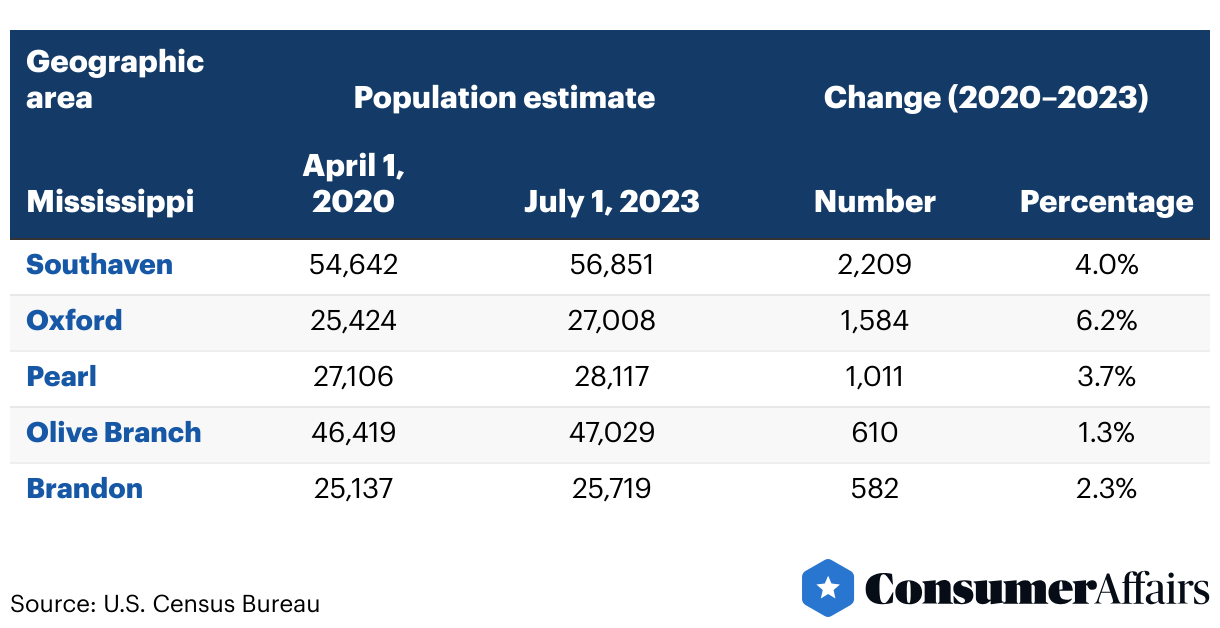
Of those choosing to move to the Magnolia State, the majority are relocating to suburbs outside of Jackson or Memphis. Southaven — a Memphis suburb — attracted the most new residents, adding 2,209 (4% growth) between 2020 and 2023. Olive Branch — a small town in Northern Mississippi — happened to experience the fastest growth, growing by 6.2% within that same period.
Pearl and Brandon — both suburbs of Jackson — were also popular, attracting 1,011 and 582 new residents, respectively.
Overall, the top five cities in Mississippi people moved to between 2020 and 2023 are as follows:
Why do people move to Mississippi?
The majority of movers choose Mississippi for its affordability and tax benefits, as median home prices and property taxes are well below the national average. The state also has the lowest cost-of-living index in the nation.
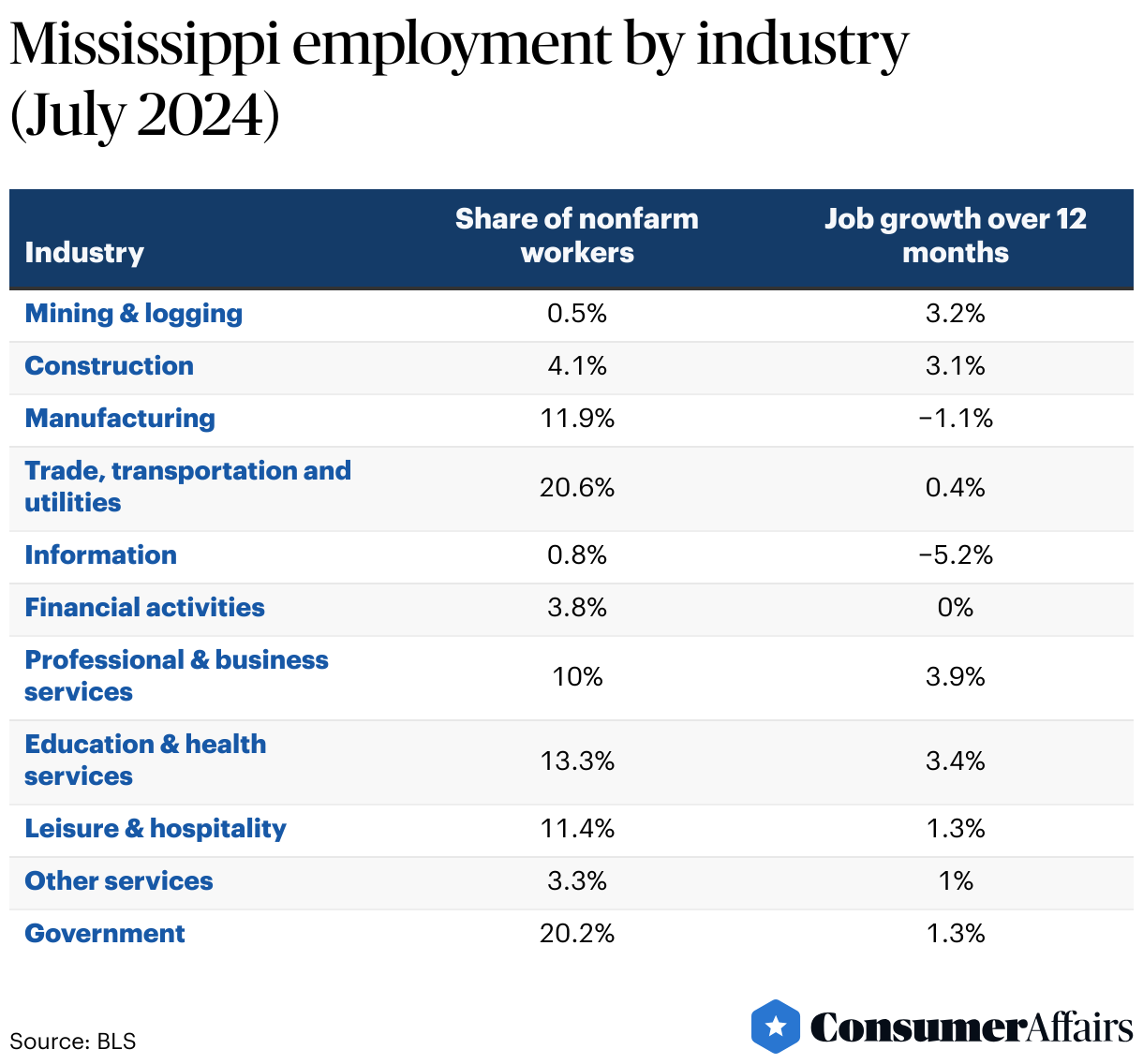
However, many young professionals are also attracted to the combination of job opportunities and communal culture. The largest industries in the state are trade, transportation, and utilities, government, and education and health. Collectively, these industries employ just over 54% of nonfarm workers. The fastest-growing industry in the state is professional and business services, growing by 3.9% between July 2023 and July 2024.
Mississippi housing statistics
With a median rent price of $1,369.59 and a median home sale price of $242,500, Mississippi renters and homeowners can expect to pay a significant 42% less than the national median for housing.
Mississippi also has the 14th lowest property tax rate in the U.S. at 0.67%. The tax rate here is at least half that of 15 states, including Kansas. In 2021, the most expensive county was Madison County, where residents paid an average of $1,715 in property taxes. Conversely, the most affordable county was Amite County, where residents paid as little as $410 that same year.
Cost-of-living statistics in Mississippi
Mississippi’s cost-of-living index is 85.3, making it the most affordable state in the union. The cost of gas per gallon ($2.94) follows this affordability trend, being one of the cheapest in the nation at nearly 10% less than the national average. The state’s proximity to major Gulf Coast oil production helps improve prices but also prevents it from becoming a more green state.
Though Mississippi does have a lower-than-average cost of living, the state’s median household income is also one of the lowest in the nation ($52,658). That means the typical household here earns more than 30% less than the national median of $75,358. Luckily, unemployment is significantly lower (2.8%) than the national average of 4.2%.
In general, Mississippi may be an excellent choice for anyone moving from a more expensive area. However, a very low median household income can be a considerable challenge for would-be movers and jobseekers.
Who lives in Mississippi?
An estimated 2,939,690 people live in Mississippi as of 2023, making it the 35th largest state in terms of population. This represents a population increase of 762 people compared to 2022, mostly due to international migration.
Mississippi’s population skews female, with women accounting for 51.5% and men accounting for 48.5% of residents. In 2023, approximately 1.51 million Mississippi residents were female, and 1.43 million were male.
On average, Mississippi's population is also slightly younger (38.7 years old) than the U.S. average of 38.9 years. The largest age demographic in the state is those between 25 and 44 years old, accounting for 25.2% of the population.
White residents account for the largest share of Mississippians, representing 58.7% of the population (1.73 million people). The state also has the largest share of Black residents as a portion of the total population in the U.S., representing 37.8% (about 1.1 million people). This is followed by a much smaller share of Hispanic residents — 7.3% of the population.
Tips for moving to Mississippi
Not sure how to start your move to Mississippi? Consider these step-by-step moving tips:
1. Understand the cost of living
With the lowest cost-of-living index in the United States and median home sale prices over 40% below the national average, affordability isn’t an issue for Mississippi. However, overall costs will still vary by location and may be more of a challenge than expected when you consider the low median household income. Whether you plan on moving to the northern forests or southern Gulf Coast, you can learn more about what to expect on MS.gov.
2. Learn about the job market
From shipbuilding and oil refinery on the Gulf Coast to agriculture on the Mississippi River, the Magnolia State is an industrial hub with a low unemployment rate. However, given the low median household income, it’s important to analyze the highest-paying opportunities available to you before making a move. You can visit online job boards or the Mississippi Department of Employment Security website for local employment information.
3. Prepare for the subtropical climate
Mississippi’s southern location on the Gulf Coast endures long, humid summers and typically mild winters. Severe storms are common in the warmer months, while occasional freezing temperatures are possible in the winter. To stay comfortable, we recommend investing in weather-appropriate clothing, maintaining good HVAC systems and staying informed about changing weather conditions. The National Weather Service is a great resource for forecasts and emergency alerts.
4. Be aware of natural hazards
Mississippi sits in a hot spot for severe weather, experiencing both hurricanes and tornadoes. Hurricane season runs from June through November, with cities along the Gulf Coast being the most vulnerable. Tornadoes are also a threat in spring time, especially between March and May. If you’re thinking of purchasing a home in the Magnolia State, consider checking flood zone maps and looking into home insurance rates before you move. The Mississippi Emergency Management Agency website is a great resource for information and emergency planning.
5. Understand transportation options
While Jackson and the suburbs surrounding Memphis offer public transportation in the form of bus routes, most of Mississippi is car-dependent. From highways to rural gravel roads, we recommend a personal vehicle for easy travel around the Magnolia State. Check traffic updates and road conditions on the Mississippi Department of Transportation website.
6. Embrace Deep South culture
When determining who has the right to hold the title of a Deep South state, Mississippi can never be called into question. From its legendary cuisine and blues music to stunning Gulf Coast beaches, this state is steeped in Southern hospitality and culture. To learn more about the state’s historical attractions and cultural events, check out Visit Mississippi.
7. Understand mover quotes and tipping
When moving to Mississippi, carefully review and compare moving company quotes. Be sure to account for potential additional fees depending on where you’re relocating to. Tipping movers is customary; a tip of 10% to 20% of the total cost is standard based on the quality of service.
Article sources
ConsumerAffairs writers primarily rely on government data, industry experts, and original research from other reputable publications to inform their work. Specific sources for this article include:
- United States Census Bureau, “State-to-State Migration Flows.” Accessed Feb. 13, 2025.
- United States Census Bureau, “State Population Totals and Components of Change: 2020-2023.” Accessed Feb. 13, 2025.
- Tableau Public, “Redfin Data Center.” Accessed Feb. 13, 2025.
- FRED Economic Data, “Median Sales Price of Houses Sold for the United States.” Accessed Feb. 13, 2025.
- World Population Review, “Cost of Living Index by State 2024.” Accessed Feb. 13, 2025.
- Tampa Bay EDC, “2022-2023 State Net Migration.” Accessed Feb. 13, 2025.
- United States Census Bureau, “City and Town Population Totals: 2020-2023.” Accessed Feb. 13, 2025.
- Tax Foundation, “Property Taxes by State and County, 2023.” Accessed Feb. 13, 2025.
- U.S. Bureau of Labor Statistics, “Economy at a Glance.” Accessed Feb. 17, 2025.
- AAA, “National Average Gas Prices.” Accessed Feb. 17, 2025.
- U.S. Energy Information Administration, “Oil and petroleum products explained.” Accessed Feb. 17, 2025.
- United States Census Bureau, “Household Income in States and Metropolitan Areas: 2022.” Accessed Feb. 17, 2025.
- U.S. Bureau of Labor Statistics, “Local Area Unemployment Statistics.” Accessed Feb. 17, 2025.
- United States Census Bureau, “State Population by Characteristics: 2020-2023.” Accessed Feb. 17, 2025.
- United States Census Bureau, “America Is Getting Older.” Accessed Feb. 17, 2025.
- MS.gov, “Welcome to the State of Mississippi Citizen Portal.” Accessed Feb. 17, 2025.
- Mississippi Department of Employment Security, “Homepage.” Accessed Feb. 17, 2025.
- National Weather Service, “NWS Forecast Office Jackson, MS.” Accessed Feb. 17, 2025.
- Mississippi Emergency Management Agency, “Homepage.” Accessed Feb. 17, 2025.
- Mississippi Department of Transportation, “Homepage.” Accessed Feb. 17, 2025.
- Visit Mississippi, “The Birthplace of America’s Music.” Accessed Feb. 17, 2025.
Figures