Lowest-cost-of-living States in the U.S. (2026)

+2 more



With the possibility of new tariffs raising the costs of everyday necessities, Americans are preparing for financial impacts. Couple that with news of widespread layoffs, and some Americans are opting to move to parts of the country where the cost of living is lower. Whether you’re looking to buy a home or simply save more money, your dollar goes further in some states than others.
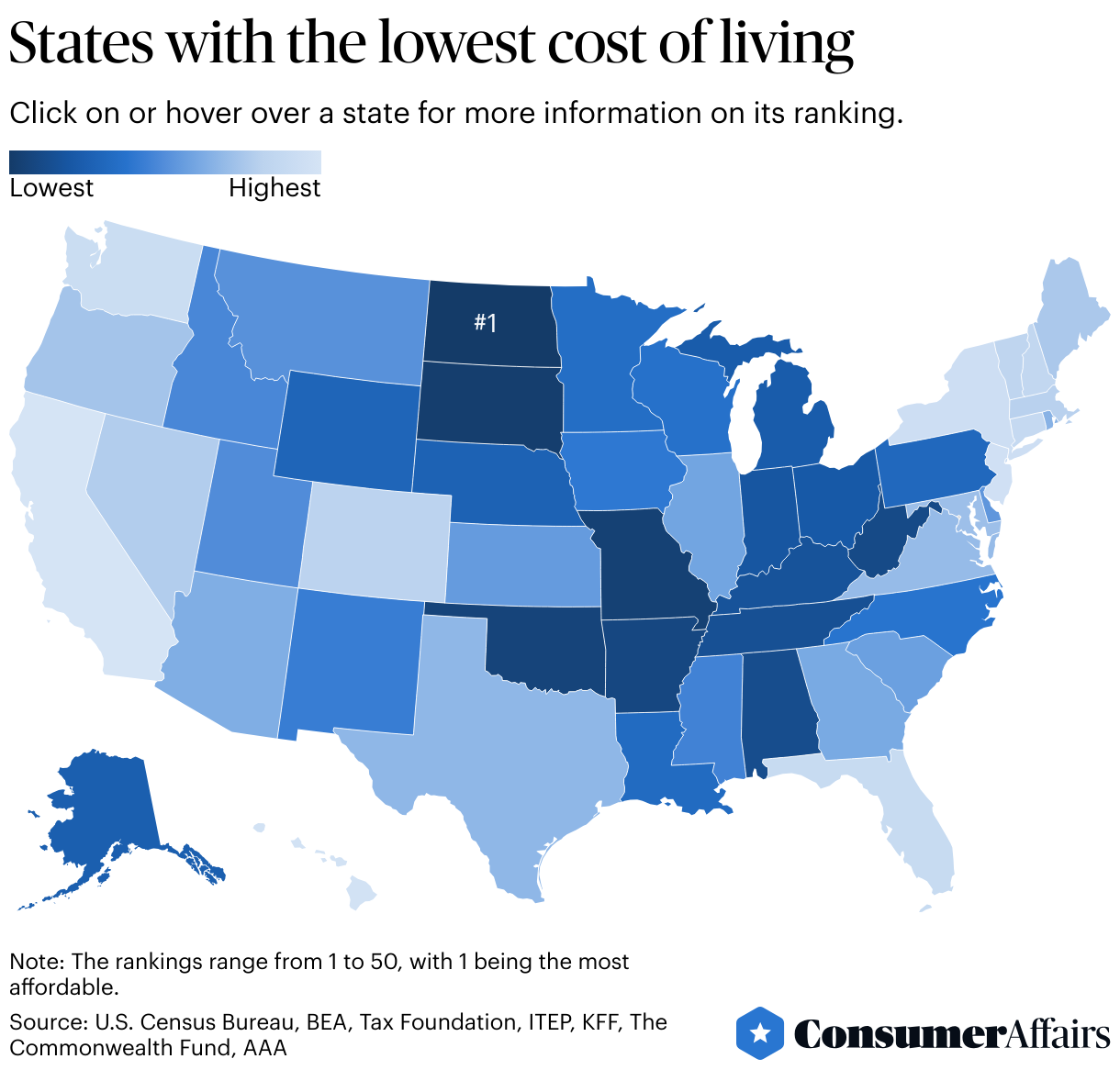
To better understand the cost of living in different parts of the United States, the ConsumerAffairs Research Team ranked all 50 states by cost of living, considering housing costs, tax burden, grocery spending, out-of-pocket health care costs, gasoline costs and purchasing power.
Key insights
The Dakotas lead the nation in affordability, with North Dakota having the lowest cost of living overall and South Dakota ranking No. 2.
Jump to insightSix of the 10 most affordable states are in the South, while the other four are in the Midwest..
Jump to insightCalifornia is the most expensive state, followed by Hawaii and New Jersey.
Jump to insightThe most expensive states to live in are largely clustered in the Northeast and West, with only one Southern state making the list: Florida.
Jump to insightThe 10 most affordable states
Many Americans feel the squeeze of rising prices, but their paychecks could stretch further in some places than others. With affordability a priority for many Americans, these states could be ideal for anyone looking to save a few (or more) dollars: from housing to groceries to gas, these 10 states rank among the most affordable for essential costs. Our analysis found that the most affordable states were clustered in the South and the Midwest.
1. North Dakota
81.92 out of 100
North Dakota tops our list due to the state’s low housing, grocery and gasoline costs, which ranked the most affordable among all states. And it seems like North Dakota is committed to holding on to that ranking when it comes to housing: a bipartisan bill in the state Senate would allocate $200 million to the state’s Housing Incentive Fund, which helps to create affordable multifamily housing.
Key findings:
- Affordable housing: North Dakotans spend just 13.6% of their budgets on housing and utilities, the lowest share in the nation. The state also has one of the lowest median two-bedroom rents in the U.S., at $934.
- Low gasoline costs: As a major oil state, North Dakota has some of the most affordable gas prices, averaging $3.27 per gallon of midgrade gas — about 10% below the national average. Residents also spend just 2% of their total budgets on gas, one of the lowest shares in the nation.
2. South Dakota
74.55 out of 100
The other Dakota came in second in our ranking. Like their northern counterparts, South Dakotans enjoy affordable housing and gasoline costs – plus, residents in the Mount Rushmore State have the third-highest purchasing power in the nation.
Despite affordability in some areas, South Dakota falls short when it comes to health care-related costs, with residents putting just over a fifth of their budgets into health care spending.
Important metrics:
- Strong purchasing power: South Dakota ranks third in purchasing power, trailing only Arkansas and Mississippi. The state’s regional price parity is 88.1, meaning the cost of goods is about 12% lower than the national average.
- Low gas prices: South Dakota residents pay almost 50 cents less than the national average of $3.61 for a gallon of midgrade gas.
3. Missouri
72.47 out of 100
Missouri residents can expect reasonable housing costs and a relatively low tax burden. That tax burden might be even lighter soon, as Missouri lawmakers are discussing a proposal that could eliminate income tax across the state.
Residents looking to save additional money will not find it in their gas costs: Missourians spend about 4% of their budgets on gas, about 56% more than the national average.
Some stats:
- Affordable rent: Missouri residents pay a median two-bedroom rent of $988 – $350 less than the national median.
- Low tax burden: The Show Me State has the 10th-lowest tax burden in the United States, with residents paying a low share of state, local and property taxes.
4. Oklahoma
71.45 out of 100
With strong purchasing power and a low tax burden, Oklahoma comes in fourth on our list. It’s also the first Southern state on our list.
Unfortunately, 13% of adults in Oklahoma went without medical care due to cost in 2023, the eighth-highest rate in the nation. That’s not surprising, given that it’s in the top 10 most expensive states for health care.
Key data callouts:
- Strong purchasing power: The Sooner State ranks fourth in the nation for purchasing power, just behind South Dakota, Mississippi and Arkansas. The cost of goods in Oklahoma is 11.7% lower than the national average.
- Affordable tax burden: Oklahoma residents have a per capita state and local tax burden of $4,527, fifth lowest in the country.
5. Arkansas
71 out of 100
Arkansas earns the distinction of having the strongest purchasing power in the United States, with a regional price parity of 86.5. Additionally, residents benefit from the second-cheapest two-bedroom rent in the nation.
Though residents may be saving on rent, Arkansas ranks second highest in percentage of budget spent on gas, at about 4%. Those looking to switch to electric vehicles to reduce gas costs may want to think twice, though, as Arkansas has one of the worst rankings for charging stations in the nation, at only 19 stations per 1,000 EVs.
Top data points:
- Top purchasing power: Arkansas boasts the best purchasing power in the nation. The state’s average cost of goods is about 13.5% less than the national average.
- Cheap rent: The median rent for a two-bedroom home in Arkansas is a mere $873 – a whopping $465 less than the national median.
6. West Virginia
70.68 out of 100
West Virginia has both the second-most affordable housing — including the lowest median rent — and the second-lowest tax burden in the U.S.
However, when it comes to groceries, the Mountain State is much less impressive: West Virginia ranks 47th in grocery spending. Additionally, West Virginians pay the highest percentage of their budgets on health care in the United States, at over 23%.
Key facts about West Virginia:
- Cheapest rent: West Virginia has the lowest median rent for a two-bedroom home, at only $869.
- Low tax burden: The middle 20% of West Virginian taxpayers pay a property tax rate of 1.7%, below the 3.1% paid across the country as a whole.
7. Alabama
69.83 out of 100
Alabama has the lowest tax burden in the nation, with the middle 20% of taxpayers paying the lowest property tax rate in the U.S. In 2024 the state passed a law that caps how much property taxes can increase. Alabama also has the fourth-cheapest two-bedroom rent in the country.
Though Alabama may have a low tax burden, health care costs can be a challenge: Alabama has the seventh-highest percentage of adults who went without medical care in 2023 due to cost, at 13.5%.
Top findings:
- Lowest tax burden: Alabamians enjoy the lowest tax burden in the country. Residents pay an average of $4,585 in state and local taxes each year, and the property tax rate is just 1.5%.
- Affordable rent: Alabamians can expect to pay a median of $913 on a two-bedroom home, $425 less than the national median.
8. Tennessee
68.53 out of 100
Tennessee ranks third across the nation in lowest tax burden. Residents also spend the 10th-lowest percentage of their budgets on groceries.
On the other hand, Tennesseans pay the third-highest average annual family health insurance premium for employer-based coverage: $8,128. Tennessee ranks as the third-most expensive state for health care in general.
Important metrics:
- Low tax burden: Tennessee has the third-lowest tax burden in the country, with residents paying an average of $4,036 in state and local taxes, over $1,700 less than the national average of $5,755.
- Grocery savings: Residents spend 7.2% of their budgets on groceries, a bit lower than the 7.7% paid by the average American.
9. Kentucky
68.07 out of 100
The Bluegrass State comes in fifth in affordable housing, a ranking that factors in the fifth-lowest two-bedroom rent in the United States. However, Kentuckians put some of what they’re saving on rent toward their grocery bills, as residents spend the sixth-highest share of their budgets on groceries.
Important points:
- Affordable housing: Kentuckians pay a median rent of $931 for a two-bedroom home, $400 less than the national median.
- Low property taxes: The middle 20% of Kentucky taxpayers pay a property tax rate of 2%; the national average is 3.1%.
10. Indiana
67.59 out of 100
The Hoosier State rounds out our top 10 states with the lowest cost of living. Indiana residents pay one of the lowest shares of income on housing. However, residents put about 3.3% of their budget toward gas, higher than the 2.5% spent by the average American.
Important metrics:
- Low share of income on housing: Indiana residents pay a median of 17.5% of their incomes on housing costs, lower than the national median of 20.4%
- Affordable rent: Residents pay a median rent of $1,030 on a two-bedroom home, about $300 cheaper than the national median.
What are the most expensive states?
Three out of the five most expensive states – California, New York, and Washington – are home to some of the most expensive cities in the country, including San Jose, San Francisco, San Diego, Seattle, Los Angeles and New York City. Though Hawaii and New Jersey may not have cities on that list, they join three other states outside the South and Midwest, which dominate the list of least expensive states.
- California
- Hawaii
- New Jersey
- New York
- Washington
Residents in all five of the most expensive states pay above-median rent costs, and they have higher-than-average state and local property tax burdens. New York has the cheapest rent of the five states, but the median two-bedroom rent is still $1,574, which is $236 higher than the national median.
The high costs in the four continental states may explain why each shows up in the top five states residents are considering moving from. Still, the states aren’t equally expensive across the board: Hawaii, for example, has the most affordable health care in the United States.
The cost of living in each state
Each state has pros and cons when it comes to affordability, with some states ranking high in one category and low in another. Explore the data below to see how your state compares.

Methodology
To determine the states with the lowest cost of living, the ConsumerAffairs Research Team compared all 50 states across six weighted categories. In each category, the state that performed the best was given the highest possible score, with others earning relative scores. We added the category scores together to get overall scores out of a maximum of 100 points.
- Housing costs (35 points): This category includes median rent for a two-bedroom home (15 points), median housing costs as a share of median income (10), and housing and utility spending as a share of per-capita expenditures (10). Data is from the U.S. Census Bureau and the Bureau of Economic Analysis and is from 2023.
- Tax burden (25 points): This category includes state and local tax burden per capita in 2022 (12.5 points) and property tax rates paid by the middle 20% of taxpayers by income in 2024 (12.5). Property taxes include taxes on homes, rent and motor vehicles. Data is from the Tax Foundation and ITEP.
- Grocery spending (15 points): This category measures grocery spending as a share of per-capita expenditures in 2023. It reflects the percentage of personal consumption expenditures devoted to food and beverages purchased for off-premises consumption. Data is from the Bureau of Economic Analysis.
- Out-of-pocket health care costs (15 points): This category includes health care spending as a share of per capita spending (5 points), the average annual family premium per enrolled employee for employer-based health insurance (5) and the percentage of adults in the state who went without medical care due to cost (5). Data is from the Bureau of Economic Analysis, KFF and The Commonwealth Fund from 2023.
- Gasoline costs (5 points): This category considers the state’s average per-gallon cost of midgrade gasoline on Feb. 7, 2025 (2.5 points) and gasoline spending as a share of per-capita spending by state residents in 2023 (2.5). Data is from AAA and the Bureau of Economic Analysis.
- Purchasing power (5 points): This category factors in the state’s 2023 regional price parity (RPP) to provide a broad measure of the overall cost of goods and services in a state relative to the national average. Data is from the Bureau of Economic Analysis.
For questions about the data or if you'd like to set up an interview, please contact acurls@consumeraffairs.com.
Reference policy
We love it when people share our findings! If you do, please link back to our original article to credit our research.
Article sources
ConsumerAffairs writers primarily rely on government data, industry experts and original research from other reputable publications to inform their work. Specific sources for this article include:
- U.S. Census Bureau, “Explore Census Data.” Accessed Feb. 17, 2025.
- Bureau of Economic Analysis, “Personal Consumption Expenditures by State, 2023.” Accessed Feb. 17, 2025.
- Tax Foundation, “Facts & Figures 2024: How Does Your State Compare?” Accessed Feb. 17, 2025.
- ITEP, “Who Pays? A Distributional Analysis of the Tax Systems in All 50 States.” Accessed Feb. 17, 2025.
- KFF, “Average Annual Family Premium per Enrolled Employee For Employer-Based Health Insurance.” Accessed Feb. 17, 2025.
- The Commonwealth Fund, “Adults who went without care because of cost.” Accessed Feb. 17, 2025.
- AAA Fuel Prices, “State Gas Price Averages.” Accessed Feb. 17, 2025.
- Bureau of Economic Analysis, “Regional Price Parities by State and Metro Area.” Accessed Feb. 17, 2025.
- Michigan News, “Consumer sentiment drops as inflation worries escalate.” Accessed Feb. 23, 2025.
- KVRR Local News, “Affordable housing plan in North Dakota draws broad support.” Accessed Feb. 17, 2025.
- KFVS12, “Missourians could stop paying income taxes soon, but everything comes at a price.” Accessed Feb. 17, 2025.
- 1819 News, “Ivey signs property tax increase cap into law.” Accessed Feb. 17, 2025.
Figures