What America’s Driving Habits Reveal About Road Safety (2026)

+1 more


You’re cruising along the highway on a beautiful afternoon. The radio is playing your favorite song, your seat belt is buckled, and your hands are at 10 and 2 on the wheel. Nothing can go wrong — in your car, at least. But what about when it comes to your fellow drivers? According to a new ConsumerAffairs survey, not everyone behind the wheel actually knows the rules of the road. (That’s a good sign to make sure your car is protected with a good auto warranty and car insurance.)
ConsumerAffairs surveyed 1,000 licensed U.S. drivers about their knowledge of traffic laws, driving confidence and safety habits. Questions covered topics such as written test readiness, opinions on retesting older drivers, knowledge of core road rules and more. Read our full methodology below.
Key insights
Almost half of drivers (46%) don’t know the legal blood alcohol content limit.
Jump to insightMany American drivers believe myths about the road — like the idea that it’s illegal to drive barefoot — but may not know real road rules.
Jump to insightAbout one in four drivers admits to texting behind the wheel.
Jump to insightThree out of four Americans believe drivers over age 70 should be retested before getting behind the wheel, either with a written exam, a driving test or both.
Jump to insightOne in four U.S. drivers admits to texting while driving
Ding, ding! That’s the sound of your phone alerting you to a new message from its spot in your car’s cup holder. But you’re halfway through your drive to the grocery store. So, do you check your text, or can you wait until the car is in park?
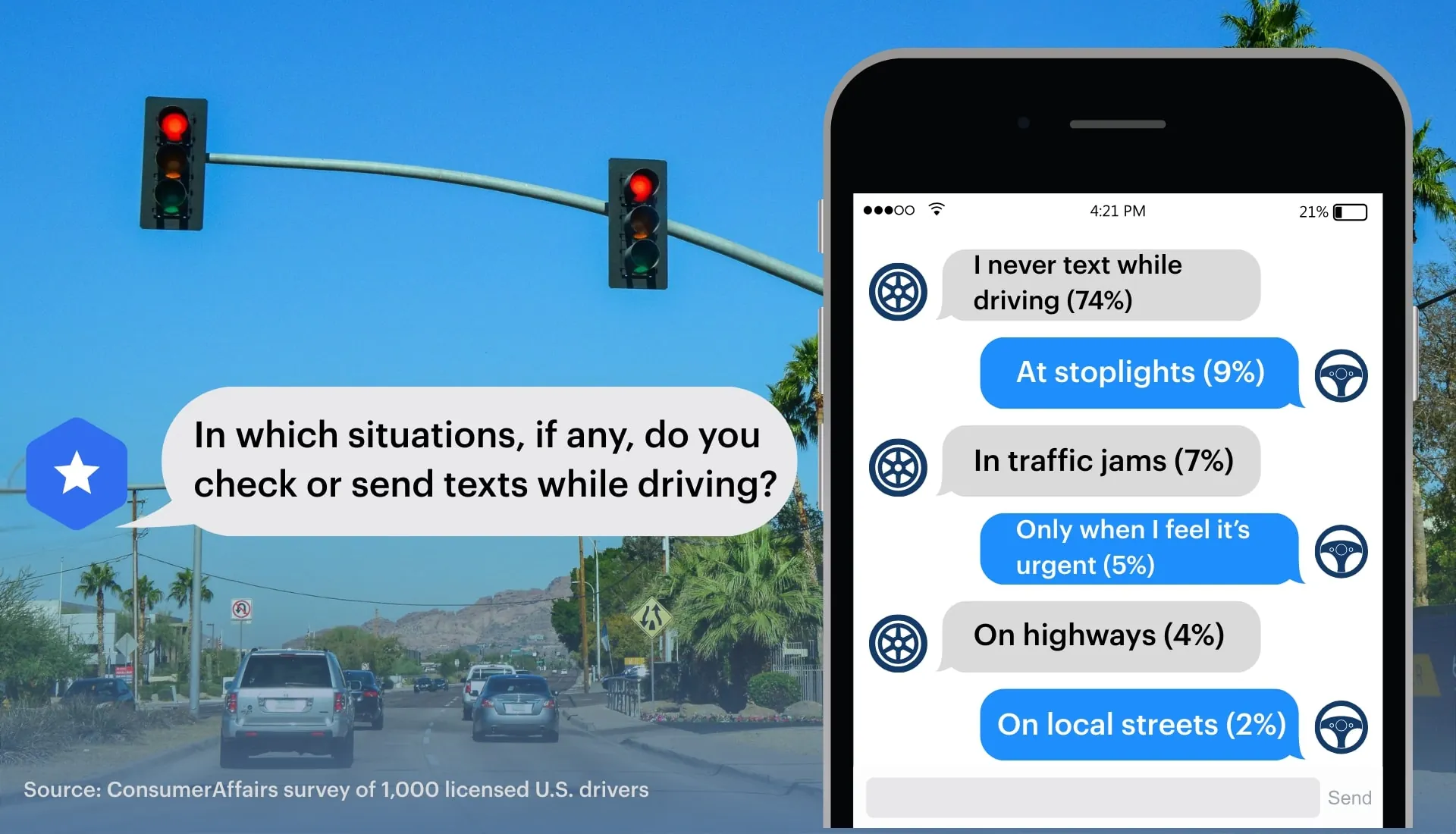
Our survey shows 74% of drivers claim they don’t text while driving, while 26% admit they do (at least sometimes). Here’s where these drivers tend to pull out their phones the most:
- At stoplights (9%)
- In traffic jams (7%)
- Only when they feel it’s urgent (5%)
- On highways (4%)
- On local streets (2%)
FWIW, if common text lingo confuses you, you’re not so likely to be texting and driving. Nearly all (97%) baby boomers say they never text and drive. (FWIW means “for what it’s worth,” BTW.)
Most drivers think driving a few miles over the limit is safe
Our survey also asked about how often drivers follow another common road rule: the speed limit. You may want to buckle your seat belt, because over 80% of drivers report speeding under certain conditions. Thirty-one percent of drivers speed on highways, 22% speed to keep up with traffic, and 10% speed if they’re late or in a hurry.
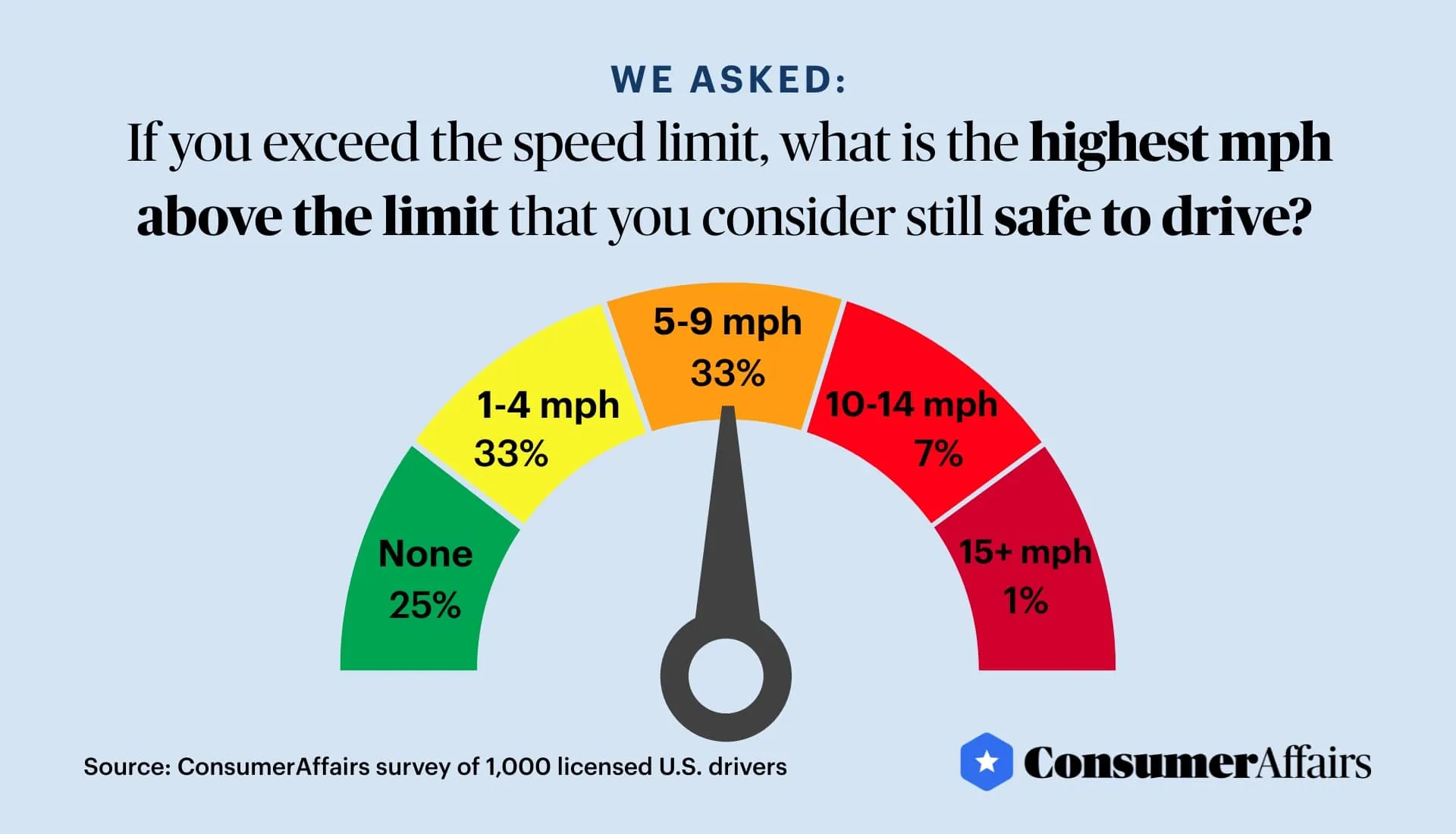
Most of these drivers aren’t true speed racers, though, preferring to stick to under 10 mph above the posted limit. When asked what’s still “safe” above the speed limit:
- 33% said 1 to 4 mph
- 33% said 5 to 9 mph
- 7% said 10 to 14 mph
- 1% said 15-plus mph
- 25% said none
Survey finds widespread confusion about basic road rules
Pop quiz: At a four-way stop, two cars arrive at the same time from opposite directions. The blue car is turning left, and the orange car is turning right. Who has the right of way?
Nearly one in five Americans can’t answer that question correctly. (Here’s the answer: The orange car has the right of way because it’s turning right.)
Here are some road rules we think are pretty important. Some drivers may need a refresher on their driver’s exam.
- The blood alcohol concentration (BAC) rule
- The rule: The legal blood alcohol concentration limit for drivers in most states is 0.08%.
- 46% of drivers think it’s a different BAC or aren’t sure of the answer.
- 59% of men correctly identify the legal limit versus 47% of women.
- The school bus rule
- The rule: Drivers must stop for a school bus flashing its lights, even if it’s in the other lane.
- 92% of drivers know it’s the law to stop for a school bus
- But 6% think you can proceed with caution. Think of the children!
- The dashed yellow line rule
- The rule: You’re allowed to pass another driver when you have a dashed yellow line closest to you on a two-lane road.
- 25% of drivers think you can’t pass on this type of road.
- 6% believe you can pass on a two-lane road at any time.
- The left lane rule:
- The rule: The left lane on the highway is for passing other cars.
- 36% of respondents say the left lane is the “fast lane.”
- 8% think the left lane has no special purpose, or is for driving at any speed.

Over half of Americans believe it’s illegal to drive barefoot
We just discussed drivers who don’t follow the rules. What about drivers who love rules so much, they make some up?
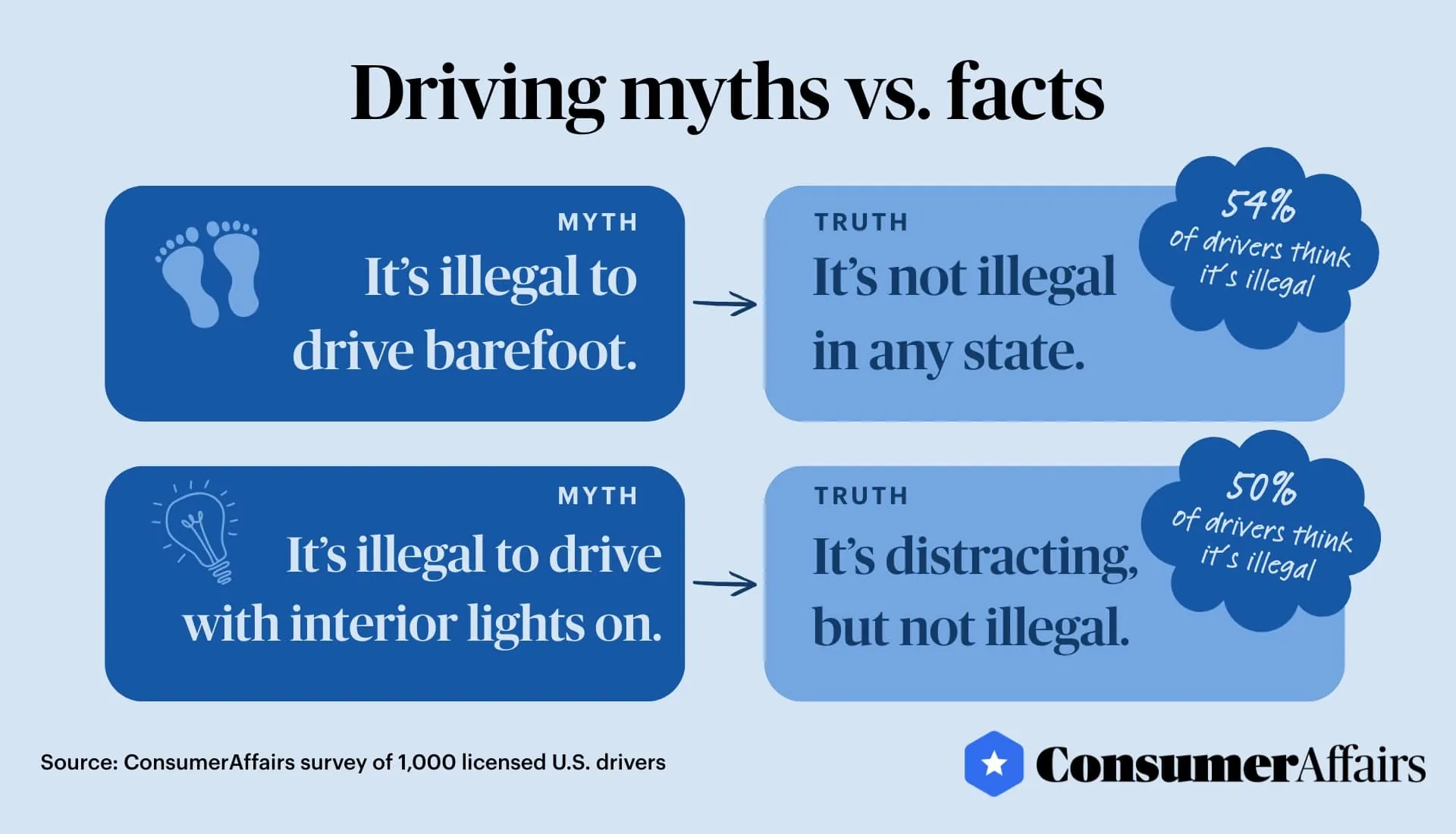
About 54% of American drivers believe it’s illegal to drive barefoot — but that’s not true anywhere in the U.S. Sure, your feet might get a little sweaty. But you won’t get a ticket that could affect your car insurance rates.
Half of drivers (50.3%) believe it’s illegal to drive at night with your interior lights on. This is another myth! Maybe it’s just what our parents told us to minimize distractions from the back seat.
Three in four Americans support retesting drivers over 70
Many drivers first earn their driver’s license as teenagers. Decades (and decades, and decades) later, these drivers are still on the road. Should they be?
Not everyone thinks so. Three in four Americans support retesting drivers over the age of 70, either with a written test, driving test or both.
No surprise here: This opinion is generational. 50% of baby boomers believe drivers over 70 should not be required to take any form of test to retain their license, compared with 20% of Generation X and 23% of drivers of all ages. (Some states agree with the 50% of boomers: Illinois just enacted a law that raises the age of senior driving tests to 87.)
Drivers are confident, but knowledge doesn’t always match
We’ve learned that not all drivers actually know the rules of the road. Despite those statistics, 44% of Americans are “very confident” they could pass a written driving test today. And this confidence doesn’t shrink with age. Even though nearly all baby boomers got their license over 15 years ago, 50% remain “very confident” they could still pass the test. What do the three in four Americans who support retesting drivers over 70 think about that?
Let’s take a look at the stats. Here’s how drivers judge their skills against the average driver:
- 31% say excellent
- 41% say above average
- 27% say average
- 1% say below average
- 0.3% say poor
Think back to the last time you were in the driver’s seat. Do you think just 1% of your fellow drivers had below-average skills? Honk twice if so.
Smart habits for safer driving and car ownership
As a driver, you have to expect the unexpected. Potholes, traffic jams and barefoot drivers could be just around the corner. (Though remember: driving barefoot is not illegal.)
Stay safe out there. And remember these tips on driving and car ownership while you cruise:
- Stay alert. Avoid distractions like your phone and keep your eyes on the road — even at stoplights.
- Make sure your car is fully insured. Finding cheap car insurance is always a bonus.
- Always buckle up. It’s the simplest way to protect yourself in a crash.
- Be prepared for a breakdown. A roadside assistance service can be a lifesaver.
- Customize your ride — the smart way. Keep up to date on auto accessories and the law.
With so many drivers admitting to risky habits, it’s a good reminder to stay alert, buckle up and prioritize safety every time you hit the road.
Methodology
ConsumerAffairs surveyed 1,000 licensed U.S. drivers using Pollfish in August 2025 to learn more about their knowledge of traffic laws, driving habits and road safety. Results were poststratified by age and gender to better reflect the U.S. driving population.
Participants were asked about:
- Confidence in passing a written driving test today
- Self-rated driving skills compared with the average driver
- Opinions on retesting older drivers
- Knowledge of traffic laws, including right of way rules, the legal blood alcohol concentration (BAC) limit and school bus safety laws
- Beliefs about driving myths, such as whether it’s illegal to drive barefoot, drive with interior lights on or ride without a seat belt in the back seat
Findings were analyzed by generation (Gen Z, millennials, Gen X and baby boomers) and by gender. Some survey questions allowed multiple responses. Percentages are rounded and may not add up to 100%.
Reference policy
We love it when people share our findings! If you do, please link back to our original article to credit our research.
Questions?
For questions about the data or if you'd like to set up an interview, please contact rsowell@consumeraffairs.com.
Article sources
ConsumerAffairs writers primarily rely on government data, industry experts and original research from other reputable publications to inform their work. Specific sources for this article include:
- Illinois General Assembly, “Bill Status of HB1226.” Accessed Sept. 8, 2025.