How Many Cars Are Stolen Each Year? (2026)

+2 more



Vehicle theft is on the rise in the U.S. Thefts of both standard vehicles and motorcycles each increased by nearly 7% year over year (YoY) in 2022. Full-size pickup trucks were the most sought-after vehicle type and Honda the most popular motorcycle brand among thieves.
Although a majority of states saw increases in vehicle theft in 2022, this type of crime is most prominent in the Western U.S.
Key insights
In 2022, 1,001,967 vehicles were stolen in the U.S., up about 6.8% from 2021. It had been 15 years since the number of stolen vehicles surpassed one million annually; in 2007, there were 1,100,472 vehicles stolen.
Jump to insightVehicle thefts have been on the rise since 2019. A 10.9% increase in vehicle theft in 2020 was attributed to the COVID-19 pandemic.
Jump to insightSix of the top 10 states with the highest vehicle theft rates per capita in 2022 were in the West. Colorado has had the highest theft rates among all the states in recent years.
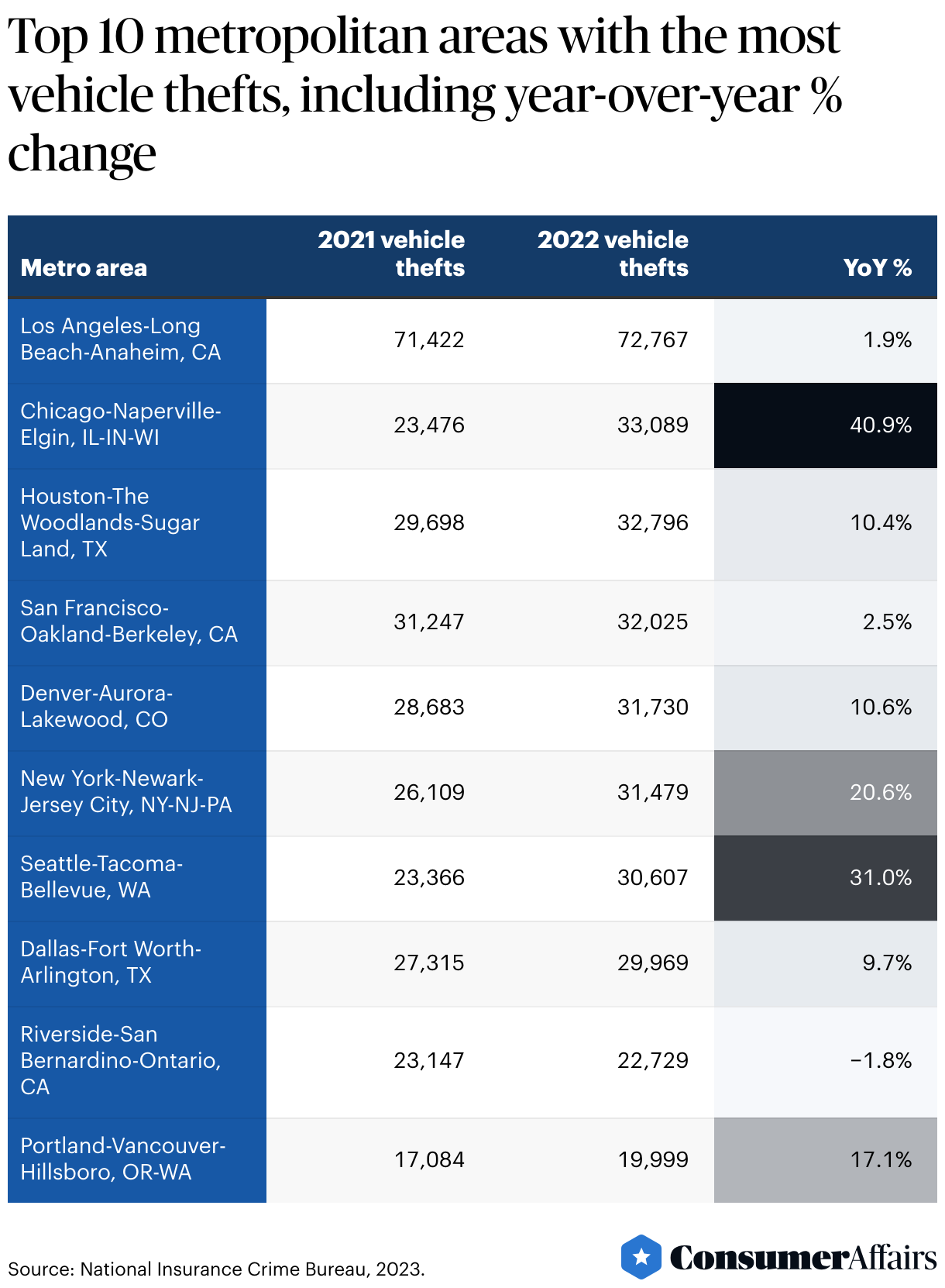
Jump to insightJust 10 metropolitan areas accounted for over one-third of all vehicles stolen nationally in 2022. Los Angeles-Long Beach-Anaheim led all other metro areas in terms of total vehicles stolen, followed by Chicago-Naperville-Elgin and Houston-The Woodlands-Sugar Land.
Jump to insightPickup trucks are the most frequently stolen type of vehicle, holding three of the top 10 spots among the most stolen vehicle models in 2022. Honda is the most frequently stolen vehicle make.
Jump to insightVehicle theft statistics
Vehicle thefts reached over one million in 2022, the highest total since 2007. After peaking at 1,261,226 stolen vehicles in 2003, the number of annual stolen vehicles began a period of decline for nearly 10 years. Vehicle thefts dropped nearly every year from 2004 to 2014, except for 2012, when thefts rose slightly.
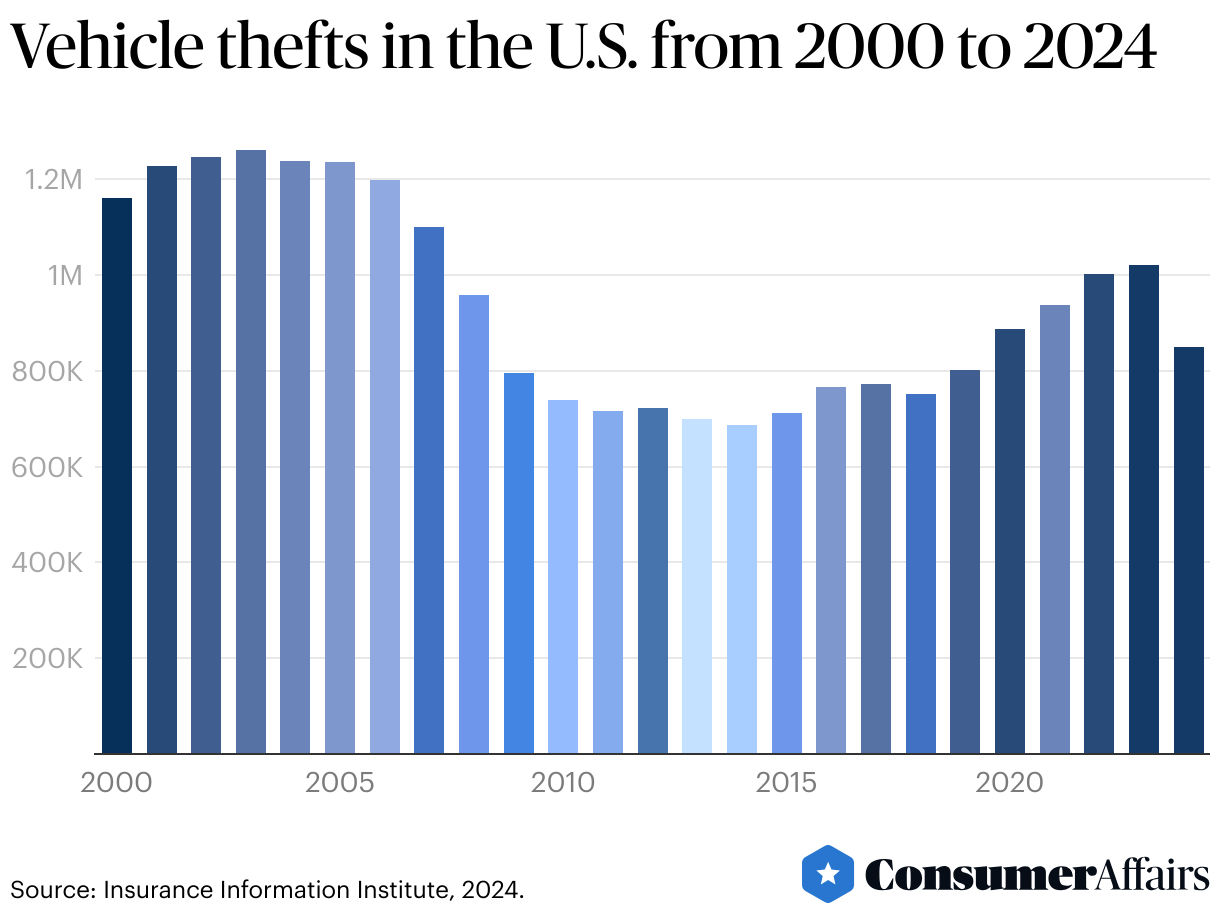
However, vehicle thefts began to generally trend upward again in 2015. A particularly sharp 10.9% increase in vehicle thefts from 2019 to 2020 was attributed to the COVID-19 pandemic; this was followed by 5.6% and 6.8% YoY increases in 2021 and in 2022.

While not in the top 10 list of states with the most stolen vehicles overall, Vermont had a 67.3% increase in stolen vehicles YoY from 2021 to 2022, which was the highest increase of any state. Other notable states with high YoY vehicle theft increases included Pennsylvania with 24.2%, Michigan with 21% and Maryland with 16.9%.
The majority of states saw YoY increases in vehicle thefts, while nineteen states experienced declines in 2022. Utah, Wyoming and Hawaii saw the biggest decreases in vehicle thefts from 2021 to 2022.
Motorcycle theft statistics
There were 54,736 motorcycle thefts in the U.S. in 2022, an increase of 6.7% from 2021.
Only 10 states accounted for 60% of all motorcycle thefts. California easily held the top spot, accounting for 30% of total motorcycle thefts in 2022, totaling 9,838 motorcycles. Florida and Texas reported the second and third most motorcycle thefts, reporting 8,708 thefts combined.
Motorcycle theft is most common during the summer months. July 2022 saw 6,394 motorcycle thefts nationally, which was the highest number of any month that year and a 16.8% increase YoY.
Honda was the most stolen motorcycle manufacturer in 2022, and it has topped the list of most stolen motorcycle manufacturers every year since 2017, followed by Yamaha. In 2022, Harley-Davidson moved into the third position for stolen motorcycles, surpassing Kawasaki. Notably, Harley-Davidson’s motorcycle thefts had the highest YoY increase of the top five most frequently stolen motorcycle manufacturers, totaling about 9%.
Approximately 42% of stolen motorcycles are recovered, according to the National Insurance Crime Bureau (NICB).
Top five motorcycle thefts by manufacturer: 2021 vs. 2022
| Motorcycle manufacturer | 2021 thefts | 2022 thefts | YoY % change |
|---|---|---|---|
| Honda | 10,282 | 10,631 | +3.4% |
| Yamaha | 8,185 | 8,358 | +2.1% |
| Harley-Davidson | 5,811 | 6,333 | +9% |
| Kawasaki | 5,904 | 6,260 | +6% |
| Suzuki | 4,890 | 4,886 | -0.1% |
| Subtotal | 35,072 | 36,468 | 4% |
| % of total motorcycle thefts | 68.4% | 66.6% |
Top states for vehicle theft
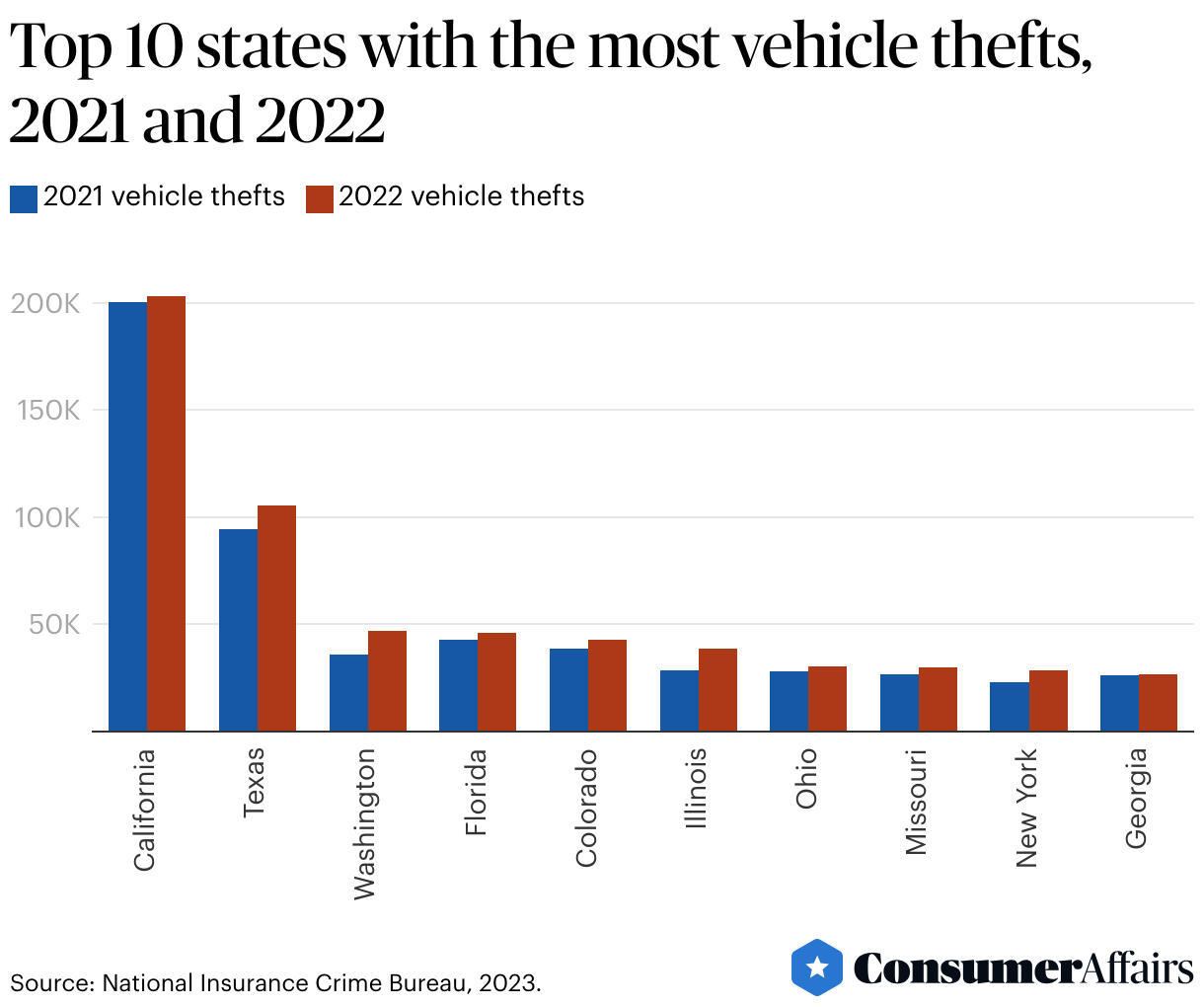
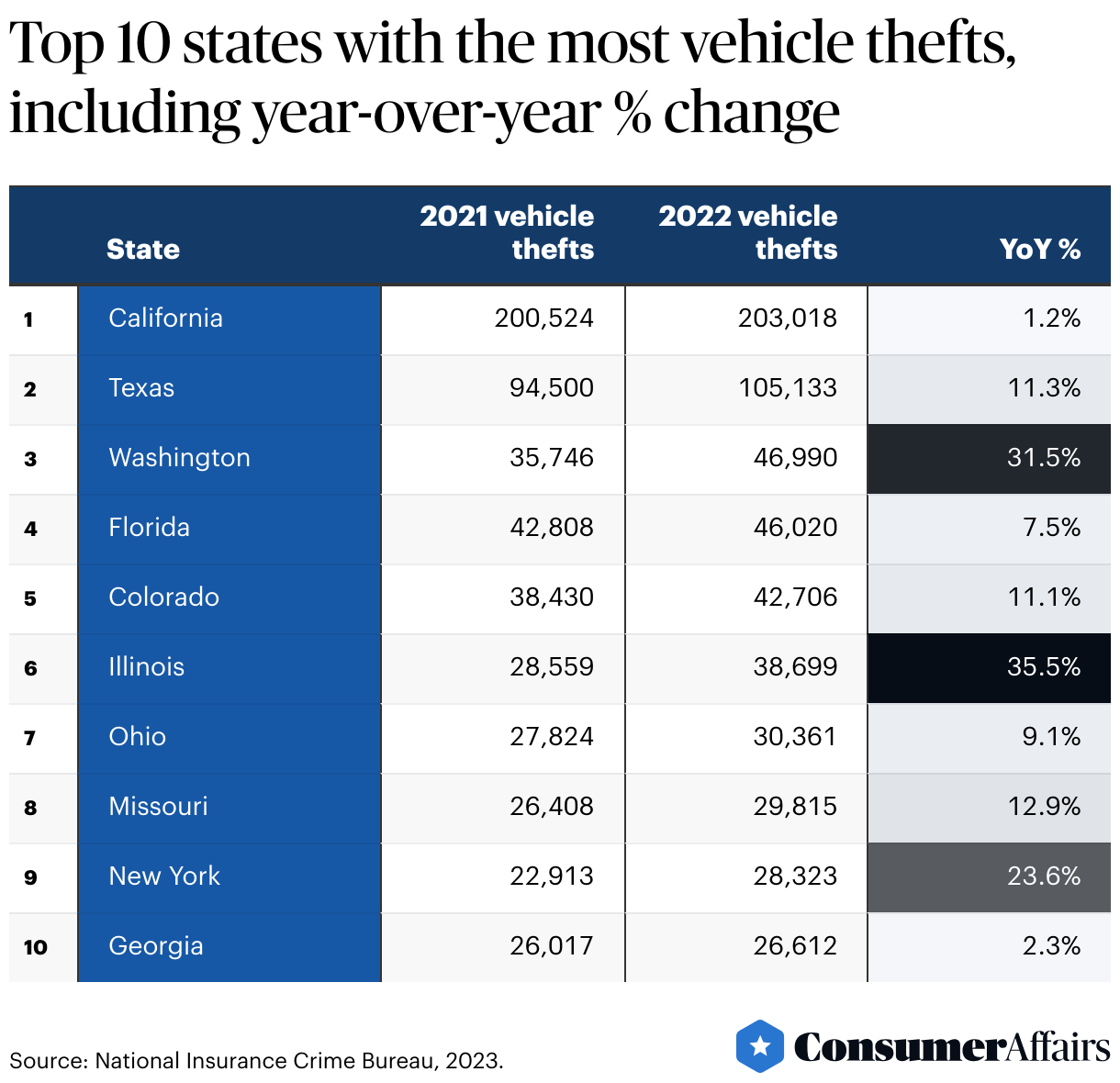
Ten states accounted for 59.7% of the total number of stolen vehicles in the U.S. in 2022. California led with 203,018 stolen vehicles, nearly double Texas’ total of 105,133. Of the top 10 states with the most stolen vehicles, Illinois and Washington experienced the highest increase in stolen vehicles YoY, increasing by 35.5% and 31.5%, respectively.
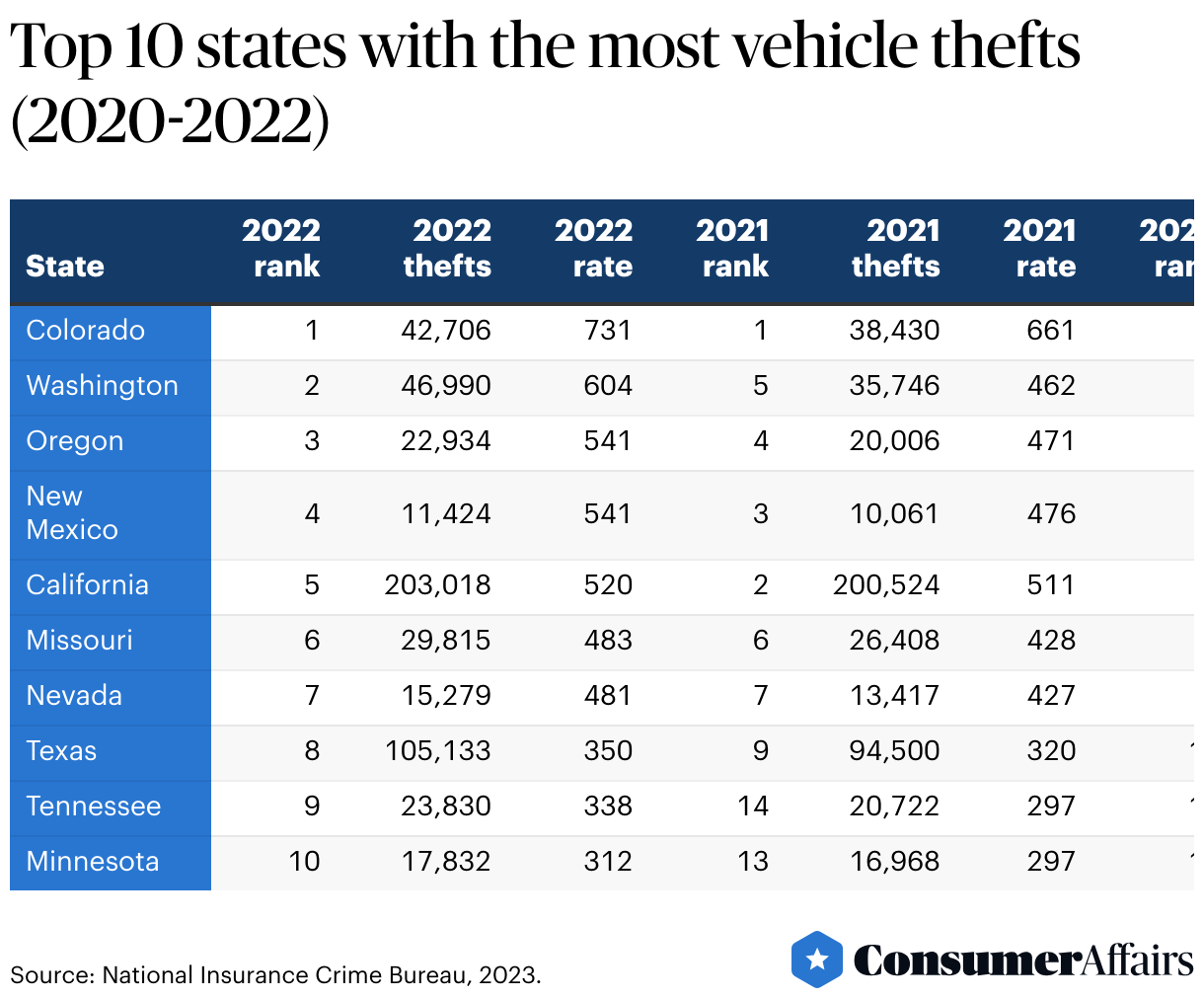
In addition to measuring the total number of vehicle thefts in a state, a state’s vehicle theft rate, which measures the number of vehicles stolen per 100,000 residents, is also telling. The West was home to six of the 10 states with the highest vehicle theft rates in 2022.
Colorado has had the highest vehicle theft rate for the past two years. The five states with the lowest vehicle theft rates in 2022 were West Virginia, Massachusetts, Idaho, Maine and New Hampshire.
Top metropolitan areas for motor vehicle theft
The top 10 metropolitan areas for total vehicle thefts accounted for over one-third of all vehicles stolen nationally in 2022.
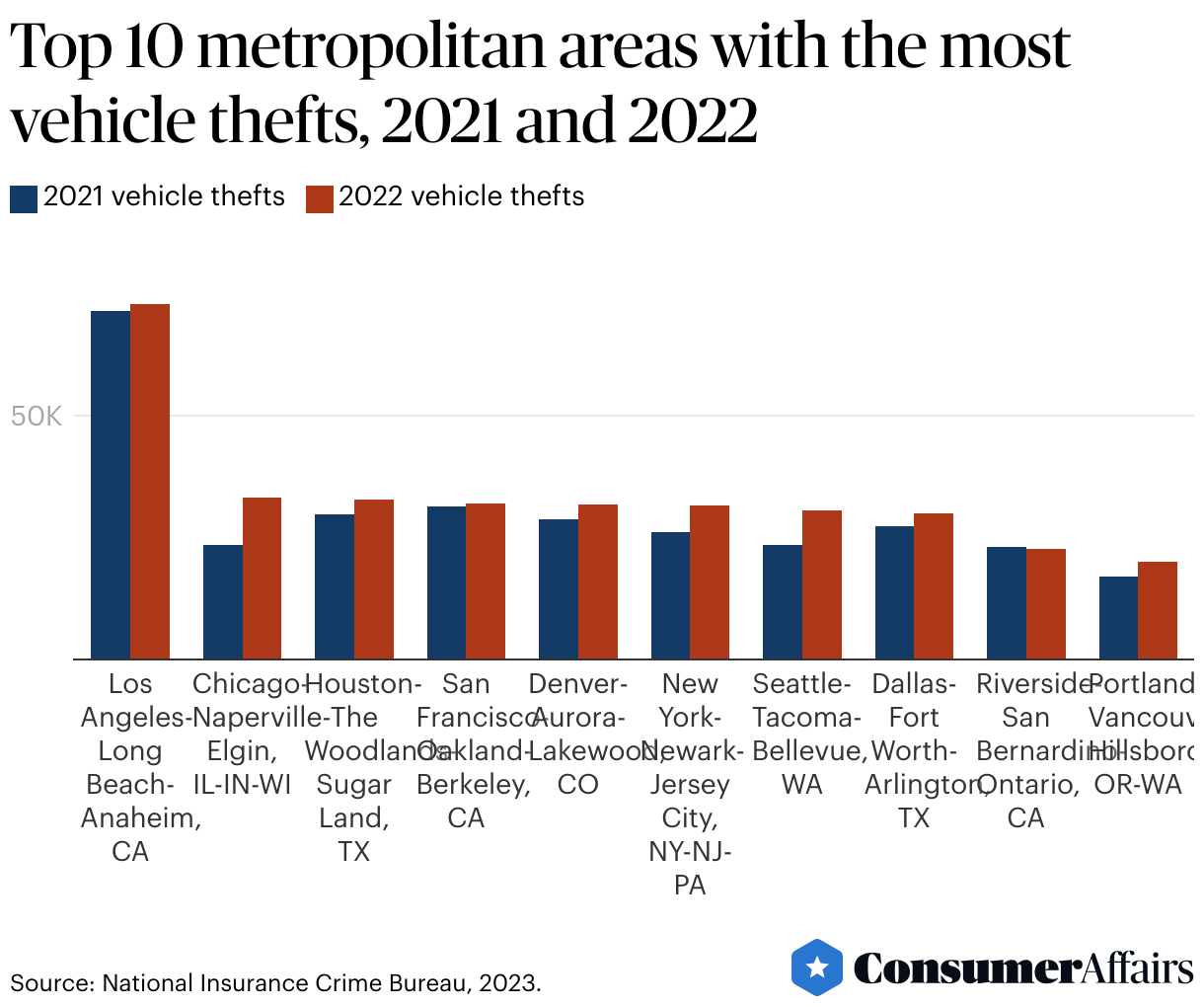
The Los Angeles-Long Beach-Anaheim metro area experienced more vehicle thefts total than any other metro area, followed by the Chicago-Naperville-Elgin region and Houston-The Woodlands-Sugar Land. Of the top 10 metropolitan areas, the Chicago-Naperville-Elgin region and Seattle-Tacoma-Bellevue regions saw the highest YoY increases in stolen vehicles.
Consistent with the overall theft rate by states, the vehicle theft rates by metropolitan area were higher in western states; in 2022, eight of the metropolitan areas with the highest vehicle theft rates nationally were in California, Colorado, Oregon, New Mexico and Washington.
Colorado’s Pueblo metropolitan area had the highest vehicle theft rate of all metropolitan areas in the U.S. in 2022. Additionally, Colorado was the only state that had three metropolitan areas within the top 10 for that category.
The metropolitan areas with the lowest vehicle theft rates in 2022 were: Barnstable Town, Massachusetts; Gettysburg and State College, Pennsylvania; and Aguadilla-Isabela, Puerto Rico.
Top 10 metropolitan areas with the highest vehicle theft rates, 2021 and 2022
| Vehicle theft ranking in 2022 | Metropolitan area | 2021 vehicle theft rate (per 100,000 residents) | 2022 vehicle theft rate (per 100,000 residents) |
|---|---|---|---|
| 1 | Pueblo, CO | 891.39 | 1,086.44 |
| 2 | Bakersfield, CA | 1,023.68 | 1,072.36 |
| 3 | Denver-Aurora-Lakewood, CO | 964.92 | 1,062.67 |
| 4 | Memphis, TN-MS-AR | 512.31 | 845.68 |
| 5 | Portland-Vancouver-Hillsboro, OR-WA | 680.20 | 796.94 |
| 6 | Albuquerque, NM | 710.58 | 795.18 |
| 7 | Seattle-Tacoma-Bellevue, WA | 582.47 | 758.68 |
| 8 | San Francisco-Oakland-Berkeley, CA | 675.86 | 699.30 |
| 9 | Greeley, CO | 387.02 | 589.42 |
| 10 | Kansas City, MO-KS | 529.80 | 572.67 |
Vehicle theft by season
Authoritative sources report conflicting information regarding the time of year when vehicles are most likely to be stolen. The National Highway Traffic Safety Administration reports that vehicle theft is most common during the summer, which may explain why July is National Vehicle Theft Prevention Month.
According to the National Insurance Crime Bureau, however, vehicle thefts increase during October, November and December.
Vehicle theft by make and model
Full-size pickup trucks are stolen more often than any other type of vehicle, holding three of the top 10 spots among the most commonly stolen vehicles in 2022, including the first two spots. The GMC full-size pickup had the biggest YoY increase of the top 10 vehicles stolen, at 6.6%.
Honda is the most commonly stolen vehicle manufacturer. The Honda Civic, Accord and CR-V were among the 10 most commonly stolen vehicles in both 2022 and 2021. In 2022, three new vehicle models were added to the top 10: the Hyundai Sonata, Hyundai Elantra and Kia Optima. The vehicles that dropped out of the top 10 in 2022 were the Nissan Altima, Jeep Cherokee/Grand Cherokee and Toyota Corolla.
Most commonly stolen vehicles by manufacturer and YoY % change
| Rank | Model | 2022 vehicle thefts | YoY % |
|---|---|---|---|
| 1 | Chevrolet full-size pickup | 49,903 | +3.5% |
| 2 | Ford full-size pickup | 48,175 | +0.4% |
| 3 | Honda Civic | 27,113 | -14.4% |
| 4 | Honda Accord | 27,089 | -10.5% |
| 5 | Hyundai Sonata | 21,707 | N/A |
| 6 | Hyundai Elantra | 19,602 | N/A |
| 7 | Kia Optima | 18,221 | N/A |
| 8 | Toyota Camry | 17,094 | -1% |
| 9 | GMC full-size pickup | 16,622 | +6.6% |
| 10 | Honda CR-V | 13,832 | +3.9% |
FAQ
What do I do if my vehicle has been stolen?
Report the vehicle to your local law enforcement and provide the vehicle’s make, model, color, license plate number and vehicle identification number (VIN). There is a better chance that the vehicle will be recovered if you report its theft quickly, as 35% of recovered stolen vehicles are recovered on the same day the theft occurred, and 45% are recovered within two days.
The police should provide you with a record of the theft to show to your insurance company.
How do I prevent my vehicle from being stolen?
Remove valuables from your vehicle or store them out of sight. Never leave your keys in your car, and always lock the doors. Roll the windows all the way up.
Special devices can help to deter theft, such as steering wheel locks and brake pedal locks, as well as devices that can disable the fuel system or cut off the ignition.
How do I know if the car I am purchasing has been stolen?
The NICB provides a free VINCheck service to help consumers determine if a vehicle has been reported as stolen but not recovered or if it has been reported as a salvage vehicle by NICB member insurance companies. A VIN is required to perform a search.
Article sources
ConsumerAffairs writers primarily rely on government data, industry experts, and original research from other reputable publications to inform their work. Specific sources for this article include:
- Insurance Information Institute, “Motor Vehicle Theft.” Accessed Dec. 14, 2023.
- National Insurance Crime Bureau, “Lock Up Your Bikes – Motorcycle Thefts Rise for the Third Consecutive Year.” Accessed Dec. 14, 2023.
- National Insurance Crime Bureau, “PROTECT YOUR RIDE! MOTORCYCLE THEFTS ARE ON THE RISE FOR SECOND YEAR IN A ROW.” Accessed Dec. 14, 2023.
- Insurance Information Institute, “Motorcycle Thefts.” Accessed Dec. 10, 2023.
- National Insurance Crime Bureau, “Motorcycle Thefts Surge By 30 Percent In 2020.” Accessed Dec. 14, 2023.
- National Insurance Crime Bureau, “‘Hot Spots’ Report Shows Vehicle Theft Rates Spiking in Different Regions of the U.S.” Accessed Dec. 14, 2023.
- National Insurance Crime Bureau, “New Report Shows Full-Size Trucks Have Highest Theft Rate.” Accessed Dec. 30, 2023.
- National Insurance Crime Bureau, “Chevrolet and Ford Full Size Pick-Ups Most Stolen Vehicles For Second Year in a Row.” Accessed Dec. 30, 2023.
- National Insurance Crime Bureau, “How to Report a Stolen Vehicle.” Accessed Dec. 14, 2023.
- National Insurance Crime Bureau, “Buying a Vehicle.” Accessed Dec. 14, 2023.
- National Highway Traffic Safety Administration, “Vehicle Theft Prevention.” Accessed Dec. 29, 2023.
Figures