Moving Statistics (2026)

+2 more



While the number of people moving trended downward during the COVID-19 pandemic, things appear to be changing as families seek more affordable housing and safer neighborhoods. For the first time since the pandemic began, the rate at which Americans are moving has increased. U.S. residents are moving beyond their own counties and increasingly moving out of their own state, most commonly citing the need for newer/larger homes, owning a home (instead of renting), establishing a household, and accommodating a new job. In the U.S., Southern and Western states rank among the top choices, with seven out of the top 10 growth states in the South and three in the West.
Key takeaways
In 2022, over eight million Americans made interstate moves.
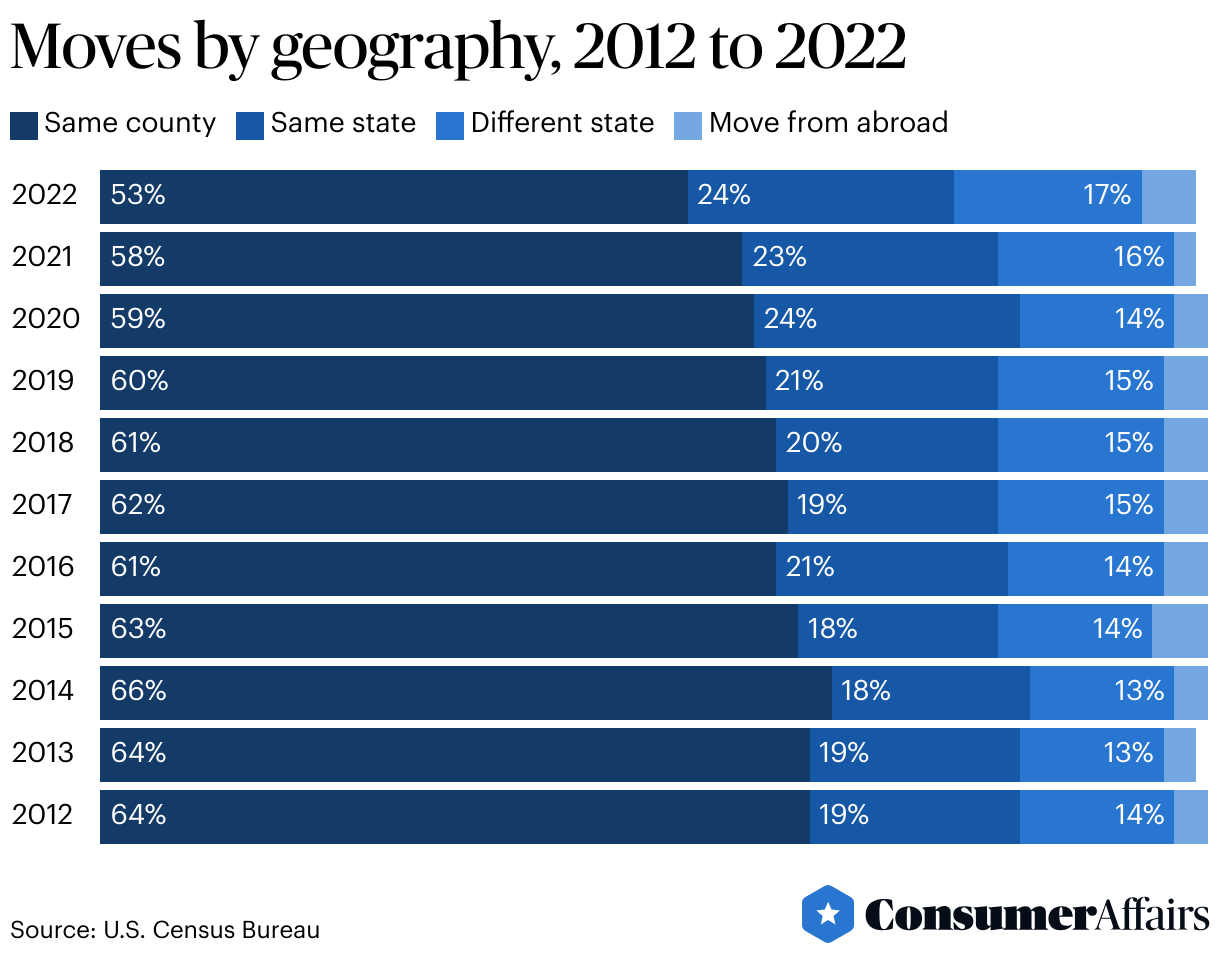
Jump to insightMoving within one’s county continues to be the most common move, representing 53% of all relocations in 2022. However, this move type has been declining over the past 10 years, as the percentage of moves within the state, and out of state has been increasing.
Jump to insightIn 2022, 235,000 Americans moved to retire.
Jump to insightIn their lifetime, the average American moves approximately 11.7 times.
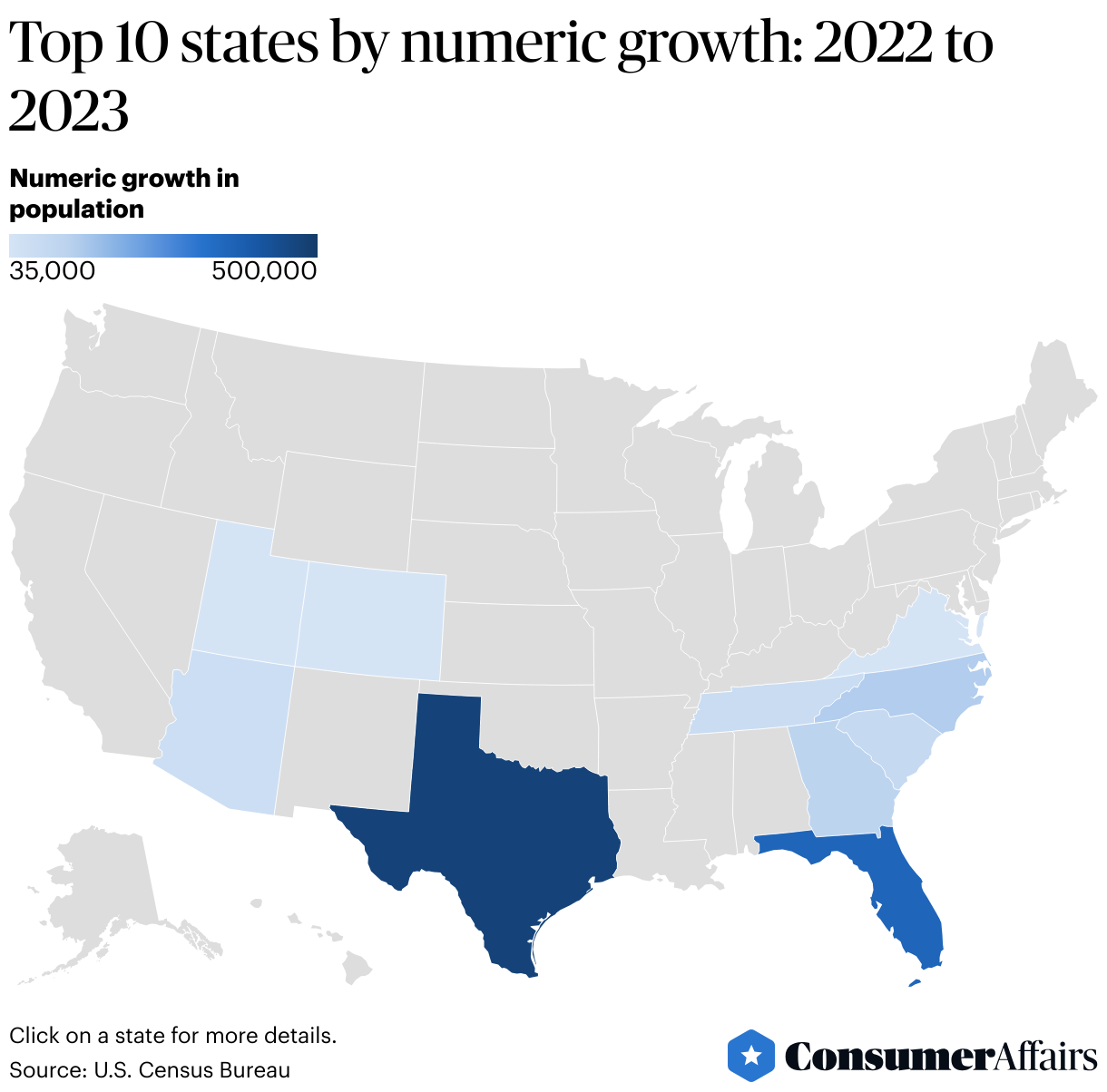
Jump to insightAmericans are moving to southern states — from 2022 to 2023, Texas, Florida, and North Carolina are the top three locations.
Jump to insightGeneral moving statistics
There are approximately 16,851 moving companies in operation in the U.S. The industry directly employs about 114,240 workers and runs 50,000 moving trucks.
Select state-to-state migration, 2022
Notable state moves (including to and from) in highly populous states report large numbers of movers relocating from California to Texas, and New York to Florida.
| Origin state | Destination state | Number of movers |
|---|---|---|
| California | Texas | 102,442 |
| New York | Florida | 91,201 |
| New York | New Jersey | 75,103 |
| California | Arizona | 74,157 |
| Florida | Georgia | 51,380 |
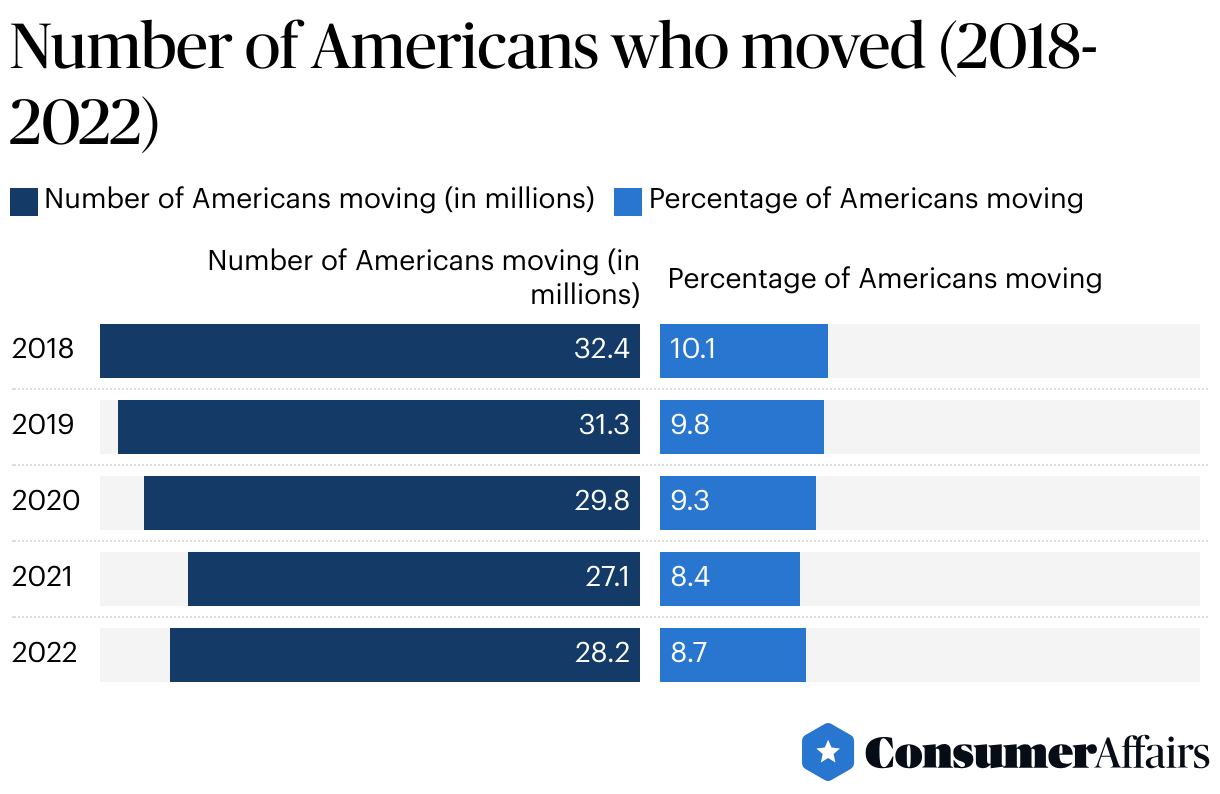
In 2022, 53% of the 28.2 million moves were made within the same county. While this figure is still high, it dropped from 58% in 2021, and has been steadily declining over the past 10 years from 64% of Americans who moved within the same county in 2012. U.S. residents are increasingly moving within the same state, 24% in 2022, and 17% to different states.
During 2022, the moving rate in the U.S. was 8.7%, up from 8.4% in 2021, but down from 10.1% in 2018.
Types of moves
There are generally five types of moves:
- Residential local moves refer to household moves of less than 100 miles.
- Residential long-distance/interstate moves are between 100 and 400 miles within the same state, or they may be of a shorter distance across state lines.
- Military relocations involve moving military households from one duty station to another. These are often interstate or international moves, but they could be local as well.
- Corporate relocations move entire businesses which demand fast turnarounds so that a business can be back up and running as quickly as possible. These moves may include additional support, such as furniture assembly and organizational assistance.
- International relocation is a move from one country to another. These moves may include handling of goods by air or sea, dealing with customs procedures, and taking special tracking measures to prevent property loss. International moves can be residential or corporate.
Who moves the most?
Most movers are renters rather than homeowners, and a majority of movers have residences of two bedrooms or less.
- The average move in the U.S. is completed by a couple between the ages of 18 and 34 with one or two children.
- Moves made by individuals and families make up 44% of relocations in the U.S., with corporate moves following at 38%.
- Gen Z and millennials are more likely to relocate than members of other generations.
- In 2022, the migration rate for individuals moving within the same county was highest among Native Hawaiian and Pacific Islanders, totaling 9.2% of this demographic population, followed by 7.3% of Black or African Americans, and 6.8% of Hispanic Americans.
- In 2022, 235,000 Americans moved to retire (a 4% increase from 2021).
- Florida, North Carolina and Michigan are the three most popular states for retirement.
| Move by housing type/size | Percentage of moves |
|---|---|
| Studio apartments | 9.37 |
| One-bedroom homes | 28.1 |
| Two-bedroom homes | 21.16 |
| Three-bedroom homes | 20.27 |
| Four-bedroom+ homes | 7.7 |
Move destinations and places of origin
With the post-pandemic increase in remote work, Americans are taking advantage of the lower cost of living in smaller cities and rural areas. Several cities and counties in states like Alabama, Mississippi and Oklahoma are even offering incentives to attract remote workers, such as relocation assistance, free coworking space memberships and sizable cash payments.
Most popular relocation destinations
Southern states are the most popular relocation destination according to the United States Census Bureau’s latest state population results comparing 2022 to 2023. As of July 1, 2023, compared to the previous year, Texas, Florida and North Carolina rank as the top three states for adding the most new residents.
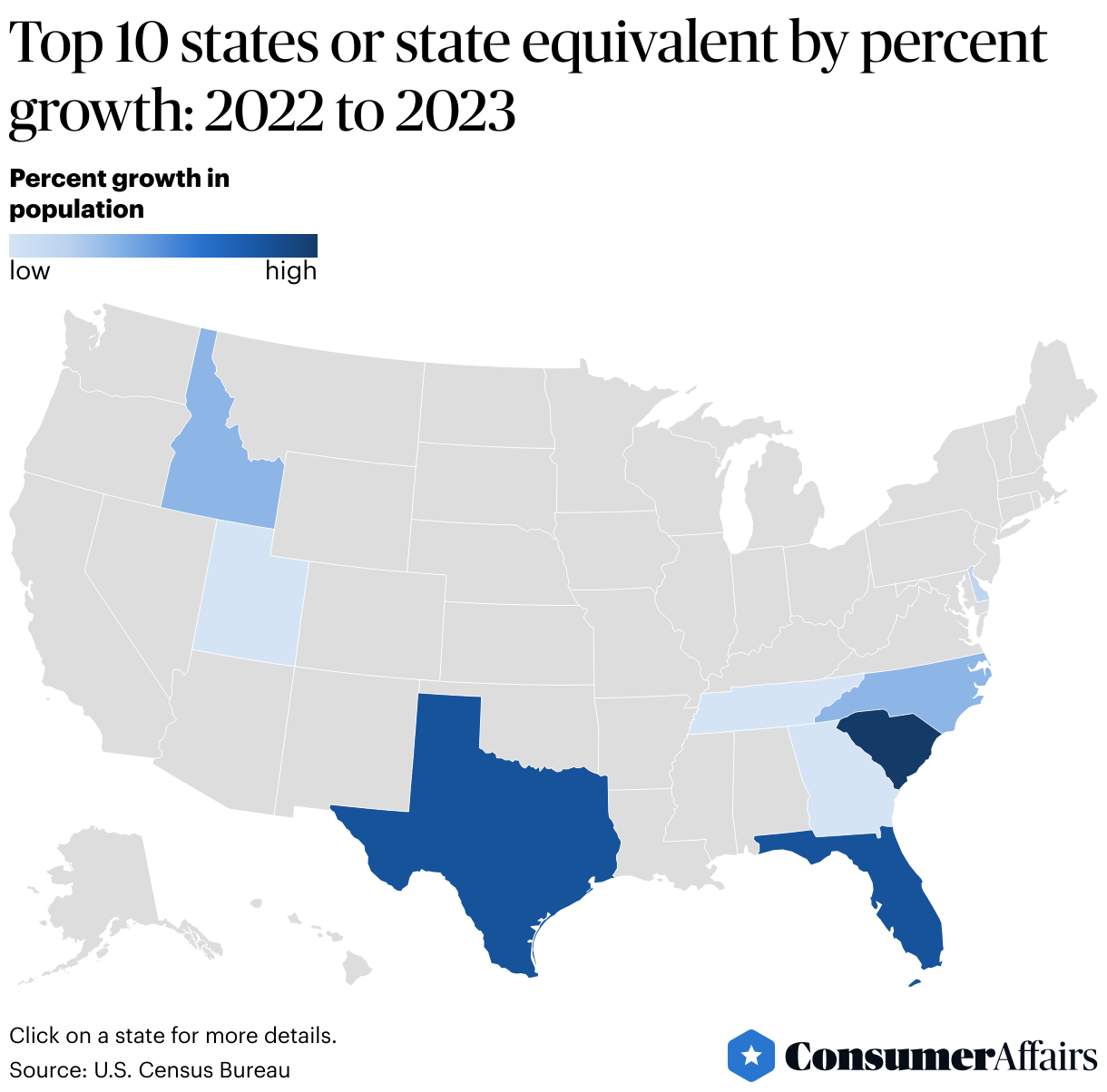
South Carolina, Florida and Texas ranked in the top three in terms of percent growth.
How far do people move?
Most moves (53.5%) occur within the same county, followed by moves within the same state (24.3%), moves to a different state (17.3%), and moves from abroad (4.9%).
Most young adults (six in 10) live within 10 miles of where they grew up, and eight in 10 live within 100 miles.
Why people move
Housing-related reasons, were cited by 41.6% of Americans as their primary motivations for moving in 2022, down from 45.7% in 2021.
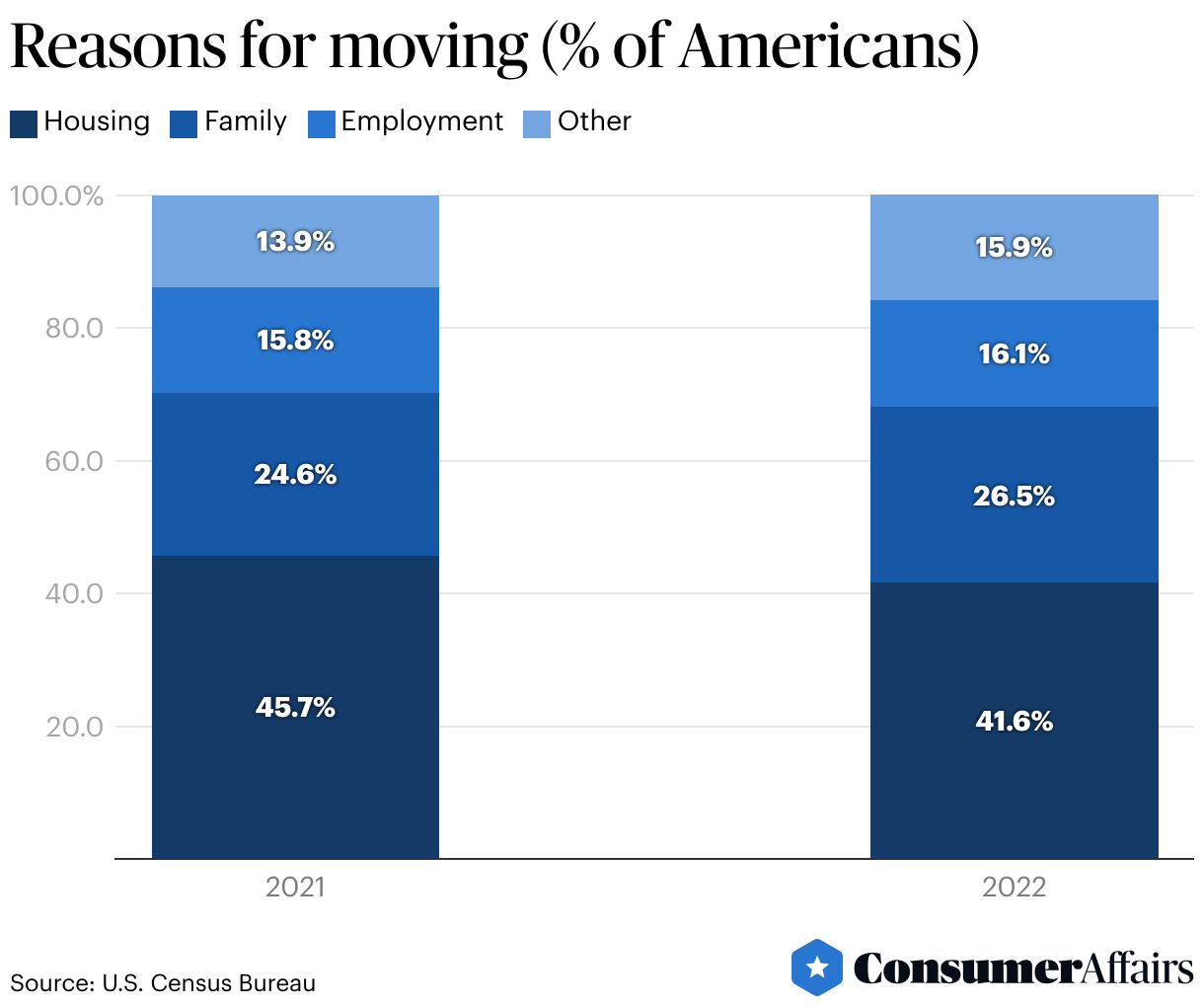
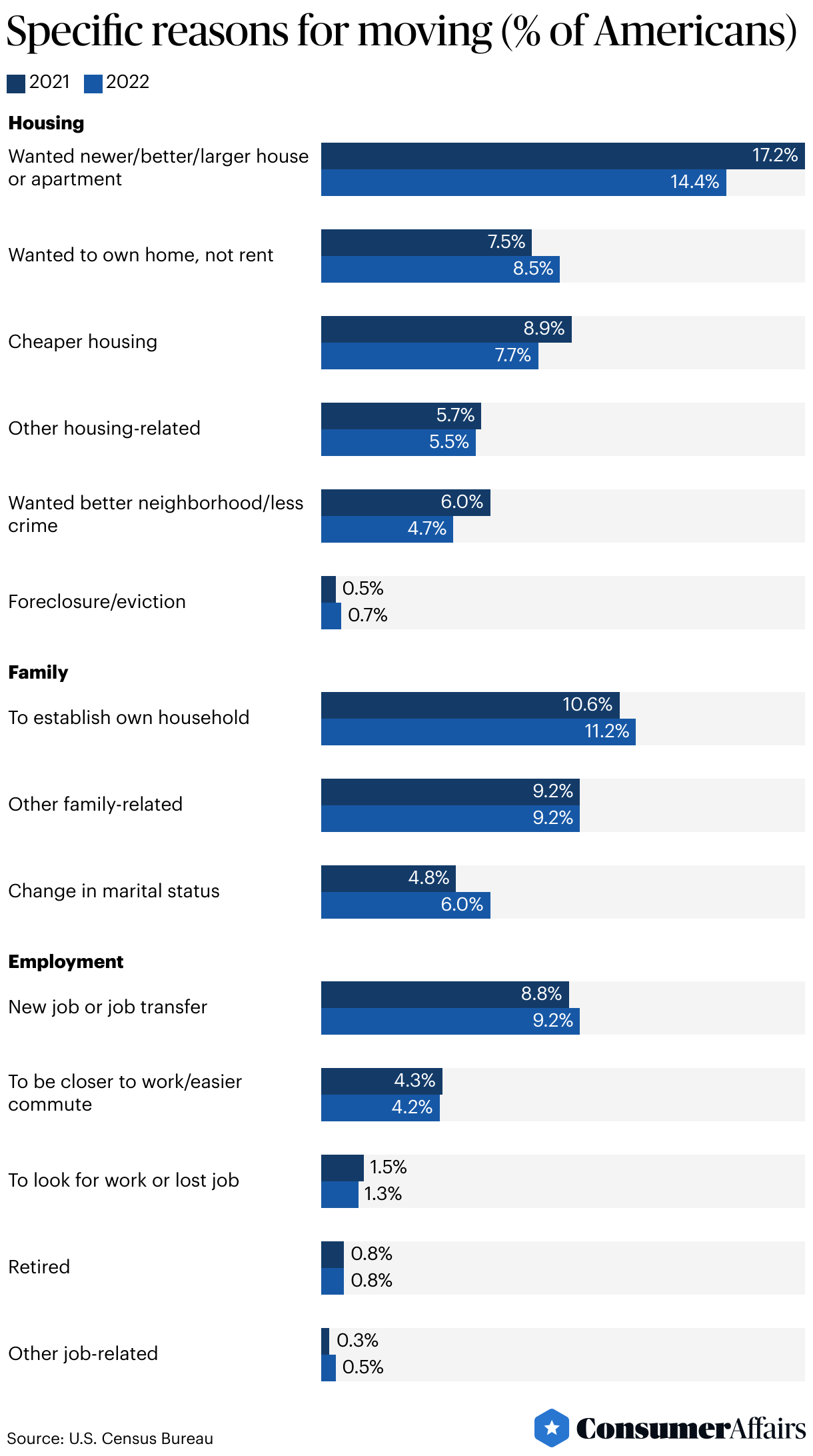
In 2022, the percentage of Americans citing that wanting newer, better or larger houses or apartments trended down to 14.4% from 17.2% in 2021, as did those seeking a better neighborhood, from 6% to 4.7%. Individuals seeking to rent residences increased to 8.5% in 2022, from 7.5% in 2021.
All family-related moves increased from 24.6% in 2021 to 26.5% in 2022. In 2022, more Americans reported that they were moving to establish their own households, at 11.2%, up from 10.6% in 2021. Additionally, 6% moved due to a change in marital status, up from 4.8% in 2021.
Employment-related moves increased slightly in 2022 to 16% from 15.7% in 2021. While there was an increase in 2022 of Americans moving due to a new job or a transfer to 9.2% from 8.8% in 2021, this was nearly offset by a decline in U.S. residents moving for easier commutes, as well as those moving due to a lost job or to look for work.
Moving costs
Though relocation has never been cheap, it’s now getting even more expensive.
- The average cost of a local move is $560 to $1,000, while a long-distance move costs around $5,500.
- A DIY move will generally cost between $100 and $2,500.
Actual moving costs vary based on multiple factors, including:
- Weight of household goods
- Location
- Move distance
- Home size
- Seasonality
- Insurance coverage
- Fuel charges
- Environmental fees
- Additional services needed, like packing, navigating stairs, transporting large items, long-carry services and extra stops
FAQ
What states are people moving to in 2024?
In 2024, the National Association of Realtors predicts that the following real estate markets will outperform all others: Austin, Texas, Dallas, Texas, Dayton, Ohio, Chapel Hill, North Carolina, Harrisburg, Pennsylvania, Houston, Texas, Philadelphia, Pennsylvania, Portland, Maine, and Washington, DC.
What is a reasonable moving budget?
On average, a local move costs around $1,250, and long-distance moves cost an average of about $4,890. What you end up paying will vary depending on factors like the weight of your household goods, your location, moving distance and home size.
Skipping the cost of movers and organizing a move yourself may be a less expensive option. You can relocate for as little as a few hundred dollars if you pull together resources like trucks, and enlist family or friends to help with the manual labor.
Can I negotiate moving costs?
Yes, you can potentially negotiate moving costs. The best method for negotiation is to get at least three moving quotes from reputable moving companies. Each quote should include the same details and services, such as the list of items to be moved, distance, dates and additional services like packing or transporting large items.
Send the lowest of the three quotes to the moving company that you’d most like to hire and ask if the company can drop its quote to be closer to the lowest quote you found.
Article sources
ConsumerAffairs writers primarily rely on government data, industry experts, and original research from other reputable publications to inform their work. Specific sources for this article include:
- United States Census Bureau, “Fewer People Reported Moving in Previous Year in 2021 Than in 2019.” Accessed Sept. 29, 2023.
- Nexus, “Interesting Statistics About Moving Industry 2024.” Accessed Feb. 26, 2024.
- United States Census Bureau, “There’s No Place Like (Close-to) Home.” Accessed March 1, 2024.
- United States Census Bureau, “Why People Move.” Accessed Feb. 26, 2024.
- Indeed, “Craving a Location Change? These 10 US Cities Offer Perks If You Move There.” Accessed March 1, 2024.
- United States Census Bureau, “CPS Annual Social and Economic (ASEC) Supplement.” Accessed Oct. 11, 2023.
- United States Census Bureau, “Calculating Migration Expectancy Using ACS Data.” Accessed Oct. 11, 2023.
- Axios, “Mapped: Where Americans are moving.” Accessed Oct. 11, 2023.
- National Association of Realtors, “Where People Moved in 2022.” Accessed March 1, 2024.
- United States Census Bureau, “American Community Survey Data.” Accessed Oct. 11, 2023.
- United States Census Bureau, “About 8.2 Million People Moved Between States in 2022.” Accessed Feb. 26, 2024.
- IBIS World, “Moving Services in the US - Number of Businesses.” Accessed March 1, 2024.
- United States Census Bureau, “Geographic Mobility by Selected Characteristics in the United States.” Accessed March 1, 2024.
- United States Census Bureau, “CPS Historical Migration/Geographic Mobility Tables: Table A-5.” Accessed March 1, 2024.
- Hire a Helper, “2022 Study: Where Americans Moved to Retire This Year.” Accessed March 1, 2024.
- United States Census Bureau, “CPS Historical Migration/Geographic Mobility Tables: Table A-5.” Accessed March 1, 2024.
- United States Census Bureau, “U.S. Population Trends Return to Pre-Pandemic Norms as More States Gain Population.” Accessed March 1, 2024.
- National Association of Realtors, “NAR Forecasts 4.71 Million Existing Home Sales, Improved Outlook for Home Buyers in 2024.” Accessed March 1, 2024.
- Moving.com, “Moving Cost Calculator for Moving Estimates.” Accessed March 1, 2024.
- Today’s Homeowner, “Tips for Negotiating with a Moving Company.” Accessed March 1, 2024.
Figures