This topic focuses on the latest updates and changes happening at Walmart, including new shopping policies, exclusive sales events, and innovative services. Articles cover a range of topics such as Walmart's updated return policies, expanded delivery and pickup options, and new in-store technologies like virtual try-ons and automated shopping assistants. Additionally, it highlights competitive sales events, partnerships, and customer-centric initiatives aimed at improving convenience and value. Whether it's seasonal sales, special membership perks, or new product launches, this topic provides a comprehensive overview of how Walmart is evolving to meet consumer needs.
How to serve Thanksgiving dinner for 10 people for under $40 at Walmart
Walmart’s 2025 Thanksgiving meal bundle serves 10 people for less than $4 per person.
The bundle includes over 20 items — turkey, sides, dessert ingredients — featuring national and private-brand favorites.
The offer is easy to grab online or in-store with convenient pickup/delivery options to take the stress out of holiday prep.
Holiday hosting can feel like running a marathon: stockings to hang, dishes to prep, and a budget that somehow balloons faster than the gravy boat.
That’s where Walmart steps in with a straw-saver of a deal: its annual Thanksgiving meal bundle for 2025 is back — and it’s better (and more affordable) than ever.
Whether you’re feeding family, friends or “friends-giving,” this one-click solution gives you a classic Thanksgiving spread — without the typical stress or sticker-shock.
“We know every dollar and minute counts – which is why we are offering a low priced, one-click Thanksgiving Meal Basket featuring iconic brands like Butterball and Stove Top alongside trusted Walmart private brand items,” Walmart’s President and CEO John Furner said in a news release.
“We want every family to be able to share a meal and celebrate without compromising on quality, quantity or tradition.”
The details: What’s in the bundle & how much it costs
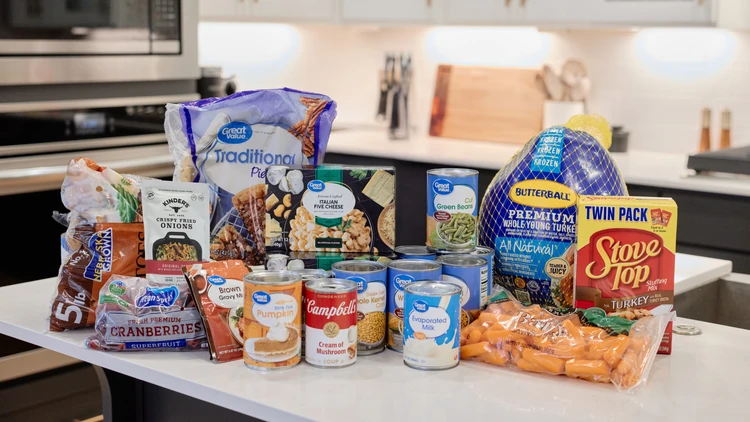
Here’s the lowdown: this year the bundle is priced at $39.92 (serving 10 people — under $4 per person) according to the online “Thanksgiving Value Meal” listing. It includes the following items (while supplies last, and availability may vary):
Butterball Turkey (10-16 lbs): $13.14
Fresh Cranberries, 12 oz bag: $1.42
Fresh Whole Russet Potatoes, 5 lb. bag: $3.27
Great Value Brown Gravy Mix: $0.32/each (two required)
Great Value Golden Sweet Whole Kernel Corn, 15 oz: $0.50/each (three required)
Fresh Baby-Cut Carrots, 2 lb. bag: $1.82
Great Value Cut Green Beans, 14.5 oz can: $0.50/each (three required)
Campbell’s Condensed Cream of Mushroom Soup, 10.5 oz can: $1.00
Kinder’s Crispy Fried Onion: $2.97
Great Value Artisan Crafted Macaroni and Cheese: $1.47/each (three required)
Stove Top Turkey Stuffing Mix, 2-count: $3.64
Great Value Brown and Serve White Dinner Rolls, 12-count: $1.38
Great Value Frozen Traditional Pie Crusts, Two 9-inch Pie Crust & Pans: $1.87
Great Value 100% Pure Pumpkin, 15 oz: $1.16
Great Value Evaporated Milk, 12 oz: $1.00
You’re getting a full spread — turkey, vegetable sides, mac and cheese, dessert-friendly ingredients — all for around $40.
And it doesn’t stop there. Walmart is offering extra bundle options this year: a gluten-free meal basket, a balanced-swaps basket (more protein, healthier sides), and a prime-rib meal basket for a more upscale twist.
To make it even easier: you can shop online or in store, pick up your basket with adhesive simplicity, or even have it delivered — and if you’re a first-time Pickup & Delivery customer you may qualify for free express delivery.
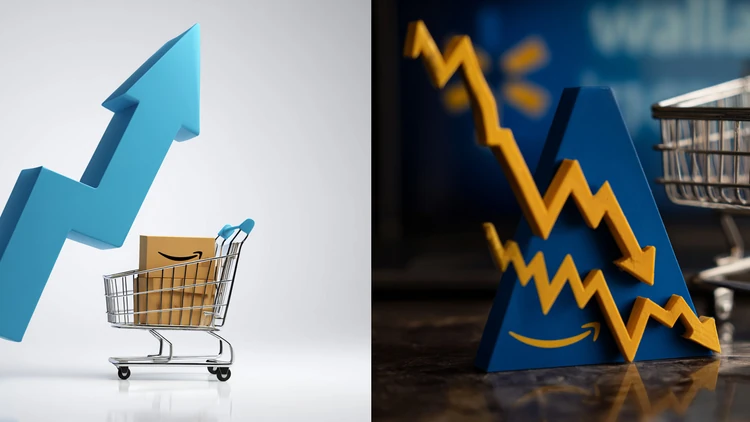
WSJ study says Amazon raises prices on essentials while Walmart cuts costs; Amazon denies it
The Wall Street Journal says Amazon increased prices on over 1,200 low-cost essentials despite pledge to hold the line
Walmart dropped prices on the same products by nearly 2%, diverging sharply from Amazon, the WSJ said
Retailers navigate political pressure and supply shocks as tariff policies continue to evolve
As the U.S. grapples with the economic fallout of sweeping new tariffs imposed earlier this year by President Trump, a Wall Street Journal analysis found that Amazon has quietly raised prices on many of its most affordable household products — despite previously stating it would avoid such increases.
Amazon denied the Journal's claims. “This story is false and misleading. We have not seen the average prices of products offered in our store change up or down appreciably outside of typical fluctuations across millions of items on Amazon," an Amazon spokesperson said.
The investigation, which examined nearly 2,500 items using pricing data from e-commerce tracker Traject Data, found that Amazon increased prices on more than 1,200 of its lowest-cost items — ranging from deodorant to protein shakes and pet supplies — while competitor Walmart lowered prices on the same items by almost 2%.
These moves come as retailers respond to an increasingly volatile business environment shaped by rising import costs, political pressure, and rapidly shifting consumer demand. Analysts say the changes signal differing strategies as the nation’s largest retailers position themselves amid the tariff storm.
Amazon contends that the study's sample size was not nearly large enough.
"This study is seriously flawed, cherry picking a mere 2,500 items out of the hundreds of millions we sell, and failing to accurately compare like-for-like offers in stock and available for sale across retailers," the Amazon spokesperson told ConsumerAffairs in an email.
"For the full set of 2,500 items investigated, we found the vast majority had no price change or a price decrease, and further we were still competitively priced compared to other retailers."
Did Amazon defy its April pledge?
In April, Amazon publicly vowed to “hold the line” on prices. But internally, the company struggled to absorb new costs. According to Corey Thomas, an Amazon vendor consultant, thin profit margins and high shipping costs on inexpensive items have made it harder for Amazon to keep prices low.
By contrast, Walmart has greater flexibility due to its network of brick-and-mortar stores, where in-store purchases of higher-margin products can subsidize losses on cheaper online items.
One example cited by the Journal comes from Dayglow, an Ohio-based manufacturer of stackable metal baskets. Amazon sold the baskets for $9.31 in February. By late April, the price had soared to $19.99 — even though Dayglow hadn’t increased its own prices to Amazon.
Company CEO Nick Morrisroe said his firm faced tariffs as high as 145% on goods in transit from China. While the final tariff rate was reduced to 30%, the uncertainty alone was enough to prompt him to begin negotiating with non-Chinese suppliers and consider raising prices.
Walmart slashes prices, gains competitive edge
The Journal said that while Amazon boosted prices on everyday essentials — items that account for one in three units sold on its platform — Walmart moved in the opposite direction. Its cuts helped it maintain a reputation for affordability just as inflation and tariff fears rattled consumers.
But an Amazon source who was not authorized to speak publicly noted that there are "hundreds of millions of items available in the Amazon store," so a price comparison of a small sampling of 2,500 products is not an accurate reflection of Amazon overall.
The Amazon source also quoted recent independent analysis from Profitero that named Amazon the lowest-priced U.S. retailer for eight years in a row, showing that Amazon’s online prices were an average of 14% less expensive than all major U.S. retailers in 2024, including up to 6% less on everyday essentials. Learn more here.
Target also said it is prioritizing internal cost controls over raising prices. Across the industry, many retailers are reportedly using coded language in investor communications to avoid political scrutiny. Earlier this year, Amazon scrapped a plan to display tariff-related price increases on its bargain site, Haul, after criticism from the White House, which labeled the idea a “hostile and political act.”
President Trump himself took a hard line, warning businesses to “EAT THE TARIFFS” in May — shortly after Walmart publicly said prices would rise in response to import taxes.
Prices still volatile as retailers await clarity
Price movements have fluctuated for various reasons, including seasonal sales, inventory changes, and inflationary pressures. Amazon did cut prices on higher-end items, particularly around its Prime Day event from July 8 to July 11, though those prices rebounded after the promotion ended.
The broader impact of tariffs remains somewhat muted. According to Harvard Business School researcher Alberto Cavallo, prices on imported goods have risen about 2% since March. He notes that the ongoing lack of clarity is leading retailers to make pricing changes “more cautiously and incrementally.”
Amazon, for its part, defended its pricing strategy. In a statement, the company said, “We have not seen the average prices of products offered in our store change up or down appreciably. Our commitment to offering low prices—not relative percentage changes—is what delivers the most value to our customers.”
Still, with inflation accelerating and tariff deadlines looming — despite a recent extension to August 1 — the cost of household basics may continue to rise, especially for consumers who rely on e-commerce for essential goods.
Walmart's back-to-school sale has lower prices than last year
Walmart’s back-to-school sale features over 200 rollbacks and 2,000+ items under $10, with full supply lists starting under $10.
Budget-friendly school lunch bundles let parents pack 10 lunches for under $20, with one-click shopping available.
Parents can get everything on their child’s school supply list with one click for under $10.
With retailers like Target and Dollar General preparing for the back-to-school season, Walmart is the latest big-name store to announce its back-to-school sale.
Some of the highlights: a full back-to-school stock-up for under $65 and school supplies at lower prices than last year.
“We understand how important it is for families and teachers to save time and money when preparing for the school year,” Denise Incandela, executive vice president, Fashion, Walmart U.S., said in a news release.
“As the go-to destination for back-to-school shopping, we’re proud to offer another year of incredible value — including school supplies, must-have styles and essentials.”
School supply checklist
Walmart is offering school supplies at prices lower than last year, and here’s a look at some of the deals:
More than 200 back-to-school rollbacks
100+ supplies priced under $1
1,000+ supplies priced under $5
2,000+ supplies priced under $10
On top of that, shoppers can get Walmart's back-to-school essentials list – which is priced under $10 – with just one click. Here’s what’s included:
Pen+Gear 5-inch Blunt-tip Kids Scissors, School Supplies, Multi-Purpose, Blue: $0.92
In addition to supplies, Walmart also has deals on school lunch favorites.
Similar to the school supply checklist, shoppers can take advantage of Walmart’s one-click kids’ lunch essentials. The list includes everything you need to make 10 school lunches for under $20. Here’s what you get:
Great Value Concord Grape Jelly, 18 oz: $1.98
Great Value White Sandwich Bread, 20 oz: $1.42
Great Value Creamy Peanut Butter, 16 oz: $1.94
Fresh Banana, Each: $0.28/each ($2.80 total)
Smartfood Popcorn White Cheddar Flavored Popcorn Snacks, 0.625 oz Bags, 10 Count Multipack: $5.37
Capri Sun Roarin' Waters Fruit Punch Wave Flavored Water Kids Drink Pouches, 10 Ct Box, 6 fl oz Pouches, Crisp, Light, Thin: $2.68
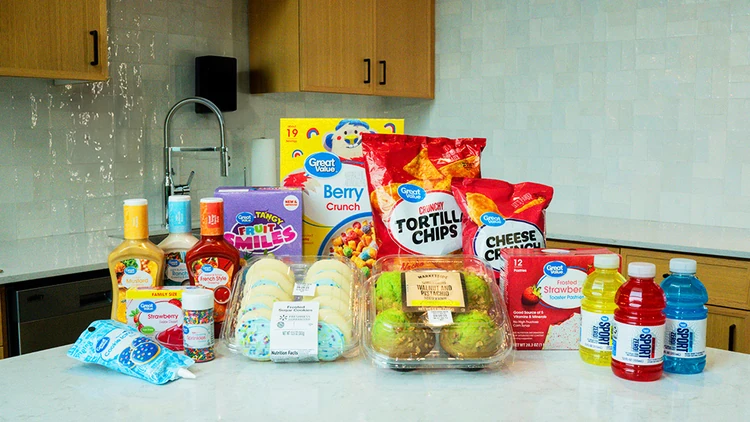
Walmart also has other one-click food options depending on your needs and preferences, including a healthier lunch option (under $20), a dorm food basket (under $50), and a snack stock-up (under $25).
All of Walmart’s back-to-school deals are available online and in-store, as well as with any pick-up or delivery option.
Walmart+ Week offers members exclusive savings, perks
Following on the heels of its Super Savings Week in March, Walmart is now hosting a week-long sale specifically for its Walmart+ members.
Walmart+ Week will be held from April 28 through May 4, and the retailer is sharing some of the early deals for its members.
“We recognize and appreciate the loyalty of our Walmart+ members,” Seth Dallaire, executive vice president and chief growth officer, Walmart U.S., said in a news release.
“They continue to utilize and enjoy the diverse range of benefits available across multiple categories, such as streaming, travel and fast-food. Walmart+ Week celebrates this momentum by helping our members maximize their suite of benefits in a way only Walmart can, with the membership that pays for itself."
What are the deals?
The goal of the week-long sale is to give Walmart+ members exclusive perks and bonuses for their loyalty to the retailer. Here’s a look at what Walmart has planned for the sale:
$5 Walmart Cash for members who use Scan and Go in-stores on one order of $15+
$0.50 off every gallon of gas at participating Exxon and Mobil stations nationwide
6 months of the Paramount+ with SHOWTIME plan
Engagement bonus of $10 Walmart Cash if members take advantage of two or more Walmart+ Week offers
Up to 2 free sandwiches from Burger King daily with your $1+ purchase (1 Croissan’wich 1 Whopper Jr.)
1 free Express Delivery for everyday essentials and more in as soon as 1 hour
These perks, and other benefits of Walmart+ Week, will only be available to Walmart+ members. New members can get a 30-day free trial, or sign up for an annual membership for $98.