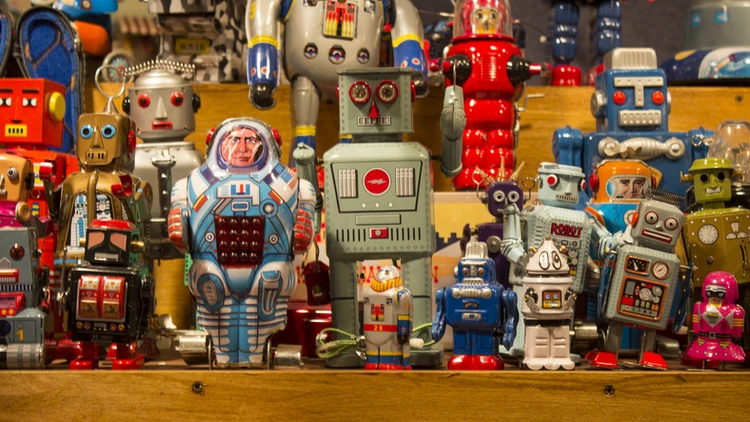
The number of childrens toys tainted with high levels of lead continues to decrease, according to research released today by The Ecology Center, a Michigan environmental organization.
Thats the good news in Toyland.
The bad news is one in three children's toys tested by the Ecology Center contained lead, arsenic, and other worrisome chemicals. That's one of the key findings in the organization's "2009 Guide to Toxic Chemicals in Toys."
But a spokesman for the Statistical Assessment Service (STATS), a non-profit organization affiliated with George Mason University in Virginia, said the threat of toxins in toys may not be as dire as the Ecology Center's reports indicate.
"Chemicals in toys may sound alarming, but there's little evidence that they are actually poisoning children. There would have to be some way that the chemicals entered the bloodstream -- something this report doesn't investigate," said Trevor Butterworth. "Simple play is where toys do their most damage: a boy under the age of four has a one in 359 chance of sustaining a non-fatal injury from a toy, while a girl has a 1 in 898 chance."
Over the past three years, the Ecology Center has tested more than 4,000 childrens products for hazardous chemicals and released its annual guide just in time for the busy holiday shopping season. This year, the non-profit organization analyzed nearly 700 toys and children's products, including shoes, belts, wallets, handbags, and backpacks.
Those test results -- now posted on the centers HealthyStuff.org Web site -- revealed:
The number of childrens products with lead levels higher than the current federal standard of 300 parts per million (ppm) has decreased by 67 percent since 2007. That drop corresponds with a 78 percent reduction in lead-related toy recalls issued by the Consumer Product Safety Commission (CPCS), the center said;
32 percent of all the toys tested this year contained one or more dangerous chemicals, including lead, cadmium, arsenic, and mercury. Thats one in three toys tainted with harmful toxins. Tests revealed cadmium -- a carcinogen linked to lung and prostrate cancer -- in levels greater than 100 ppm in 3.3 % (22 of 669) of all the products tested. Arsenic was found at levels greater than 100 ppm in 1.3 percent -- or nine -- of the products tested;
42 percent of the childrens products tested contained polyvinyl chloride (PVC), which the center calls a worst in class plastic because it can contain dangerous additives. Those additives include lead, cadmium, and other heavy metals;
18 percent (116) of the products tested contained detectable levels of lead, a chemical linked to developmental and learning disabilities Three percent (17) had lead levels higher than 300 ppm. Seven percent (44) had lead levels of more than 40 ppm, which is the maximum amount the American Academy of Pediatrics (AAP) recommended in 2007 for childrens products;
More than half of the 100 plastic handbags tested had lead levels higher than 1000 ppm;
Two-thirds of the products tested did not contain lead, cadmium, arsenic, or mercury. Many of those products were made in China. Fifty-eight percent of the childrens products tested were not made with PVC. Researchers say that proves its possible for companies to make safe, chemical-free toys.
The centers top researcher says this years findings show manufacturers are listening -- and starting to respond -- to consumers concerns about the safety of childrens toys.
Big impact
The most interesting finding this year is that consumer vigilance on the issue of lead in toys -- combined with increased regulatory consumer protection -- is having a big impact in terms of lead in toys, the centers Jeff Gearhart told ConsumerAffairs.com. People should feel more comfortable this year in terms of lead in consumer products. Theres a lot less of it out there.
We often focus on the negative, but its important that when we see change occurring to acknowledge it, he added. Its happening in this case because theres been a lot of focus on this issue and a push to make manufacturers do testing and clean up their products.
To illustrate his point, Gearhart cited the centers recent tests on the Leapster LeapFrog carrying case.
We tested that product last year and it contained lead, he said. We retested it this year and its (basically) lead-free (23 ppm). The Leapster folks were adamant last year that the product did not contain lead. But the whole time they were adamant, they were finding out that it did have lead. And then they went back and reformulated it.
Thats the overall trend were seeing, he added. The number of products with high levels of lead is down by two-thirds.
But too many childrens products on store shelves still contain dangerous chemicals, Gearhart said.
Whats most worrisome overall is that were still finding one in three toys out there that have detectable levels of one or more chemicals we test for, he told us. While the number with lead is declining, were still finding other chemicals -- cadmium, arsenic, mercury, and other metals -- in these products. And there are still a lot of products that contain PVC.
'Naughty' list
Here are some of the childrens products that made the centers naughty list because they contained high levels of lead, arsenic, bromine and other worrisome chemicals:
The Barbie Bike Flair Accessory Kit Tests revealed the kits outer fabric contained 1,865 ppm of lead,163,107 ppm of chlorine, and 3,363 ppm of bromine. The inner line contained high levels of those chemicals, too. Researchers say chlorine in a product indicates the use of PVC. Bromine is part of a family of fire-retardant chemicals called brominated flame retardants (BFRs). Studies have found that exposure to those chemicals can permanently affect brain development in a fetus;
Dora the Explorer Activity Tote Tests revealed the tote contained high levels of chlorine, including 550,000 ppm in the yellow bottom, 480,577 in Doras purple dress, and 5,680 ppm in the shiny orange vinyl part of the bag. That part of the bag also contained 5,680 ppm of lead;
High School Musical Argyle Belt Tests revealed this accessory contained 2,871 ppm of lead, 550,000 ppm of chlorine, and some parts contained 379 ppm of arsenic. Researchers say arsenic is an element that can be present in both organic and inorganic compounds. Inorganic arsenic is a known human carcinogen, linked to lung, skin, and bladder cancer;
Marvel Hot Rod Tests revealed the top of this Marvel Heroes toy car contained 1,940 ppm of lead and 380 ppm of bromine.
'Nice' list
Dozens of childrens toys and other products, however, made the centers nice list because they did not contain any detectable chemicals of concern. Some of those chemical-free products include: Barbies Life vest;
Gator Golf by Playskool Games;
Gabriella doll - High School Musical 3 by Disney;
Poptunes Big Rocker Guitar by Little Tikes;
Mega Bloks - 80pc blocks -- by Mega;
PEZ Candy and Dispenser by Pez Candy, Inc.;
The Oball Football by Rhinotoys;
Silly Putty -- The original, by Silly Putty;
Sock Monkey - Lavender/Crew Belly by Maggie's Organics/Clean Clothes;
Talking Thomas, by Thomas and Friends;
Changes needed
While Gearhart sees some signs of improvements in this years test results, he says the country needs to systematically change the way it regulates chemicals in consumer goods.
If we approach this issue on a chemical-by-chemical basis, it will take forever to get the hazardous chemicals out of toys and other consumer products, he told us. Were pushing for a broader chemical reform.
Recent consumer protections for lead and phthalates in products were a good first step, he added. But we have a long way to go in terms of protecting our children from thousands of other unregulated chemicals in toys and products throughout our economy.
Gearhart said the Toxic Substances Control Act (TSCA) -- an obsolete law passed in 1976 to regulate chemicals -- needs to be immediately overhauled. Under that law, the EPA only requires testing on about 200 of the more than 80,000 chemicals now on the market.
All the stakeholders in this, including manufacturers, have acknowledged that the way we regulate these chemicals is not protecting children or the public, or helping businesses, Gearhart said. If you have to come into this on the tail end -- and force businesses to spend thousands of dollars to test their products and prove theyre safe -- at that point, you have a failure in the system.
Its more effective to show the products are safe going in, he added. And we, (as consumers) need assurances that what is getting into our products is safe.
The U.S. Senate Environment & Public Works Committee today was scheduled to hear testimony from three federal agencies about reforming the TSCA. Senator Frank Lautenberg (D-NJ) and Representative Bobby Rush (D-IL) are also expected to introduce a new bill to reform the outdated law.
No. 1 Danger
STATS' Butterworth said there's a bigger danger than trace toxins in toys: the medicine cabinet.
"Young children instinctively put things in their mouth and pills turn out to be a very tempting threat. The Centers for Disease Control found that children were twice as likely to poison themselves with prescription or over the counter medications than other items in the home -- and 75 percent of an estimated 70,000 poisonings each year occurred in children under the age of five," Butterworth said.
Most documented toy injuries come not from poisoning but from simple accidents, he said: "Tripping over a toy and falling, falling on a toy, falling with a toy in mouth, dropping a toy on a foot; swallowing a toy or part of toy, sticking a toy up a nostril and it getting stuck, poking one's self in the eye with toy, sticking a toy in one's ear; being hit by toy thrown by another child, or hitting one's self with a toy. Fatal injuries are, fortunately, very rare."
Meanwhile, consumers looking for chemical-free childrens products this holiday season can search the www.healthystuff.org HealthyStuff.org's Web site by product name, manufacturer, or retailer. The Web site has all the products tested this year categorized according to the levels of toxins found. A Spanish version is also available.
Gearhart said his organization will continue to monitor the chemicals in childrens toys and other consumer products, including pet toys and plastic handbags.
For our next project, we plan to screen and evaluate mattresses from those used in cribs to ones by adults, he said. We will release those findings next year.